Sewer Line Repair in Sewaren, NJ 07077
Sewer line repair in Sewaren, NJ covers the full lateral lifecycle — inspection, cleaning, trenchless bursting, spot repairs, and full replacement — across ZIP 07077. Most of Sewaren's homes predate 1970, so laterals are typically aging clay tile — and the Arthur Kill waterfront's high water table means replacements here are specified watertight and joint-free as standard practice.
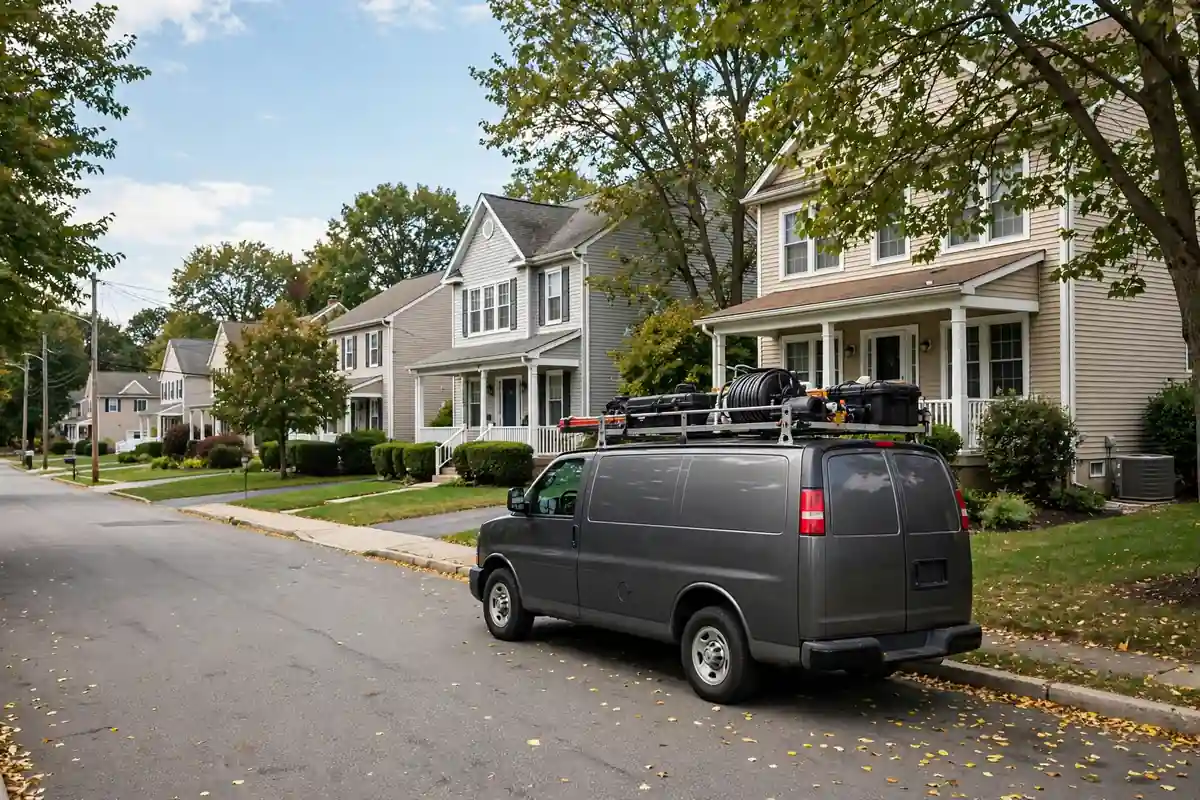
Sewaren began as a resort. Boynton Beach opened here on the Arthur Kill in 1877, and the waterfront community that grew around it still carries that history in its early-1900s beach-era homes along Main Street and Cliff Road. Today Sewaren is a Woodbridge Township waterfront neighborhood of about 3,000 residents — mostly single-family detached homes — with new high-rises and infill steadily replacing older structures.
The housing stock tells the sewer story: roughly a quarter of homes predate 1939, nearly 40 percent were built between 1940 and 1969, and the rest came in the 1970s through 1990s. That means most of Sewaren's laterals are clay tile installed 50 to 100-plus years ago — at or past the end of their service life.
And then there is the water. Sewaren sits on the Arthur Kill at low elevation with a high water table, so its sewer laterals fight two enemies at once: age from above, in the form of failing clay, and tidal infiltration from below. Sewer Line Repair Group plans every Sewaren job around both.
From Boynton Beach Resort to Arthur Kill Waterfront
Sewaren's resort origins left it a legacy of early-1900s beach cottages and colonials — small homes built for summer people, not for the century of service their sewer laterals have since provided. Some of these properties may still carry their original shallow clay lines, now 100-plus years old.
The mid-century waves that followed — the 1940s-to-1960s homes that make up the largest share of Sewaren's stock — brought standard clay-tile laterals of their era. These are now 60 to 80 years old: joint-separated, root-invaded, and in many cases bellied where the waterfront ground has settled.
Newer construction from the 1970s onward, plus the current round of high-rise and single-family infill, is on modern materials. But in a neighborhood where the majority of the stock predates 1970, the old clay is the dominant reality.
The practical takeaway: in Sewaren, a home's build decade is a reliable predictor of lateral material, and anything pre-1970 deserves a camera inspection before anyone assumes the line is sound.
Beach-Era and Mid-Century Laterals at End of Life
Clay tile fails in predictable ways, and Sewaren shows all of them. Joints separate as ground settles, roots enter through the gaps, sections belly and hold standing water, and eventually lengths of pipe crack or collapse. A lateral that has done this for 70 years is not a candidate for another cleaning — it is a replacement waiting to happen.
Cast iron appears in the same vintage of home as interior stacks and building drains, corroding from the inside until flow is restricted. When an older Sewaren home has slow drains at every fixture, the building drain and the lateral are both suspects.
The symptom pattern homeowners describe is consistent: a drain that needs clearing every few months, gurgling when fixtures drain, or a basement floor drain that reacts during heavy use. Each of those is the pipe describing its condition — the camera just translates.
Because so much of Sewaren's stock sits in the same age band, whole streets can be on the same replacement timeline. If a neighbor has replaced their lateral, yours is likely the same age and material.
High Water Table and Tidal Infiltration
Sewaren's Arthur Kill waterfront position means groundwater sits high — in the lowest blocks, not far below the surface. Old clay laterals with open joints do not just carry the household's wastewater; they take on groundwater along their entire length. The pipe runs fuller than it should, and capacity meant for the house is spent carrying seepage.
Tidal influence adds a second dimension. Nor'easters push surge up the Arthur Kill, and the low-lying laterals near the waterfront can see both infiltration from below and surcharge from the main side. Backups that arrive with coastal storms are the signature complaint.
This is why a Sewaren replacement is specified watertight as a matter of course: continuous fused HDPE with no joints, installed by pipe bursting. A jointed replacement in this ground just recreates the infiltration problem in new pipe.
Dewatering is the other half of the plan. Excavation below the water table — for pits, connections, or spot repairs — has to be planned with the water in mind, not discovered mid-dig. Jobs here are sequenced around it.
Dewatering, Sealed Pipe, and Careful Planning
Working below a high water table changes the logistics of a sewer job. Pits for trenchless bursting need to stay workable, connections at the main need a dry window, and any open excavation needs a dewatering plan. None of this is exotic — it is standard waterfront practice — but it has to be planned, not improvised.
Pipe bursting remains the preferred method precisely because it minimizes open excavation: two pits instead of a full trench. Less open ground means less water to manage and less disruption to the established yards of Sewaren's single-family streets.
Where a spot repair is appropriate — a single bad joint on an otherwise sound line — the excavation is small and the dewatering plan scales down with it. The camera footage determines whether the problem is local enough for this approach.
Restoration matters on these blocks too. Sewaren's older homes often have mature plantings and established hardscaping; keeping the work footprint to two pits is as much about the yard as it is about the pipe.
Camera Inspections Before You Buy or Build
Sewaren's ongoing turnover — older homes being replaced by new infill — makes pre-purchase camera inspections especially valuable. A buyer inheriting a 1950s clay lateral is inheriting a near-term replacement, and the inspection puts that fact on the table before closing rather than after the first backup.
For builders and renovators, the inspection maps the existing lateral's path, depth, and connection — information that prevents the new work from colliding with the old line, and that confirms whether the existing lateral is worth keeping or should be replaced while equipment is already on site.
The inspection itself is straightforward: camera from a cleanout or pulled toilet out to the main, with every defect logged by distance and depth. In Sewaren, the inspector also notes visible infiltration — water entering through joints — which dry-weather inspections in inland towns rarely show.
Documented findings travel with the property's records. When the eventual replacement happens, the crew works from known facts instead of rediscovering the line.
Sewer Services for Sewaren Homes
Sewer Line Repair Group serves Sewaren's 07077 ZIP end to end — the historic Boynton Beach blocks along Main Street and Cliff Road, the mid-century streets inland, and the waterfront near Alvin P. Williams Memorial Park and Captain Carlsen Park. The full lateral lifecycle is covered: inspection and locating, cleaning and root cutting, spot repairs, trenchless bursting and lining, and full replacement.
Waterfront jobs get the water-aware planning described above as standard: watertight pipe specifications, dewatering plans for below-grade work, and backwater-valve conversations for homes with basement fixtures near the Kill.
The neighborhood's single-family character — 77 percent detached homes — means most jobs are straightforward residential laterals from house to curb. Access is typically easier than in denser towns, which keeps the work efficient.
If your Sewaren home predates 1970, if backups arrive with coastal storms, or if a drain needs clearing more than once a year, a camera inspection is the right next step.
Available Services
Contact Us Now
One call connects you with a local sewer professional serving Perth Amboy, NJ — day or night.
Contact Us Now: (833) 713-2101Frequently Asked Questions
Why do Sewaren sewer problems get worse during coastal storms?
Two forces combine: nor'easter surge pushes up the Arthur Kill and can surcharge the sewer system from the main side, while high groundwater infiltrates old clay laterals through open joints. The result is backups that arrive with the weather, not with household use. Watertight trenchless replacement seals the infiltration path, and a backwater valve guards basement fixtures against surcharge.
My Sewaren home was built in the 1950s. What pipe do I have?
Almost certainly clay tile, now 65 to 75 years old. That is the standard lateral material for Sewaren's 1940s-1969 building wave, and it is squarely in the failure window: separated joints, root intrusion, and settled bellies are the norm. A camera inspection will confirm the material and show exactly how far along the deterioration is.
What is dewatering, and why does my sewer job need it?
Dewatering means managing groundwater during excavation below the water table — which, in waterfront Sewaren, can be most of the dig. Pits for trenchless work and any open excavation need a plan to keep water out of the work area. It is standard waterfront practice, planned before the job starts, and it is one reason trenchless methods (two small pits instead of a full trench) are preferred here.
Pipe bursting or digging up my yard — which fits my Sewaren home?
For most Sewaren laterals, trenchless bursting is the less disruptive fit. It replaces the full line through two small pits, preserving lawns, plantings, and driveways, and the fused HDPE pipe it installs is joint-free and watertight — exactly what a high-water-table neighborhood needs. Open excavation is reserved for cases where the line's condition rules bursting out, which the camera inspection determines.
Should I inspect the sewer before buying in Sewaren?
Yes. With the majority of Sewaren's homes built before 1970, the odds are high that any given listing has an original clay lateral near the end of its life. A pre-purchase camera inspection reveals the pipe's material, condition, and remaining years, letting you negotiate the upcoming replacement before closing instead of absorbing it afterward.
How often should an older Sewaren lateral be inspected?
If the line is original clay and over 50 years old, an inspection every few years is reasonable — more often if you have mature trees near the line's path or a history of backups. After a replacement with modern watertight pipe, the inspection interval stretches out considerably, since the failure modes of old clay no longer apply.