Pipe Lining (CIPP) in Perth Amboy, NJ
Pipe lining — cured-in-place pipe (CIPP) — in Perth Amboy, NJ restores a damaged sewer line from the inside, with no excavation. A resin-saturated liner is inserted into the existing pipe and cured into a smooth, jointless pipe within the old one. It seals cracks, blocks root intrusion, and renews flow in clay and cast-iron lines that are damaged but still standing.
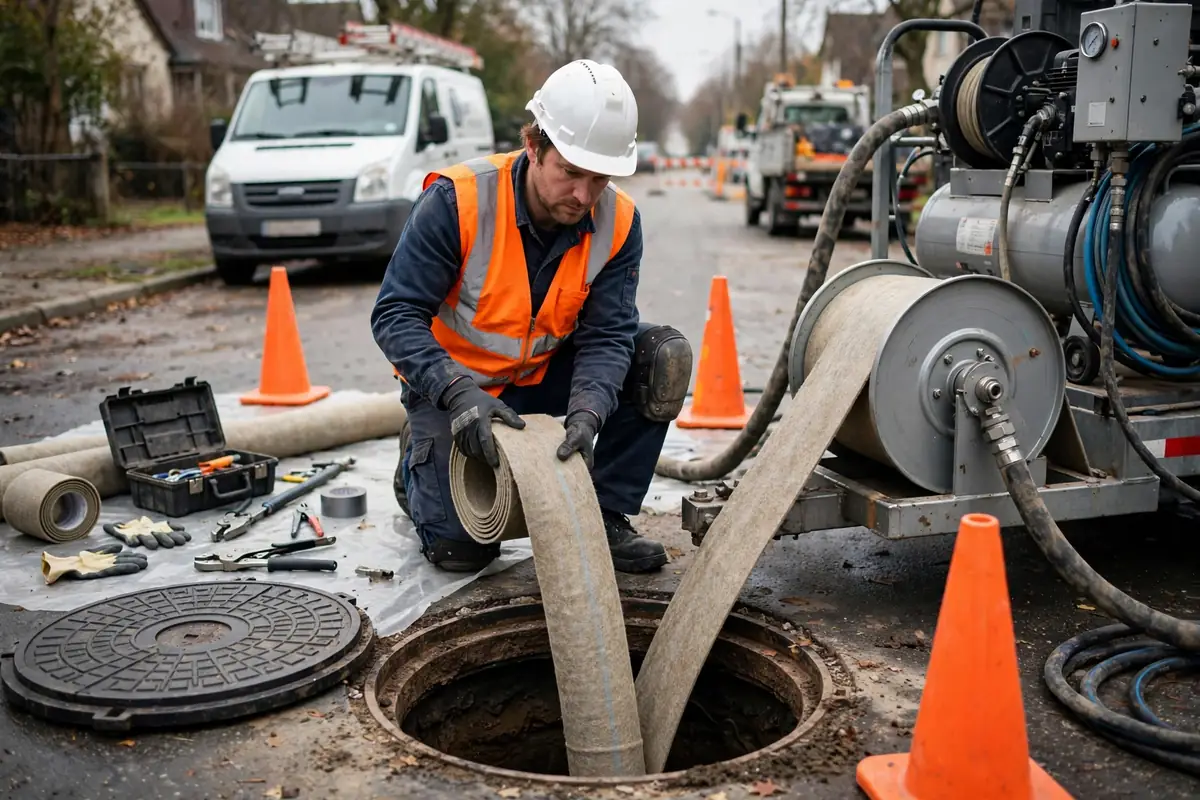
Not every damaged sewer line needs to be removed. When a pipe is cracked, leaking at joints, or roughened by decades of scale — but still holding its shape — pipe lining can create a new pipe inside the old one without digging. The method is called cured-in-place pipe, or CIPP, and it has become the go-to trenchless repair for lines that are damaged but not destroyed.
The concept: a flexible liner saturated with epoxy resin is inserted into the existing pipe, pressed against its interior walls, and cured — hardened — into a rigid, jointless tube. The old pipe becomes a host; the liner becomes the new working pipe. Access is through existing cleanouts or small entry points, so lawns, driveways, and floors stay intact.
In Perth Amboy, lining is a strong fit for the city's aging clay-tile and cast-iron laterals, especially where lines run under slabs, additions, or mature landscaping that would make excavation punishing. But it only works when the host pipe qualifies — which is why every lining job starts with a camera.
How cured-in-place pipe lining works
A lining job begins where every trenchless job begins: a camera inspection that confirms the pipe is standing, measures its diameter and length, and maps every defect. Next comes preparation — the most underrated phase. The line is mechanically cleaned and descaled, and any root masses are cut out, because the liner must bond to a clean interior; debris left behind becomes a permanent lump under the new pipe. The liner itself, a felt or fiberglass tube, is saturated with a two-part epoxy resin and calibrated to the pipe's dimensions. It's then inserted — either pulled into place or inverted with water or air pressure so the resin side faces the pipe wall — and expanded with an inflation bladder that presses it firmly against the interior. Then comes the cure: heat (hot water or steam) or ambient curing hardens the resin into a rigid structural tube, a process monitored for time and temperature. Once cured, the bladder is removed, the liner ends are trimmed at the connections, any branch lines are reinstated with a robotic cutter, and a final camera pass verifies a smooth, continuous new pipe.
When lining makes sense — and when it doesn't
Lining is ideal for pipes with distributed damage but intact structure: longitudinal cracks, leaking joints, root intrusion at the joints (after the roots are cut), corrosion pitting in cast iron, and rough scale that chokes flow. It's the natural choice where the line runs under something you don't want to disturb — a slab foundation, a new addition, a mature oak, a stamped-concrete patio. Lining is not the answer for collapsed sections, because there's no shape to form against; for severe bellies or back-pitched runs, because the liner copies the host's flawed grade; for major offsets where pipe segments have shifted apart; or where the line needs to be upsized. Those are bursting or excavation jobs. The dividing line is structural: standing but damaged means lining; destroyed or misgraded means replacement. A camera inspection draws that line clearly before anyone commits.
The lining process from inspection to final check
From the homeowner's side, a lining day is notably uneventful — which is the point. The crew sets up at the access point, usually an existing cleanout, and stages the liner and curing equipment nearby. Preparation — cleaning and descaling — often takes longer than the lining itself, because a proper bond demands a clean host. Insertion is careful, methodical work: the liner must travel the full run without folds or twists. During the cure, the line is out of service for a few hours while the resin hardens; plan around that window by limiting water use. After curing, branch connections to the home's plumbing are reopened with a robotic cutter guided by camera, the ends are finished, and the post-lining inspection confirms full-bore flow. There's no trench to backfill, no sod to replace, no concrete to re-pour. The most visible sign of the day's work is usually just the equipment trailer that was parked out front.
How a lined pipe performs over time
A cured liner behaves like a new pipe because, functionally, it is one. The epoxy surface is jointless along the lined run — the joints where roots entered clay tile simply cease to exist — and the material is immune to the corrosion that thins cast iron. Its smooth interior sheds the scale and grease films that accumulate on rough old walls, which is why flow often improves after lining even though the diameter is marginally smaller. The liner is designed for decades of service under normal ground loads, and because it bonds to the host pipe, the two work together structurally. Two honest caveats belong here: performance assumes proper installation — resin mixing, saturation, and cure monitoring are skilled work, not commodities — and the host pipe must have qualified in the first place. A liner installed over a collapsing pipe is a liner that will fail with it. That's why the pre-lining camera inspection is non-negotiable.
Caring for a newly lined sewer line
A newly lined line needs less attention than the pipe it replaced, but not zero. The main rule is about what goes down the drains: wipes, hygiene products, grease, and harsh chemical drain cleaners are as bad for a liner as for any pipe — worse, in that chemical cleaners can attack the epoxy surface. Enzyme or bacterial drain maintainers are fine; caustic openers are not. Keep the cleanout accessible so future inspections are simple. If mature trees stand over the lateral, periodic root management outside the line is still wise — the liner blocks entry at the pipe, but aggressive roots can still pressure the surrounding soil. And schedule a follow-up camera inspection a few years out, not because liners are fragile, but because a quick look confirms what you expect: a smooth, jointless pipe doing its job quietly underground.
Pipe lining availability around Perth Amboy
Sewer Line Repair Group installs CIPP pipe lining across Perth Amboy, NJ 08861 — from older clay-lateral neighborhoods like Chickentown and Hall Avenue to slab-on-grade homes in Spa Springs — plus nearby Woodbridge, Carteret, Edison, and Metuchen. The camera inspection determines whether your line is a lining candidate.
Service Areas
Request Service Today
One call connects you with a local sewer professional serving Perth Amboy, NJ — day or night.
Request Service Today: (833) 713-2101Frequently Asked Questions
Is a lined pipe as strong as a new pipe?
A properly installed CIPP liner is a structural, standalone pipe — it doesn't rely on the old pipe for strength once cured. The epoxy-hardened liner resists root intrusion, corrosion, and normal ground loads. Its performance depends on correct installation and a qualifying host pipe, which is why the pre-lining inspection matters so much.
How long does pipe lining take?
Most residential lining projects are completed in a day, with curing time depending on the method and the line's length and diameter. Because there's no excavation, there's no digging or backfilling phase — the schedule is driven by preparation, insertion, and cure time alone, not by restoration work.
Does lining make the pipe smaller?
Slightly, in raw diameter — but the liner's smooth interior actually improves flow compared to a rough, scaled, or root-narled old pipe. In practice, lined lines drain as well or better than before, because friction and obstructions drop dramatically once the jointless epoxy surface is in place.
What kinds of pipes can be lined?
Clay tile, cast iron, concrete, and PVC can all serve as host pipes, provided they're still structurally standing and properly cleaned. The key qualification isn't material — it's condition: the pipe must hold its shape so the liner has something to form against.
How do I know whether my line needs lining or bursting?
The camera decides. If the pipe is cracked or leaking but holding its shape, lining usually fits. If it's collapsed, severely bellied, or undersized, bursting — which replaces the pipe entirely — is the answer. A technician will show you the footage and explain which category your line falls into.
Does pipe lining fix bellies or sagging sections?
No — and this is the most important limitation to understand. The liner takes the shape of the host pipe, so a sag stays a sag. Bellies and back-pitched sections need correction by excavation or by bursting with regrading, not by lining. An honest assessment will tell you when lining isn't the fix.