Sewer Line Repair in Port Reading, Woodbridge Township, NJ
Port Reading was built by the Reading Railroad in the late 1800s, and its 1910s-1960s worker housing still runs on clay-tile laterals — some now over a century old. The Arthur Kill waterfront adds tidal flood exposure to the age story. Camera inspection, trenchless pipe bursting with watertight HDPE, and infiltration control are the core services for this railroad town.
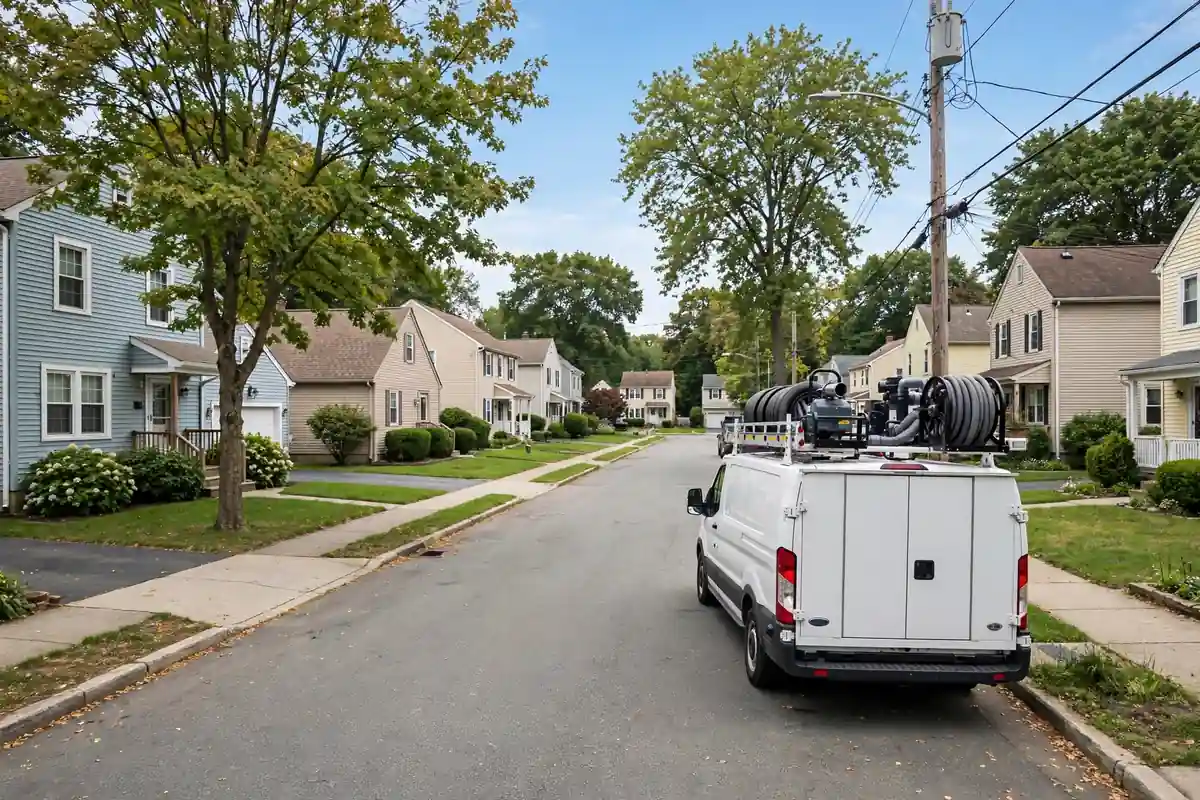
Port Reading is Woodbridge Township's railroad town — a community of about 3,900 built in the late 19th century by the Reading Railroad as a coal-shipping port on the Arthur Kill. The railroad's imprint is still visible in the street names, the surviving McMyler Coal Dumper, and the Port Reading Avenue corridor once known as the Blazing Star Trail. The housing the railroad era produced — single-story and split-level worker homes from the 1910s through the 1960s, Cape Cods, ranches, and bungalows, some dating to the early 1900s — still defines the community's residential blocks.
Those homes carry some of the oldest sewer laterals in Woodbridge Township. Clay-tile lines laid when the houses were built are now 60 to 120 years old, with the earliest 1900s-1910s installations past the century mark. The failure pattern is the familiar clay-tile story — opened joints, root intrusion, cracked sections, bellies — playing out on lines that have had longer than most to deteriorate.
Port Reading's second defining fact is the water. The community sits at about 13 feet of elevation on the Arthur Kill, more than a fifth of its area is water, and the Woodbridge River marshland lies adjacent. Tidal surge during nor'easters, heavy-rain infiltration into century-old clay, and a high water table combine to make this a place where sewer work must handle both age and water at once. The 1970s Project Bowtie urban renewal — which rehabilitated 225 housing units and added 34 new single-family homes — refreshed part of the stock, but the underlying pipe era remains. The sections below cover Port Reading's railroad-era laterals, its tidal exposure, and the services that fit this waterfront community.
A Railroad Towns Century-Old Clay Laterals
Port Reading's housing was built for railroad and port workers, and its sewer infrastructure went in with the houses. The 1910s-1960s worker housing — Cape Cods, ranches, bungalows, and split-levels on the community's residential streets — was served by vitrified clay-tile laterals, the standard of the era. The earliest of these lines, under homes from the early 1900s, have now been in the ground for over a century. Even the younger 1950s-60s installations are 60 to 75 years old — well into the joint-failure zone.
A century-old clay lateral in Port Reading shows the full catalog of tile deterioration. Mortared joints have dried, cracked, and separated. Roots have entered at the openings and expanded them. Sections have cracked under freeze-thaw heave and ground movement. Bellies have formed where the line has sagged over the decades, pooling wastewater. Offsets have developed where sections shifted out of alignment. The camera inspection of an original Port Reading lateral rarely shows a single problem — it shows a line that has aged everywhere at once.
Basements in the older capes and colonials give camera crews accessible launch points where the lateral exits the foundation, and they provide the early-warning system of basement floor-drain backups. The ranch homes on slabs or crawlspaces hide their drain lines under the floor, which makes camera-and-transmitter locating more important before any work is planned — the line's path has to be mapped rather than seen.
Project Bowtie, the 1970s urban renewal effort that rehabilitated 225 units and built 34 new single-family homes, refreshed a meaningful slice of Port Reading's housing. Homes touched by that program may have newer plumbing than their neighbors — another reason the camera inspection, not the house's apparent age, determines what is actually in the ground. In a community with this much history, verification beats assumption every time.
Tidal Exposure Along the Arthur Kill
Port Reading's eastern edge is the Arthur Kill — the tidal strait that made the community a coal port — and that waterfront position shapes its sewer risks. At roughly 13 feet of elevation, with 22.6% of the community's area being water and the Woodbridge River marshland adjacent, Port Reading is exposed to tidal surge during nor'easters and to the high water table that comes with living beside tidal water.
For century-old clay laterals, tidal-area groundwater is a relentless infiltrator. Every opened joint, every cracked section, every deteriorated connection admits groundwater when the surrounding soil is saturated — and near the Kill, the soil is saturated often. Infiltration does two kinds of damage: it overwhelms the lateral's capacity during wet weather, causing backups in homes whose lines handle dry-weather flow fine, and it carries fine soil particles into the pipe over time, gradually undermining the bedding around the line.
Storm surge adds the acute risk. During a nor'easter, tidal surge can raise water levels along the Kill while intense rainfall simultaneously saturates the ground and loads the storm drains. If the municipal sewer system surcharges under that combined load, pressure backs up private laterals into the lowest homes. Backwater valves — one-way valves that let wastewater out and slam shut against reverse flow — are the standard defense, and in a tidal community at 13 feet of elevation they are baseline protection rather than an upgrade.
The repair specifications for Port Reading reflect this water exposure. Replacement pipe is jointless HDPE installed by pipe bursting — no joints for tidal groundwater to exploit. Lining, where it fits, creates a continuous sealed pipe within the old clay. And infiltration sealing is treated as a primary goal of every repair, not a side benefit: in Port Reading, a lateral that is not watertight is a lateral that will back up in the next storm.
Diagnosing Old Clay Lines with Camera Inspection
On Port Reading's railroad-era housing, the camera inspection does more work than on a younger neighborhood's lines — because there is more to find, and because the findings drive bigger decisions. The inspection maps the lateral's full length from the foundation to the city connection, identifies the material (original clay, a partial replacement, or a full modern line in a renewed property), and documents every defect with its distance from the house.
What the camera typically finds on an original Port Reading lateral is distributed deterioration: root intrusion at joint after joint, multiple cracked or broken sections, bellies holding standing water, offsets catching debris. That distributed pattern is the signature of a line at end of life, and it points toward full replacement rather than piecemeal repair. When the inspection instead shows isolated defects — one crushed section, one bad joint — on a line that is otherwise sound, spot repair is the proportional response.
The inspection also maps what the surface hides. Port Reading's older properties can have laterals that take unexpected paths — around old outbuildings, under additions built over the decades, through yards regraded since the line was laid. The camera's transmitter traces the actual route from above ground, marking it for the repair plan. That mapping prevents the classic mistake of planning a repair around where the line should be rather than where it is.
For the ranch homes on slabs and crawlspaces, the inspection starts with locating: feeding the camera from an interior access point and tracing its signal to map the line under the floor and through the yard. Depth readings at each point tell the crew what any repair would involve. And for buyers considering one of Port Reading's early-1900s homes, a pre-purchase inspection is essential diligence — the lateral may be the oldest working component of the property, and its condition belongs in the purchase decision.
Trenchless Replacement for Century-Old Worker Housing
When a Port Reading lateral reaches end of life, trenchless pipe bursting is the replacement method that fits the community's housing and ground conditions most closely. The old clay line — brittle after a century in the ground — fractures cleanly as the bursting head passes through, and a new jointless HDPE pipe follows it into place along the existing alignment. The work needs only small entry and exit pits, typically at the foundation and near the curb, with no continuous trench through the yard.
The jointless HDPE pipe is the key upgrade for Port Reading's conditions. The old line failed at its joints — roots entered there, groundwater infiltrated there, sections offset there. A single continuous pipe with no joints simply does not have those failure points. In a tidal community where infiltration is the dominant wet-weather problem, that jointless construction is not a luxury; it is the specific engineering answer to the specific local problem. Bursting also keeps the city connection and foundation entry in their existing positions, avoiding the reconnection complexity of a rerouted line.
Cured-in-place pipe lining is the less invasive alternative for Port Reading laterals that are deteriorated but still structurally round. The resin-saturated liner cures against the inside of the old clay, creating a new continuous pipe within it — sealing every crack and root entry at once, with almost no excavation. Lining cannot correct bellies or collapsed sections, which are common at a century of age, so the camera determines eligibility. But for lines that qualify, it delivers a watertight renewal with minimal disturbance to the property.
Open-cut replacement remains the method for lines that are fully collapsed, that need rerouting to a new alignment, or where the city connection itself must be rebuilt. On Port Reading's modest worker-housing lots, open-cut means a trench through the yard and whatever sits above the line — which is why it is the fallback rather than the default. The method choice always follows the camera's findings, matched to the line's actual condition and the property's actual layout.
Infiltration Control in a High-Water-Table Community
In Port Reading, infiltration control deserves its own focus because the community's high water table makes it a primary sewer issue rather than a secondary one. Infiltration is groundwater entering the lateral through defects — opened joints, cracks, deteriorated connections — and in a tidal community at 13 feet of elevation, the groundwater is always close and often pressing. Every defect in a Port Reading lateral is an infiltration point waiting for the next wet spell.
The math of infiltration is unforgiving. A lateral with many small defects can admit multiples of the household's normal wastewater flow during saturated conditions. That extra water consumes the pipe's capacity, so the line that drains the house fine on a dry Tuesday backs up on a rainy Saturday — not because the household used more water, but because the ground contributed more. Homeowners who notice their backups tracking with rainfall and tides rather than with water usage are seeing infiltration-driven failure.
Controlling infiltration means sealing the defects, and the methods scale with the damage. Isolated defects get spot repairs or sectional lining. Distributed joint failure gets full cured-in-place lining, which seals the entire line at once. End-of-life lines get pipe bursting with jointless HDPE — the permanent infiltration solution, since there are no joints left to leak. Each step up the ladder costs more and lasts longer; the camera inspection places the line on that ladder.
There is a community dimension too. Infiltration from private laterals adds to the municipal system's wet-weather load across Port Reading, contributing to the surcharge risk everyone shares. Keeping your own lateral watertight protects your basement first, but it also lightens the load on the system your neighbors depend on. In a high-water-table tidal community, private lateral condition is genuinely a shared concern — and a watertight lateral is one of the most effective flood-season preparations a homeowner can make.
Sewer Services Available in Port Reading
Sewer line service in Port Reading is built for century-old clay laterals in a tidal, high-water-table community. Video camera inspection with locating is the foundation — mapping the lateral's route, depth, and material, documenting every defect, and distinguishing original railroad-era lines from renewed plumbing in Project Bowtie-era homes. For slab ranch homes, camera-and-transmitter locating maps the line under the floor before any work is planned.
Drain cleaning with professional cable equipment clears root masses and blockages from aging clay lines. Root management programs — cutting plus scheduled treatment — extend the serviceable life of laterals not yet ready for replacement. Hydro-jetting scours lines where grease or debris, rather than roots, is the blockage cause.
Trenchless pipe bursting is the primary replacement method: century-old clay fractured outward, new jointless HDPE pulled into place, minimal excavation, watertight against tidal groundwater. Cured-in-place pipe lining renews cracked-but-round lines from the inside with almost no digging. Spot repairs and sectional lining fix isolated defects on lines that are otherwise sound. Open-cut lateral replacement handles collapsed lines, reroutes, and city-connection rebuilds, with careful restoration.
Flood-protection services are central here. Backwater valve installation guards low-lying homes against municipal surcharge during nor'easters and tidal events. Infiltration sealing — through lining, joint repair, or full replacement — keeps wet-weather groundwater out of the lateral. Foundation penetration inspection and resealing addresses leaks where the line meets the wall. And pre-purchase camera inspections give buyers of Port Reading's early-1900s homes the lateral's true condition before closing — essential diligence on the oldest housing stock in Woodbridge Township's river communities.
Available Services
Contact Us Now
One call connects you with a local sewer professional serving Perth Amboy, NJ — day or night.
Contact Us Now: (833) 713-2101Frequently Asked Questions
How old are the sewer laterals in Port Reading?
The 1910s-1960s worker housing typically has original clay-tile laterals — 60 to 120 years old, with the earliest early-1900s installations past the century mark. Homes touched by the 1970s Project Bowtie renewal may have newer plumbing. A camera inspection establishes which your property has, since the house's apparent age does not always tell the story.
Why does my Port Reading home back up when it rains but not otherwise?
Infiltration. Groundwater pushes into the lateral through opened joints and cracks when the tidal-area soil is saturated, and the extra water overwhelms the pipe's capacity. A century-old clay line near the Arthur Kill is especially prone to this. If backups track with rainfall rather than water usage, infiltration is the mechanism — and sealing the defects is the fix.
Do I need a backwater valve in Port Reading?
For low-lying homes near the Arthur Kill, yes — it is baseline flood protection. A backwater valve lets wastewater flow out but closes against reverse flow, protecting your home when the municipal system surcharges during nor'easters or tidal events. No pipe repair can prevent municipal surcharge on its own; the valve is the defense for that failure mode.
Is pipe bursting suitable for a 100-year-old clay lateral?
It is an ideal match. Century-old clay is brittle and fractures cleanly as the bursting head passes, and the new jointless HDPE pipe eliminates the joint-failure mode that doomed the original — which matters doubly in Port Reading, where jointless construction is also the answer to tidal groundwater infiltration. The method needs only small entry pits on these modest lots.
What was Project Bowtie and does it affect my sewer line?
Project Bowtie was Port Reading's 1970s urban renewal program, which rehabilitated 225 housing units and added 34 new single-family homes. Properties touched by the program may have plumbing newer than the house's original construction date suggests. The camera inspection verifies what is actually in the ground rather than assuming from the neighborhood's railroad-era history.
Can tree roots be kept out of my new sewer line?
Yes — by eliminating their entry points. Roots enter clay laterals through opened joints; a new jointless HDPE pipe installed by bursting has no joints to enter through. That is the permanent solution. For existing clay lines not yet ready for replacement, scheduled root cutting and treatment manage the problem on a planned cycle.
Should I get a sewer inspection before buying an early-1900s Port Reading home?
Essential. The lateral may be the oldest working component of the property — over a century old — and its replacement is a major cost. A pre-purchase camera inspection reveals the line's material, condition, and remaining life before you commit, which is basic diligence on this housing stock.