Trenchless Sewer Repair in Perth Amboy, NJ
Trenchless sewer repair in Perth Amboy, NJ fixes or replaces underground sewer lines with minimal digging, usually through one or two small access pits. Pipe bursting pulls a new seamless line through the old pipe's path, while cured-in-place lining creates a new pipe inside the old one. Both avoid the open trench across your yard, driveway, and sidewalk.
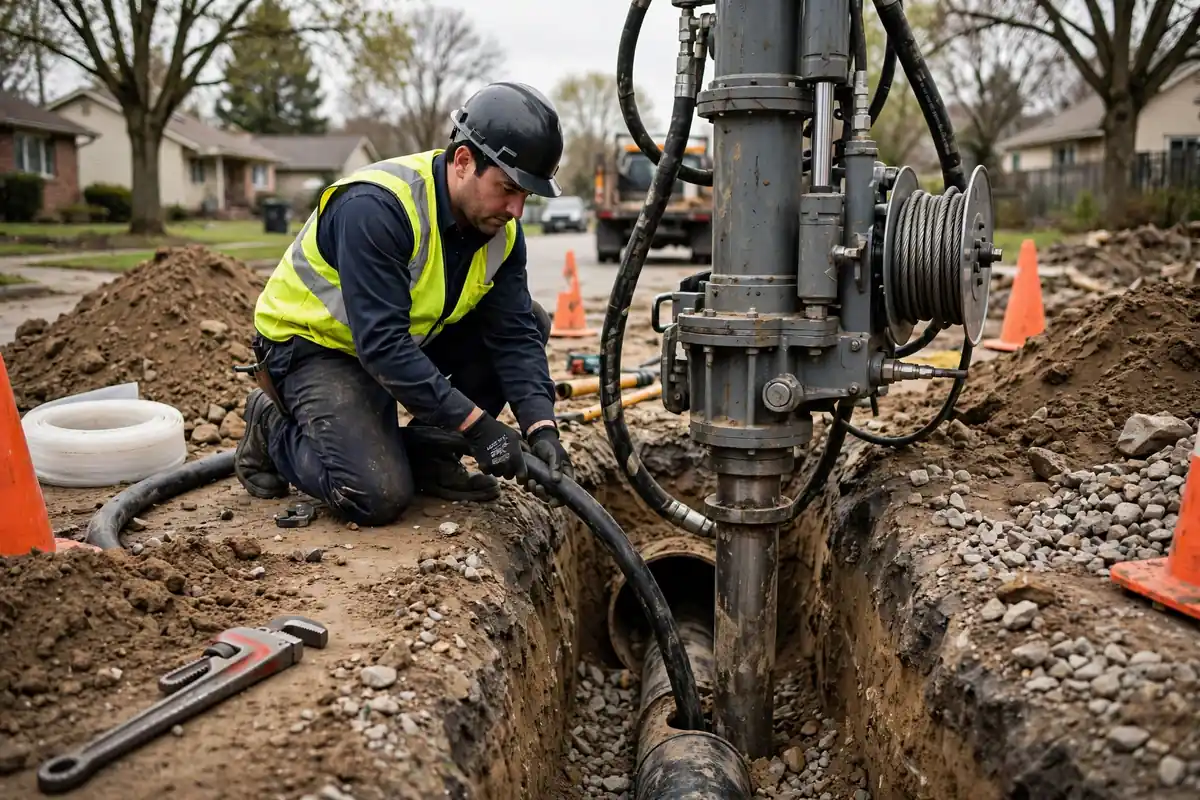
The worst part of a sewer repair used to be the excavation: a trench from the house to the street, torn-up lawn, cut driveways, and weeks of restoration. Trenchless technology changed that equation. Modern methods repair or replace a failed lateral from small access pits, leaving the surface above the pipe largely untouched. For Perth Amboy's tight urban lots, mature landscaping, and hardscaped yards, that difference is often what makes a repair feasible at all.
Sewer Line Repair Group performs trenchless sewer repair across Perth Amboy using the two proven methods: pipe bursting, which replaces the old line with a new seamless HDPE pipe, and cured-in-place pipe lining, which builds a new pipe inside the old one. The camera inspection determines which method fits, because trenchless is a set of techniques, not a single magic fix, and each has conditions where it works and where it does not.
This page explains both methods in plain terms, when trenchless is the right call, when it is not, what the work looks like on your property, and why Perth Amboy's neighborhoods are particularly well suited to it.
Pipe Bursting: A New Line Through the Old Path
Pipe bursting is a full replacement done trenchlessly. Two pits are excavated, one at the building, one at the curb or tap. A steel cable is threaded through the old pipe, and a cone-shaped bursting head is pulled through, fracturing the old clay tile, cast iron, or concrete pipe outward into the surrounding soil. Directly behind the head, a new seamless HDPE pipe is pulled into the void the old pipe left behind.
The new line follows the exact alignment of the old one, which is ideal in Perth Amboy's dense neighborhoods. Downtown, Hall Avenue, the State Street corridor, and Chickentown have tight lots where an open trench would mean tearing through fences, sheds, patios, or neighboring property lines. Bursting needs only the two pits, so the surface disruption is minimal and the work often finishes in two to three days.
The HDPE pipe itself is the long-term win: fused into a single continuous length with no joints, it is watertight and root-proof, flexible enough to tolerate ground movement, and smooth inside for reliable flow. For root-destroyed clay laterals, which are the most common failure in this city, bursting simultaneously removes the failed pipe and eliminates every joint roots could ever use again.
Cured-in-Place Lining: A New Pipe Inside the Old One
Cured-in-place pipe lining, often called CIPP, takes a different approach: instead of destroying the old pipe, it builds a new one inside it. A felt or fiberglass liner saturated with epoxy resin is inverted or pulled into the existing lateral, inflated tight against the old pipe's walls, and cured with hot water, steam, or UV light. The result is a smooth, jointless, corrosion-proof pipe within the old pipe, typically reducing the diameter only slightly.
Lining shines where the old pipe is structurally compromised but still has its shape: cracked clay tile, leaking joints, minor root intrusion, and corrosion in cast iron. It seals every joint and crack along the lined section in one operation, which makes it excellent for laterals with widespread joint leakage but no collapses. Access is through existing cleanouts or small pits, so the surface impact is even lighter than bursting.
Lining has firm limits. It cannot fix a collapsed pipe, because the liner needs the old pipe as a form. It cannot correct a belly where the pipe has settled, because the liner follows the old pipe's shape, and it slightly reduces diameter, which matters in lines that are already undersized. The camera inspection decides: if the video shows a pipe with its shape intact but its joints failed, lining is a strong candidate; if it shows collapse or grade failure, bursting or open cut is the honest answer.
When Trenchless Is the Right Call
Trenchless methods earn their keep wherever the surface above the lateral is valuable or the access is constrained. Landscaped yards with mature plantings, driveways and patios over the line, finished basements where an interior access would be disruptive, and the tight lots of downtown Perth Amboy, Hall Avenue, and the State Street corridor all favor trenchless. In these situations the avoided restoration cost, repaving a driveway, rebuilding a patio, replanting mature beds, is often larger than any difference in the pipe work itself.
The pipe's condition sets the technical side. Bursting needs a roughly intact path to follow and enough room around the old pipe for the fragments to displace. Lining needs the old pipe to hold its shape. Both need the lateral's grade to be fundamentally sound, because neither method corrects a settled belly. A thorough camera survey with a locating trace answers all of this before anyone commits.
There is also the neighborhood factor. In waterfront areas along the Arthur Kill and Raritan Bay, high groundwater makes open trenches miserable and sometimes unsafe, requiring dewatering and shoring that trenchless methods largely avoid. In industrial-adjacent ground in Maurer and Keasbey, where soils may be disturbed or contaminated, minimizing excavation is not just convenient but prudent. Trenchless is often the method that fits Perth Amboy's ground, not just its yards.
When Trenchless Is Not the Answer
Honesty about limits is what separates a professional trenchless contractor from a salesperson. A fully collapsed lateral cannot be burst or lined, because there is no path for the head or the liner to follow. Severe bellies, where the pipe has settled and holds standing water, need an open cut to re-establish proper grade; lining would just reproduce the belly in resin. Laterals with extreme offset joints or sections missing entirely are in the same category.
Proximity to other utilities can rule out bursting. The bursting head displaces soil outward as it fractures the old pipe, and if a gas line, water main, or electric conduit runs tight against the lateral, that displacement is a risk. The utility markout and careful potholing reveal these conflicts, and where they exist, lining or a surgical open cut is safer. Very shallow laterals may also favor open cut, since digging a shallow trench is quick and the grade can be verified by eye.
A contractor who recommends trenchless for every job is not doing engineering. The right process is method-neutral: camera inspection, utility locate, soil and access assessment, and then the method that fits the facts. Sometimes that is bursting, sometimes lining, and sometimes it is an honest open trench. The goal is the most durable permanent pipe, not the trendiest installation.
What Trenchless Work Looks Like at Your Home
A trenchless project starts like any sewer job: camera inspection, utility markouts, and a plan. On work day, the crew excavates the access pits, typically one near the foundation where the lateral exits and one at the curb or property line near the tap. Pits are compact, usually a few feet square, and the equipment, bursting rig or lining inversion unit, sets up at the pit, not across your whole yard.
For bursting, the pull itself is the dramatic part: the winch draws the bursting head and new HDPE pipe through the old line in one continuous motion, and the crew monitors the pull for steady progress. For lining, the liner is inverted into the pipe, inflated, and cured, which takes several hours depending on the resin system and length. In both cases the new line is camera-inspected afterward to verify a clean, continuous installation, and the connection to the city tap is confirmed.
The pits are backfilled in compacted lifts and the surface restored. What remains visible is two small restored patches instead of a trench line across the property. Water service interruptions are brief and planned, usually a few hours during the tie-in. Most residential trenchless jobs complete in one to three working days, and the homeowner's main experience is watching a serious problem get solved without the yard being destroyed in the process.
Service Areas
Get Help Now
One call connects you with a local sewer professional serving Perth Amboy, NJ — day or night.
Get Help Now: (833) 713-2101Frequently Asked Questions
Is trenchless sewer repair as durable as traditional replacement?
Yes. Pipe bursting installs a brand-new seamless HDPE pipe, which is the same result as a dig-and-replace with premium material, just installed without the trench. Cured-in-place lining creates a jointless, corrosion-proof pipe within the old line with a long service life. Both methods produce a watertight, root-resistant lateral. Durability depends on proper installation and inspection, not on whether a trench was dug.
How much digging does trenchless repair actually require?
Usually two small access pits: one at the building where the lateral exits, one at the curb or tap. Lining can sometimes be done through an existing cleanout with no new digging at all. Compare that to an open-cut replacement, which excavates the full length of the lateral. The surface above the pipe, lawn, driveway, walkways, stays intact.
Can trenchless methods fix tree root damage?
Pipe bursting is the ideal fix for root-destroyed clay laterals: it fractures the old pipe and pulls in a seamless HDPE line with no joints for roots to enter. Lining also works for moderate root intrusion in pipes that still hold their shape, sealing every joint at once. If roots have collapsed sections of the pipe, the collapsed areas must be addressed first, which the camera inspection will reveal.
How long does a trenchless repair take?
Most residential trenchless jobs in Perth Amboy finish in one to three working days: setup and pit excavation, the burst or lining operation, curing time for lining, final camera inspection, connection verification, and pit restoration. Lining adds curing time of several hours. Open-cut replacement of the same lateral typically takes longer and adds significant surface restoration afterward.
Will trenchless work damage my driveway or sidewalk?
That is the point of going trenchless: the new pipe follows the old line's underground path, so surfaces above it are not cut. The access pits are placed to avoid hardscaping where possible, often in lawn areas at the house and near the curb. If the lateral runs directly under a driveway, bursting or lining passes beneath it without disturbing the concrete.
Does the city need to approve trenchless work?
The same permits and inspections apply as any sewer replacement: plumbing and excavation permits, utility markouts, and an inspection of the work before backfill. The connection to the city tap must meet utility specification. A professional contractor handles the permits and schedules inspections as part of the job, whether the method is trenchless or open-cut.
Can every sewer line be repaired trenchlessly?
No. Collapsed pipes, severe bellies that need regrading, and laterals with utilities running too close for safe bursting all require open-cut work. Lining needs the old pipe to hold its shape. The camera inspection and utility locate determine candidacy, and a trustworthy contractor will tell you when trenchless is not the right method rather than forcing it.