Sewer Line Repair in Iselin, Woodbridge Township, NJ
About 78% of Iselin's homes were built between 1940 and 1969, putting their clay-tile laterals at peak failure age. Root intrusion at joints and bellied lines are the norm here. Camera inspection decides between spot repairs and trenchless pipe bursting. If backups follow the seasons or heavy rain, your lateral is already telling you what it needs.
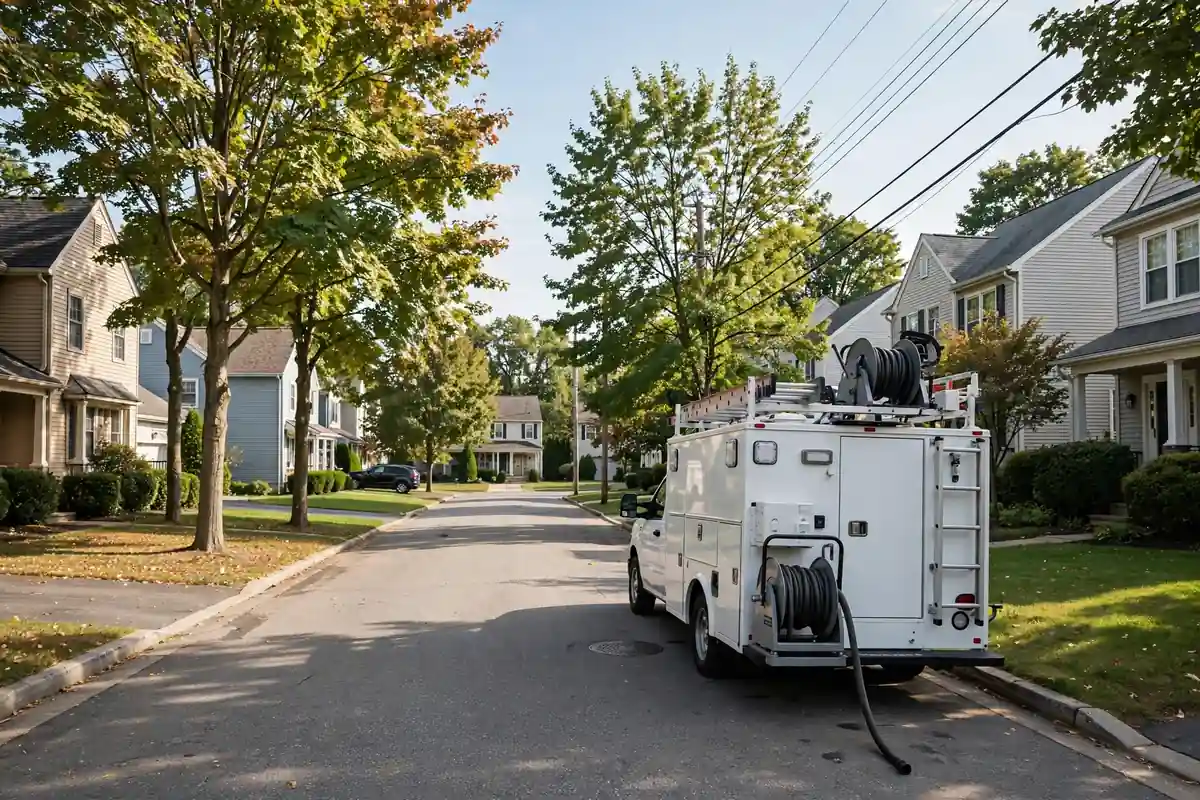
Iselin is Woodbridge Township's mid-century suburb — a diverse commuter community of about 20,000, known for the Oak Tree Road commercial corridor and its Metropark station, where roughly 78% of homes went up between 1940 and 1969. The housing is overwhelmingly single-family detached: Cape Cods, split-levels, and ranches from the postwar decades, with contemporary infill mixed in. That build era defines Iselin's sewer story completely, because the 1940s-1960s were the peak decades of clay-tile lateral installation.
Clay-tile laterals from this era are now 55 to 85 years old — squarely in the zone where joints fail. The mortared joints between tile sections have had decades of freeze-thaw heave, root pressure, and ground movement working on them. In Iselin, the camera inspection almost always shows the same picture: root intrusion at joint after joint, with bellies where the line has sagged under decades of soil movement. This is not a neighborhood where laterals are a question mark. It is a neighborhood where the laterals have a known age, a known material, and a known failure pattern.
The commercial corridors add a second dimension. Along Route 27 and Oak Tree Road, commercial laterals deal with grease and heavy buildup from food businesses — a different failure mode from the residential root-intrusion story, but one that matters for property owners on those corridors. The sections below cover Iselin's residential clay-lateral pattern, how inspections decide the repair, the trenchless methods that fit these properties, and the seasonal stresses that New Jersey's climate puts on mid-century pipe.
Mid-Century Clay Laterals in Iselins Cape Cod Neighborhoods
Iselin's housing stock is a textbook of postwar suburban construction. Cape Cods and split-levels from the 1940s through the 1960s dominate the residential streets, most with full basements in the capes and splits and slab construction in some of the ranches. When these homes were built, the standard sewer lateral was vitrified clay tile — strong against corrosion, but joined with mortar or bell-and-spigot fittings that were always the weak link. Eighty-eight percent of Iselin's homes are single-family detached, which means most properties have their own private lateral running from the foundation to the street.
At 55 to 85 years old, these laterals are at what pipe professionals consider peak failure age for clay tile. The material itself is usually intact — clay does not rot or rust — but the joints have spent decades opening up. Each freeze-thaw cycle heaves the soil a fraction of an inch; each cycle opens the joints a fraction more. Tree roots, sensing moisture at those openings, push in and expand them further. By the time a clay line reaches its sixth or seventh decade, finding a lateral with all joints still tight would be the surprise, not the norm.
Basements are common in Iselin's capes and splits, and they shape both the symptoms and the service. The lateral typically exits through the basement wall, which gives camera crews a clean access point and means backups announce themselves in basement floor drains or laundry tubs before causing damage upstairs. Slab ranch homes route their drains under the concrete floor, which makes locating the line's path more important before any work is planned.
The median build year around 1978 reflects the mix: the older 1940s-50s capes with the most worn laterals, 1960s splits in the same clay-tile era, and newer infill on PVC. On any given Iselin street, the lateral's condition tracks closely with the house's age — which is why a camera inspection is less about discovering surprises and more about confirming exactly how far along the expected deterioration has gone.
Root Intrusion and Bellied Lines: The Iselin Pattern
If there is a signature Iselin sewer problem, it is root intrusion at clay joints combined with bellied sections. The two often travel together. Roots enter through opened joints, and their growth inside the pipe catches paper and waste, creating partial blockages. Meanwhile, decades of soil movement — freeze-thaw heave, the natural consolidation of backfill around the original trench, and the weight of mature landscaping — let sections of the line sag. Where the pipe sags, wastewater ponds instead of flowing, and the pooled water feeds the root masses at the nearby joints.
Mature trees are a major factor in Iselin. The postwar subdivisions were landscaped when they were built, which means the neighborhood's maples, oaks, and evergreens are now 50 to 70 years old with root systems to match. A large tree within 20 or 30 feet of a clay lateral will find it — roots are extraordinarily good at sensing the moisture escaping from an opened joint. The worst cases on camera show root masses so dense they fill the pipe's entire diameter, with only a trickle of water passing through.
Bellies deserve special attention because they change the repair decision. A lateral with root intrusion but correct grade can sometimes be managed — roots cut back, joints sealed — but a bellied section will never drain correctly no matter how clean it is. Wastewater will always pool in the sag, solids will always settle there, and the line will always back up sooner than it should. When the camera shows standing water in a bellied run, that section needs regrading or replacement, not another cleaning.
The seasonal rhythm of Iselin's sewer calls follows this pattern. Spring brings the root-growth surge and the first backups of the year. Summer storms add infiltration through the opened joints. Fall's leaf drop and the year's final growth push send marginal lines over the edge. Homeowners who notice their backups clustering in these seasons are seeing the clay-joint failure pattern play out on schedule.
How Camera Inspection Decides Spot Repair vs. Replacement
In Iselin, the camera inspection is the decision point between two very different scopes of work — and getting it right saves homeowners from both under-repairing and over-repairing. The inspection maps the lateral's full length, material, depth, and grade, and documents every defect with its distance from the access point. That map is what separates a line that needs two joints fixed from a line that needs to be replaced end to end.
A lateral that qualifies for spot repair shows a clear pattern: most of the line is in good condition, with isolated defects — one crushed section where a vehicle drove over shallow pipe, one badly offset joint, one root mass at a single fitting. Spot repair excavates at that location only, cuts out the bad section, and installs new pipe with proper bedding. It is the right call when the inspection shows the rest of the line is sound, and it is common on Iselin's younger 1960s-70s laterals where only part of the line has failed.
Full replacement — usually by trenchless pipe bursting in Iselin's residential neighborhoods — is the call when the defects are distributed along the whole line. Roots at every joint, multiple bellied sections, widespread cracking: that is a lateral at the end of its service life, and fixing it joint by joint would cost more than replacing it while leaving a patchwork of old pipe that will fail next. Bursting pulls a new jointless HDPE pipe through the old alignment, which eliminates the joint-failure mode entirely.
There is also a middle path for lines that are cracked throughout but still structurally round: cured-in-place pipe lining. A resin-saturated liner cures against the inside of the old pipe, creating a new jointless pipe within it. Lining seals every crack and root entry at once, requires minimal excavation, and works well on Iselin's clay lines that have not yet bellied or collapsed. The inspection determines which of these three paths the line qualifies for — and that determination is the whole value of the camera.
Commercial Laterals Along Oak Tree Road and Route 27
Iselin's commercial corridors have a sewer story distinct from the residential streets. Along Oak Tree Road — the well-known commercial district — and Route 27, the Lincoln Highway, commercial laterals serve restaurants, food markets, and retail businesses whose wastewater carries far more grease and solids than a household's. Grease is the defining problem: hot grease poured down drains cools and solidifies in the lateral, building up in layers until the pipe's diameter is choked.
Commercial blockages behave differently from residential ones. A home's lateral usually fails gradually, with slow drains warning for months. A restaurant lateral can go from fine to fully blocked quickly when a grease layer sloughs off and lodges downstream. That is why scheduled maintenance — regular hydro-jetting on a calendar, not just when there is a problem — is standard practice for food-service properties. Jetting scours grease off the pipe walls and restores full diameter, and done on schedule it prevents the emergency shutdowns that cost businesses far more than the maintenance.
The inspection approach differs too. Commercial laterals are often larger diameter, run longer distances to the street, and may pass under parking lots where excavation disrupts business. Camera inspection with locating marks the line's path under pavement so that any needed repair can be planned around business operations — often scheduled for off-hours, with trenchless methods preferred to keep the parking lot open.
Property owners and managers on these corridors should also know that grease-related blockages are a maintenance responsibility, not a pipe defect. A perfectly good lateral will still block if grease is poured into it. The fix is a combination of proper grease handling inside the building and scheduled jetting of the lateral — and the camera inspection confirms the pipe itself is sound so that maintenance dollars are not wasted chasing a structural problem that is not there.
Freeze-Thaw Cycles and Joint Failure in Northern New Jersey
New Jersey's winters are the slow engine of clay-lateral failure in Iselin. Every freeze-thaw cycle moves the soil around buried pipe: water in the soil freezes and expands, heaving the ground upward, then thaws and lets it settle back. Clay tile is rigid — it cannot flex with that movement — so the stress concentrates at the joints, the weakest points. Over 55 to 85 winters, those tiny annual movements add up to joints that have opened, shifted, or cracked.
The damage is worst where the lateral is shallowest. Hand-dug trenches from the 1940s and 50s were not always dug to consistent depth, and sections of pipe near the foundation or under a driveway may sit shallower than the rest of the line. Shallow pipe feels the full force of frost heave, while deeper sections near the street ride it out. That is why camera inspections on Iselin's older lines so often show the worst joint damage in the first 20 or 30 feet from the house.
Winter also brings the freeze risk inside the pipe. A lateral with a belly holds standing water, and in a cold snap that water can freeze — expanding inside the pipe and cracking the already-weakened clay around it. Homeowners sometimes discover in spring that a line that was marginal in fall is now broken, and the winter freeze in a bellied section is usually why.
Spring's thaw brings the other half of the cycle: saturated soil, maximum root growth, and infiltration through every joint the winter opened wider. Planning sewer work around this cycle pays off. Late winter and early spring inspections catch winter damage before the root-growth season exploits it, and scheduling replacement work for the drier months avoids digging in saturated ground. For Iselin's mid-century clay lines, working with the seasons is part of working with the pipe.
Sewer Services Available in Iselin
Sewer line service in Iselin covers the full arc of mid-century clay-lateral care. Video camera inspection with locating is the starting point for nearly every job — mapping the lateral's route, depth, grade, and every defect, and producing the documentation that decides between spot repair, lining, and full replacement. Drain cleaning with professional cable equipment clears root masses and blockages when the pipe is still serviceable.
Trenchless pipe bursting is the workhorse replacement method for Iselin's residential streets: a new jointless HDPE lateral pulled through the old clay alignment with only small entry pits, no continuous trench through the yard. Cured-in-place pipe lining offers a less invasive alternative for lines that are cracked throughout but still round — sealing every joint and crack with a new pipe inside the old one. Open-cut lateral replacement remains available for collapsed lines, badly bellied runs that need regrading, and situations where the alignment must change.
Spot repairs target isolated defects on lines that are otherwise sound — a single offset joint, a crushed section, a bad fitting — keeping the work proportional to the problem. For Iselin's commercial corridors along Oak Tree Road and Route 27, scheduled hydro-jetting maintains grease-prone laterals on a calendar, and off-hours trenchless repairs keep businesses running.
Preventive services complete the picture: periodic camera inspections that track a clay lateral's condition over the years, root management programs for lines not yet ready for replacement, and pre-purchase inspections for buyers considering one of Iselin's postwar capes or splits. On a street where 78% of homes share the same pipe era, knowing your own lateral's condition is the difference between planning a repair and reacting to a backup.
Available Services
Ask a Pro
One call connects you with a local sewer professional serving Perth Amboy, NJ — day or night.
Ask a Pro: (833) 713-2101Frequently Asked Questions
How long do Iselin's clay sewer laterals last?
Clay tile itself can last a century, but the joints usually fail between 50 and 80 years — which is exactly where Iselin's 1940s-1960s laterals are now. Most lines in the neighborhood are at peak failure age, with root intrusion and joint separation being the norm. A camera inspection shows where your specific line falls on that timeline.
Why do my backups happen every spring?
Spring combines the year's most aggressive root growth with saturated soil from the thaw — both attacking the opened joints of a clay lateral at once. If your backups cluster in spring, roots have found your line's joints, and each year's growth is thicker than the last. The interval between cleanings shrinking year over year means replacement is approaching.
Can you repair just part of my sewer line?
Yes, when the inspection shows the damage is isolated. A single offset joint, one crushed section, or one bad fitting on an otherwise sound line is a good candidate for spot repair. But when roots have invaded joints along the whole line or there are multiple bellies, spot repairs become false economy and full replacement is the lasting fix.
Is pipe bursting better than digging up my yard?
For most Iselin residential laterals, yes. Bursting replaces the old clay line with jointless HDPE using only small entry pits — no continuous trench through the yard, driveway, or landscaping. Open-cut is still needed when the line is fully collapsed, badly bellied and needs regrading, or must be rerouted, but bursting is the default for these properties.
My restaurant is on Oak Tree Road. How do I prevent grease blockages?
Proper grease handling inside the kitchen plus scheduled hydro-jetting of the lateral on a calendar — not just when it blocks. Jetting scours grease off the pipe walls before it can build into a blockage. A camera inspection first confirms the pipe itself is sound, so maintenance spending targets the grease, not a structural problem.
Will a sewer camera inspection damage my pipes?
No. The camera is a small waterproof head on a flexible cable, pushed gently through the line — it is purely diagnostic. It cannot damage even fragile clay pipe. The inspection is the lowest-risk step in the whole process and the one that prevents expensive wrong guesses about what repair is needed.
Should I get a sewer inspection before buying an Iselin cape or split-level?
Strongly recommended. With 78% of Iselin's homes in the 1940-1969 clay-tile era, the lateral's condition is one of the biggest unknown costs in a purchase. A pre-closing camera inspection reveals whether the original line has years left or needs replacement — information worth having before you finalize the price.