Sewer Camera Inspection in Perth Amboy, NJ
A sewer camera inspection in Perth Amboy, NJ runs a camera through your sewer line to show exactly what's happening underground — roots, cracks, breaks, bellies, and blockages, with distance markers locating each one. Sewer Line Repair Group uses inspections to diagnose recurring clogs, plan trenchless repairs, and document line condition before you buy a home or commit to major work.
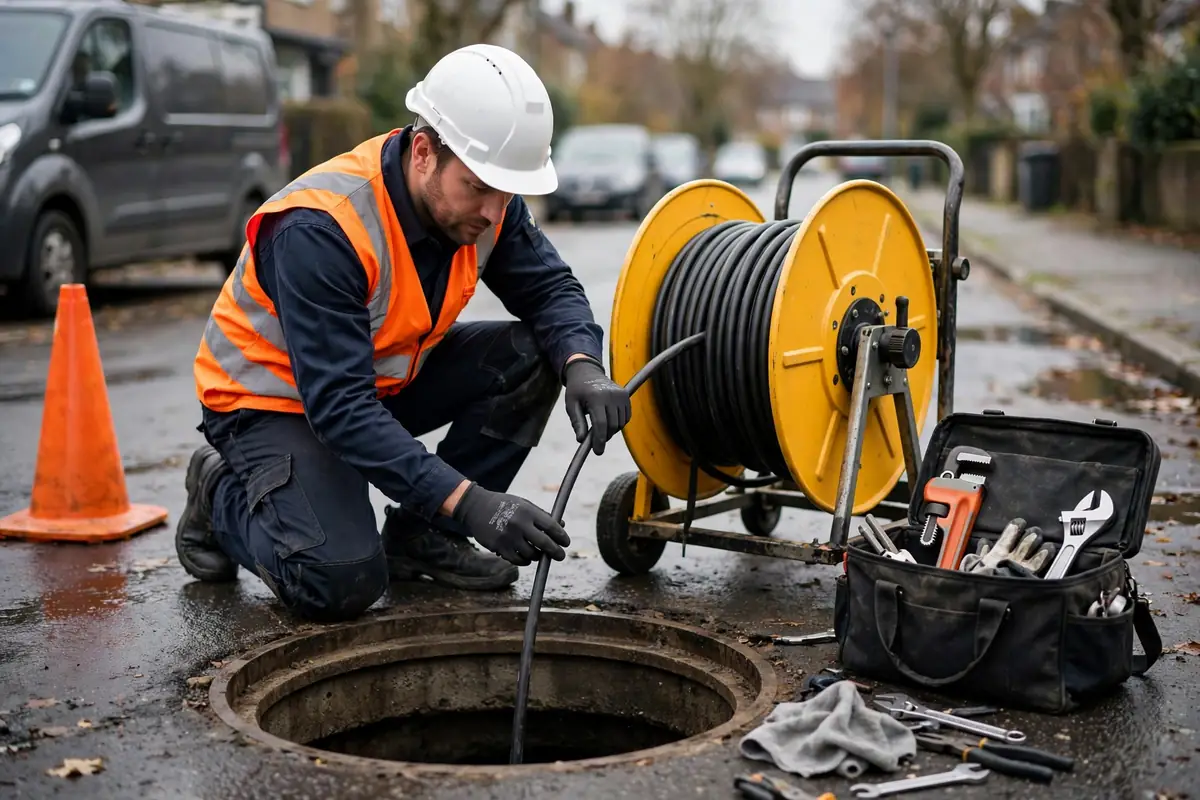
Every good sewer decision starts with seeing the pipe. Guessing at an underground problem — snaking a line blindly, or digging based on a hunch — wastes money and often misses the real defect. A sewer camera inspection removes the guesswork: a waterproof camera on a flexible push rod travels the full length of the lateral, transmitting live video of the pipe's interior to a monitor above ground.
The footage reveals what no surface symptom can confirm: root masses at clay-tile joints, longitudinal cracks, collapsed sections, bellied low spots holding water, offset joints, heavy scale, and the exact material and diameter of the line. Distance counters mark how far each defect sits from the access point, and a locating sonde in the camera head lets the technician mark the spot on the surface with its depth.
For Perth Amboy's aging laterals — many of them clay tile laid 60 to 100+ years ago — a camera inspection is the difference between treating symptoms and fixing causes. This page covers how inspections work, what they find, and when one is worth scheduling.
How a sewer camera inspection works
The technician starts at the most practical access point — ideally an existing sewer cleanout, the capped pipe near your foundation or in the yard. If there's no cleanout, access can sometimes be gained through a pulled toilet or a roof vent, though a cleanout is cleaner and faster. The camera head, about the size of a golf ball and ringed with LED lights, rides on a semi-rigid push rod that the technician feeds steadily down the line. You watch along on the monitor as the pipe's interior scrolls past: joints, walls, water flow, and any defects, all in real time. An on-screen distance counter tracks footage from the entry point, so every observation is tied to a location. The whole process is non-invasive — no digging, no dismantling — and most homeowners find the live tour of their own underground plumbing unexpectedly fascinating.
What the camera can reveal inside your line
A trained eye reads a sewer video the way a radiologist reads a scan. Root intrusion shows as fibrous masses entering at joints, sometimes fine as hair, sometimes thick as rope. Cracks appear as dark lines along the pipe wall; breaks and collapses as jagged voids where the camera sees soil instead of pipe. Bellies reveal themselves as sections where water pools and the camera seems to swim — a sign of lost grade. Offset joints show as steps where one pipe section has shifted relative to the next. Scale and corrosion roughen the interior into an orange-brown crust that narrows the bore. Blockages — grease, wipes, settled debris — are obvious obstructions. The camera also documents pipe material transitions, telling you where clay tile gives way to cast iron or PVC, which matters for repair planning. Each finding gets a distance reading, building a defect map of your entire lateral from house to main.
When an inspection is worth scheduling
Schedule an inspection when drains keep misbehaving without an obvious cause — recurring clogs that return after snaking almost always have a structural reason the camera will find. Multiple slow fixtures, gurgling drains, or sewage odors are all camera-worthy symptoms. If you're buying a home in Perth Amboy, especially one built before 1970, an inspection belongs on the same list as the home inspection and the termite check; the city's clay-tile laterals are old enough that condition varies wildly house to house. Any trenchless repair — lining or bursting — requires a pre-qualifying inspection anyway. It's also smart after major yard work or construction near the lateral, and for homes with large trees whose roots you suspect. Think of it as the cheapest information in sewer work: an hour of looking that prevents thousands in wrong guesses.
Understanding your inspection report
After the visit you get more than a video file. A proper inspection report pairs the recording with a written summary: the line's material, diameter, and approximate length; each defect described in plain language with its distance from the access point; and an overall condition assessment. Critically, it includes recommended next steps in priority order — what needs attention now, what to watch, and what can wait. That prioritization is what separates a diagnostic service from a sales pitch: not every root hair means replacement. Keep the report with your home records. It becomes the baseline for future comparisons, the documentation behind a repair quote, and the evidence you hand a buyer — or a seller — when a transaction hinges on what's underground.
Locating: marking the problem from above ground
Finding a defect on video is half the job; finding it in your yard is the other half. The camera head carries a sonde — a small transmitter that emits a signal through the soil. Above ground, the technician sweeps a handheld receiver that beeps louder as it nears the sonde, then reads out the depth. The spot gets marked with paint or a flag: here is the break, four feet down, eleven feet from the cleanout. That surface mark is what makes targeted repair possible — a spot repair digs exactly there, a bursting crew places its pits around it, and nobody excavates a exploratory trench hoping to get lucky. Locating turns an underground mystery into a set of coordinates, and it's standard practice on every inspection where defects are found.
Camera inspection coverage in the Perth Amboy area
Sewer Line Repair Group performs camera inspections throughout Perth Amboy, NJ 08861 — downtown, the waterfront neighborhoods, Chickentown, Spa Springs, and Hall Avenue — as well as in Avenel, Iselin, Colonia, Fords, and Port Reading. If your drains are telling you something, it's time to look.
Service Areas
Reach Out Today
One call connects you with a local sewer professional serving Perth Amboy, NJ — day or night.
Reach Out Today: (833) 713-2101Frequently Asked Questions
How long does a camera inspection take?
Most residential inspections take under an hour, depending on the line's length and how many issues slow the camera's progress. The technician can usually show you key findings live on the monitor during the visit, with a full recorded video and summary provided afterward.
Will the camera damage my pipes?
No. The camera head is small, smooth, and designed to travel through sewer lines without catching or scraping. If the line is fully blocked, the camera may not be able to pass until the blockage is cleared — but the inspection itself doesn't harm intact pipe.
Can the camera find the exact location of a problem?
Yes — two ways. The distance counter shows how many feet each defect sits from the access point, and the locating sonde in the camera head transmits a signal that a receiver picks up above ground, marking the spot's position and depth. That precision is what makes targeted repairs possible.
Should I get an inspection before buying a home in Perth Amboy?
Strongly recommended, especially for the city's older housing stock. Many Perth Amboy homes still run on original clay-tile laterals, and a sewer line problem discovered after closing becomes your expense. An inspection documents the line's condition before you commit — cheap certainty compared to a surprise replacement.
What happens if the camera can't get through the line?
A complete blockage stops the camera, but that itself is diagnostic — it confirms where the obstruction sits. The usual next step is clearing the blockage with mechanical cleaning, then running the camera through the cleared line to inspect the pipe's condition underneath.
Does the inspection include a written report?
Yes. You receive the recorded video along with a summary of findings — what was found, where, and what it means — plus recommended next steps. That documentation is useful whether you're planning a repair, negotiating a home purchase, or just keeping records on an older line.