Sewer Line Repair in Edison, NJ
Sewer line repair in Edison, NJ 08837 serves the township's sprawling multi-era housing — from pre-war pockets to dense 1940-1969 subdivisions to modern townhomes — so lateral materials range from century-old clay tile to PVC depending on the home's era. The Raritan River floodplain adds storm-driven infiltration risk, making camera inspection and watertight replacement the standard approach.
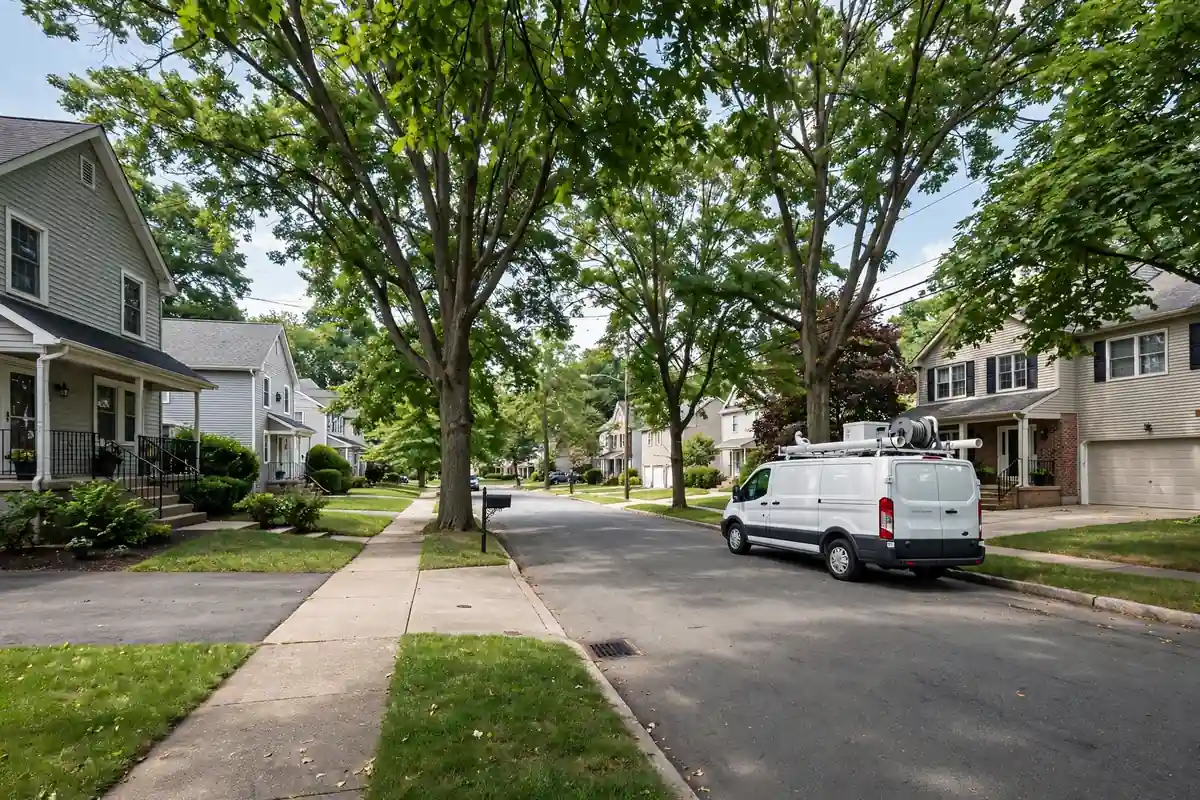
Edison is New Jersey's fifth-biggest municipality — a large township, formerly Raritan Township, renamed in 1954 — and its housing stock sprawls across eras. Colonial-era pockets survive near areas like Piscatawaytown, dense 1940-1969 suburban development filled in the postwar decades, mid-century capes and ranches spread across neighborhoods, and modern townhomes cluster near commercial corridors. Edison 08837 covers the southern township near Raritan Center.
That multi-era reality is what defines sewer work here. There is no single Edison lateral: a pre-war home may run original clay tile, a 1960s split may have clay tile with cast-iron interior drainage, and a 1990s townhome sits on PVC. Property records show homes built across a 1906-1984 range, so the only reliable way to know a lateral's material and condition is to look at it.
The Raritan River adds the second defining factor. Low land along the river floodplain — including the Johnson Park area, which flooded during hurricanes Floyd, Irene, and Sandy — exposes nearby laterals to storm-driven infiltration and surcharging. This page explains how Edison's era-by-era pipes fail, how floodplain exposure changes the repair plan, and which methods fit each situation.
Edison's Multi-Era Housing and Era-by-Era Lateral Materials
Edison's sewer story has to be told era by era, because the township was built in waves. The pre-1940 pockets — colonial-era areas and the earliest suburban streets — carry clay-tile laterals that are now 80 to 100+ years old. These lines show the classic end-of-life pattern: root intrusion at every joint, offsets, and sections cracking or collapsing.
The dense 1940-1969 build — center-hall colonials, capes, ranches, and split-levels — represents the largest share of Edison's aging laterals. Clay tile from the 1950s and 1960s is now 60 to 70 years old: past the early-failure window and deep into the decades when joints separate and roots take over. Cast-iron interior drainage in the splits and colonials of this era corrodes and scales in parallel.
Homes from the 1980s onward generally use PVC, which does not corrode and resists roots at its solvent-welded joints. PVC laterals still fail — from settlement, poor bedding, separated joints, or construction damage — but the failure pattern is isolated defects rather than system-wide aging.
The practical consequence: era-matching expectations matter when estimating any Edison job. A camera inspection on a 1920s home should be read against century-old clay; the same footage on a 1990s townhome means something entirely different. Recommendations that ignore the era misread the evidence.
Raritan River Flooding and What It Means for Laterals
The Raritan River floodplain is Edison's signature environmental risk for sewers. Low land along the river — including the Johnson Park area — floods in large storms, and the historical record is specific: hurricanes Floyd, Irene, and Sandy all flooded the Johnson Park area. Floodwater does two things to sewer systems: it surcharges public lines, pushing water back toward homes, and it infiltrates private laterals through every crack and open joint.
A lateral that was quietly aging can become an emergency during a single major storm. Cracked clay joints that admitted a little groundwater become entry points for a lot of it, and basements — common across Edison's housing eras — are where the backup appears. Homes near the floodplain should treat watertight pipe as protection, not luxury.
The standard response is jointless, sealed replacement pipe. Trenchless pipe bursting installs continuous HDPE with no joints for floodwater or roots to exploit; open-cut replacement with properly bedded and sealed pipe achieves the same watertight result. Either way, the specification for floodplain-adjacent properties should assume water will test every seam.
Heavy summer rain adds a steadier version of the same stress. Intense downpours infiltrate cracked laterals and surcharge older public infrastructure, so Edison backups cluster both around named storms and around ordinary severe thunderstorms. Freeze-thaw cycles do their slower work on clay joints each winter in between.
How Camera Inspection Sorts Edison's Mixed Laterals
In a township where the lateral could be 1920s clay or 1990s PVC, the camera inspection is the decision point for every job. The footage documents the pipe's material, its defects, and their locations — which sorts the lateral into its era's failure pattern and determines whether the fix is cleaning, spot repair, lining, or full replacement.
A pre-war clay lateral with roots at every joint and multiple offsets is a replacement candidate: the pipe has reached the end of its service life, and spot repairs would only address one failure among many. A 1980s PVC line with a single separated joint is the opposite case — a spot repair restores a line with decades of life remaining.
Between those poles sit the judgment calls: a 1960s clay lateral with one badly bellied section but otherwise tight joints, or a cast-iron line with moderate scaling but no breaks. Here the inspection's distance markers matter, pinpointing exactly which sections need work so the repair is sized to the evidence.
Pre-purchase inspections are especially valuable in Edison because the multi-era stock defeats guessing. A buyer cannot infer the lateral's condition from the street's appearance when the houses span 1906 to 1984. Documenting the line before closing turns a major unknown into a known quantity.
Basements, Slabs, and Replacement Methods for Edison Lots
Basements are common across most Edison housing eras, and that is good news for sewer work: the lateral typically exits through the basement wall or floor, giving crews a direct interior access point for camera inspections, cleaning, and even trenchless launch points. A basement cleanout makes routine sewer service straightforward.
Ranch neighborhoods with slab-on-grade or crawlspace construction are the exception. Slab homes hide the lateral under concrete, so access usually comes through an exterior cleanout or a pulled toilet, and locating the line takes more planning. Crawlspaces offer access with tight working room. If a slab home has no exterior cleanout, installing one is a small project that pays off at every future service visit.
The access difference shows up in repair planning. A basement home with a cleanout can have its full lateral camera-inspected and jetted in a single visit. A slab home without exterior access may need the cleanout installed first — worth doing, because every subsequent inspection, cleaning, or repair depends on it.
For replacements, trenchless pipe bursting suits Edison's established suburban lots: entry and exit pits replace long open trenches, preserving driveways and landscaping. Open-cut replacement remains the answer for collapsed lines, failed main connections, and grade corrections — and near the floodplain, contractors should plan dewatering for open excavations.
Raritan Center Corridors, Historic Pockets, and Floodplain Planning
Raritan Center's business park and the Route 1 and Route 27 corridors mark Edison's commercial side, where properties may combine retail or office use with the township's residential sewer infrastructure. Work near these corridors needs staging planned around traffic and business operations.
The Thomas Edison Memorial Tower and Menlo Park area anchor the township's historic identity — a reminder that Edison's oldest pockets genuinely date to the early 20th century, with laterals to match. Sewer planning on the oldest blocks starts from the assumption of aged clay until inspection proves otherwise.
Replacement work in the public right-of-way or at the connection to the township main follows the municipal permit and inspection process. For Edison's oldest laterals, the connection at the main deserves its own inspection: the tap where a decades-old line meets the public sewer is a common failure point and should be part of any complete replacement plan.
Floodplain-adjacent properties merit one more consideration: backwater protection. Where storm surcharging has caused backups, a backwater valve on the lateral can prevent public-system surges from entering the home — a complement to, not a substitute for, a watertight lateral.
Sewer Services Available in Edison
Video camera inspection is the foundation of Edison sewer work — the tool that identifies which era's pipe a home actually has and documents its defects with location-marked footage. Pre-purchase inspections are strongly recommended given the township's 1906-1984 construction span.
Drain cleaning with mechanical root cutters and hydro jetting clears blockages and restores flow in lines that remain structurally sound. On aging clay laterals, cleaning is paired with inspection so each cleaning also updates the record of the line's condition.
Trenchless pipe bursting replaces full clay and cast-iron laterals with new jointless pipe through the old line's path — the preferred method for Edison's established suburban lots. Cured-in-place lining rehabilitates pipes that still hold their shape, sealing joints against roots and infiltration. Open-cut replacement handles collapsed lines, failed main connections, and grade corrections.
Spot repairs fix isolated defects — one separated PVC joint, a single broken clay section, a failed cleanout — when the camera shows the rest of the lateral is serviceable. Backwater valve installation protects floodplain-adjacent homes from public-system surcharging during major storms.
Available Services
Reach Out Today
One call connects you with a local sewer professional serving Perth Amboy, NJ — day or night.
Reach Out Today: (833) 713-2101Frequently Asked Questions
What kind of sewer lateral does my Edison home have?
It depends on the era of your specific home, which is what makes Edison unusual. Pre-1940 pockets typically have clay tile; 1940s-60s subdivisions have clay tile; 1980s and newer homes generally have PVC. Property records in Edison show homes built across a 1906-1984 range, so two houses on the same street can have completely different laterals. A camera inspection identifies your actual pipe.
Does Raritan River flooding affect Edison sewer lines?
Yes — river flooding is a documented risk, not a hypothetical one. Hurricanes Floyd, Irene, and Sandy all flooded the Johnson Park area along the Raritan River. Floodwater surcharges sewer systems and infiltrates cracked laterals, and low-lying properties near the floodplain can see backups during major storms even when their pipes are otherwise sound. Watertight replacement pipe is the standard protection.
Why does my home's construction era matter for sewer repair?
Era-matching matters more in Edison than in single-era neighborhoods. A pre-war clay lateral with root intrusion at every joint is a replacement candidate; a 1980s PVC line with one separated joint is a spot-repair candidate; a 1970s split with scaled cast iron needs a different approach than a clay line of the same age. The camera inspection sorts the lateral into its era's failure pattern before any recommendation is made.
Is trenchless pipe bursting available for Edison's older subdivisions?
Often yes. Bursting replaces the line through its existing path with only entry and exit pits, which suits Edison's established suburban lots with driveways and landscaping. The camera inspection first confirms the old pipe's material and alignment are suitable — severely collapsed sections or a failed main connection may still require open-cut work.
How do basements versus slabs affect sewer work in Edison?
Basements are common across most Edison housing eras, which helps: the lateral usually exits through the basement wall or floor, giving crews an interior access point for camera work and cleaning. Ranch neighborhoods with slab or crawlspace construction need an exterior cleanout or access through a pulled toilet. If your home has no exterior cleanout, installing one is a worthwhile first step.
Should I get a sewer inspection before buying a home in Edison?
Absolutely — it is one of the most valuable checks on an Edison purchase because the township's multi-era stock means the lateral's condition cannot be guessed from the neighborhood. A camera inspection documents the pipe's material, defects, and remaining life, giving you facts about a major underground system before you commit to the house.
Do I need a permit to replace a sewer lateral in Edison?
Replacement work in the public right-of-way or at the connection to the township main follows the municipal permit and inspection process. Requirements should be confirmed before scheduling. Because Edison 08837 covers the southern township near Raritan Center, some properties sit near commercial corridors with additional coordination needs for staging and work zones.