Sewer Leak Detection in Perth Amboy, NJ
Sewer leak detection in Perth Amboy, NJ finds where a sewer line is leaking — before the damage spreads. Using camera inspection, smoke testing, and dye testing, Sewer Line Repair Group pinpoints leaking joints, cracks, and failed connections in aging clay and cast-iron laterals, then recommends the right fix: spot repair, lining, or replacement. Early detection protects foundations, yards, and groundwater.
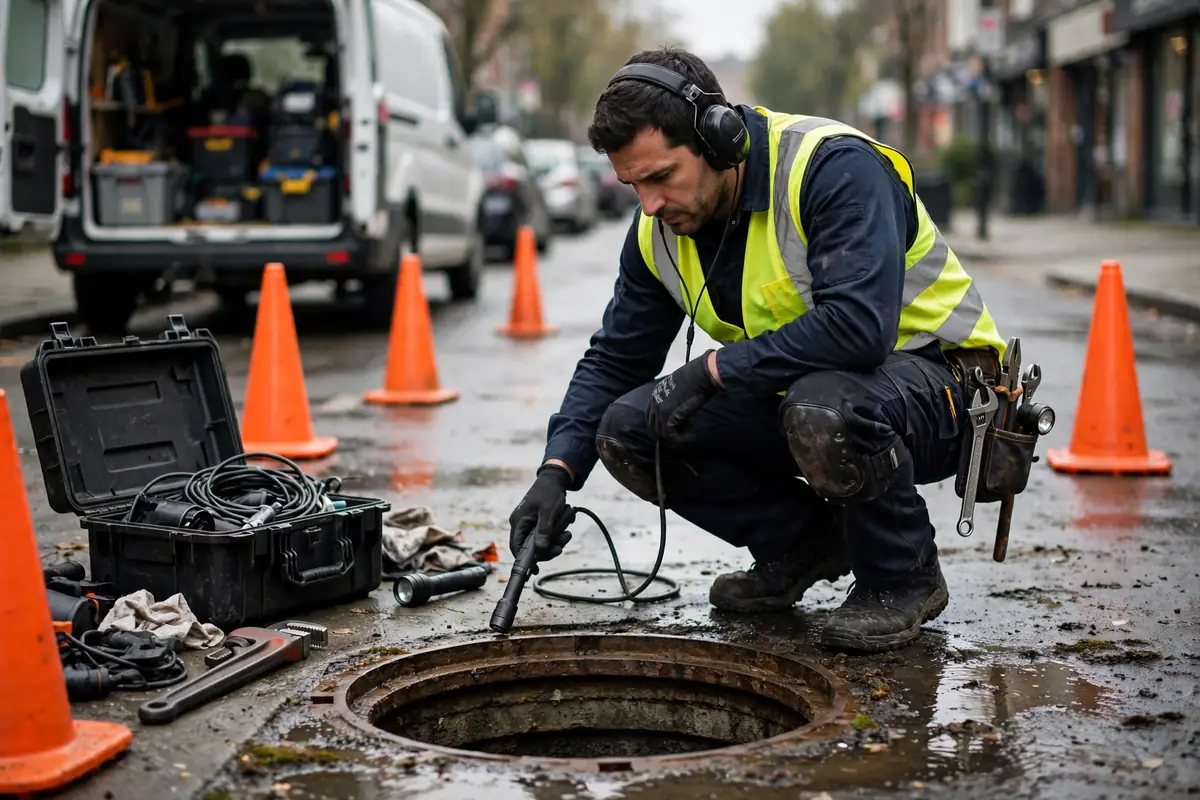
A leaking sewer line rarely announces itself with drama. More often it whispers: a patch of grass that's suspiciously greener than the rest, a musty odor in the basement that never quite leaves, a soft spot in the yard that wasn't there last year. Because the pipe is buried, leaks can run for months — saturating soil, undermining slabs, and inviting roots — before anyone connects the symptoms to the sewer.
Detection is the discipline of finding the leak's exact source without tearing up the property to look. It combines visual clues at the surface with diagnostic tools underground: cameras that show cracks and open joints from inside the pipe, smoke tests that reveal where gas escapes through defects, and dye tests that trace flow paths. Each method answers a different question, and a thorough detection job uses the right combination.
Perth Amboy's conditions make detection both harder and more important. High groundwater near the bay and the Arthur Kill can mask a leak's surface signs, while the city's stock of century-old clay laterals means joints — the most leak-prone part of any line — are everywhere. This page covers the signs, the methods, and what happens after a leak is found.
Signs of a sewer leak around your home
Learn to read your property and you'll catch most leaks early. The classic sign is vegetation: a strip of lawn or a patch of shrubs growing conspicuously greener and faster than its surroundings, fertilized by escaping wastewater. Soggy or spongy spots in the yard that persist in dry weather point to water coming from below. Indoors, a persistent musty or sewer odor in the basement — especially near where the line exits the foundation — deserves investigation, as does new dampness or mold on basement walls with no plumbing leak to explain it. Structural clues include fresh cracks in foundation walls or floors, slight settlement of a slab or walkway, and depressions or sinkholes forming in the yard above the lateral's path. Increased rodent or insect activity around the foundation can also trace back to a breached line. Any one of these warrants a look; two or more together make detection urgent.
Where sewer lines usually leak
Sewer pipes don't leak randomly — they leak at their weak points. Joints top the list: clay-tile lines are assembled from short bell-and-spigot sections, and every joint is a seam where seals degrade, roots enter, and ground movement works the connection loose. Cracks come next, opened by freeze-thaw cycles, soil settlement, or the weight of traffic and construction above shallow lines. The foundation penetration — where the line passes through the basement wall or slab — is a notorious leak point, because the rigid wall and the settling soil move differently and stress the pipe at the boundary. Cleanout risers and caps can leak if damaged or left open. The connection where your lateral meets the public main can fail with age or ground shifting. And bellied low spots, where water sits permanently against the pipe wall, corrode and weaken faster than freely draining sections. Knowing these locations focuses the search instead of treating the whole line as equally suspect.
How technicians pinpoint a sewer leak
A detection visit layers methods until the leak's location is certain. It usually starts with a camera inspection, which shows the defect directly — the open joint, the crack, the offset — and records its distance from the access point. When the camera can't explain surface symptoms, or when the leak is suspected outside the main run, smoke testing comes in: non-toxic smoke is blown into the line under gentle pressure, and wherever it escapes — a foundation crack, a broken cleanout, a failed connection — marks a defect cameras can miss. Dye testing traces flow: fluorescent dye introduced at a fixture or cleanout appears at unexpected surface points, mapping where wastewater actually travels versus where it should. A locating sonde then marks the defect's position and depth on the surface. The technician correlates all of it — what the surface shows, what the camera sees, where smoke escapes — into a single diagnosis: the leak is here, this big, caused by this.
Repair options once the leak is found
Finding the leak is the diagnosis; fixing it is the prescription, and the right one depends on what detection revealed. A single failed joint or isolated crack in an otherwise sound line is a candidate for a spot repair — a targeted excavation at the marked location, the damaged section replaced, the ground restored. Multiple cracks or leaking joints along a pipe that's still standing point to pipe lining, which seals the entire run from the inside with no excavation. Widespread failure — collapsed sections, shattered clay, or a line riddled with defects — calls for full replacement, trenchless by pipe bursting where the line qualifies. Leaks at the foundation penetration may need resealing and proper sleeving at the wall. What matters is that the repair matches the finding: detection exists precisely so you're not paying for a full replacement when a spot repair would do, or lining a pipe that's actually collapsing.
Why leaks hide well in Perth Amboy
Perth Amboy's geography complicates leak detection in specific ways. The city's low elevation near Raritan Bay and the Arthur Kill means high groundwater in many neighborhoods — and a high water table can hide a leak's surface signs, because the soil is already wet and the escaping wastewater blends into the background. Nor'easters add a second confusion: heavy stormwater infiltrating into cracked lines from the outside looks, on camera, a lot like the aftermath of a leak, and a good diagnostician has to distinguish infiltration (water getting in) from exfiltration (waste getting out). The housing stock adds the third factor: century-old clay-tile laterals with joints every few feet mean the most leak-prone component in sewer construction is present in huge numbers. Detection here isn't just about tools — it's about reading local conditions correctly, so the repair addresses the real failure instead of a symptom of the weather.
Leak detection coverage around Perth Amboy
Sewer Line Repair Group provides sewer leak detection across Perth Amboy, NJ 08861 — including the waterfront neighborhoods, downtown, the Amboy Avenue section, and Maurer — and in surrounding Sewaren, Keasbey, Sayreville, South Amboy, and Carteret. If the signs point to a leak, early detection keeps the repair small.
Service Areas
Contact Us Now
One call connects you with a local sewer professional serving Perth Amboy, NJ — day or night.
Contact Us Now: (833) 713-2101Frequently Asked Questions
How can I tell a sewer leak from a water supply leak?
A supply leak usually shows as a rising water bill, the sound of running water, or clean wet spots — and it leaks constantly. A sewer leak produces odors, unusually lush vegetation fed by nutrients, and symptoms tied to drain use. A technician can confirm which system is involved with camera inspection or targeted testing rather than guesswork.
Does a sewer leak always smell?
Not always. Small leaks deep underground may show no odor at the surface — the first signs might be a greener lawn strip or a soft spot in the yard. Odors become noticeable when the leak is near the foundation, under a slab, or large enough that gases find a path indoors. Absence of smell doesn't mean absence of a leak.
Can a small sewer leak be left alone?
It's unwise. Leaks don't seal themselves — they grow. Escaping water erodes the soil bedding around the pipe, which leads to sagging, more cracking, and eventually collapse. Roots also find leaking joints quickly and force them wider. What starts as a seep becomes a structural failure; early repair is almost always the smaller job.
What is a smoke test for sewers?
A smoke test introduces non-toxic, visible smoke into the sewer line under light pressure. Wherever the pipe is broken, joints are open, or connections have failed, smoke escapes — marking defects that cameras might miss, like leaks at the foundation penetration or faulty vent connections. It's a standard diagnostic for finding leaks and problem connections.
Will finding the leak require digging up my whole yard?
No — that's the point of detection. Pinpointing the leak's location and depth means any excavation is targeted to the defect itself. And many leaks qualify for trenchless repair: lining seals cracks from the inside, and bursting replaces failed sections — both with minimal digging.
How do tree roots cause sewer leaks?
Roots seek moisture and enter through tiny openings at pipe joints or hairline cracks. Once inside, they grow into dense masses that trap solids — and as they thicken, they wedge joints apart and crack pipe walls, turning a seep into a structural break. In Perth Amboy's older neighborhoods with mature trees over clay-tile laterals, it's the most common leak mechanism.