Pipe Bursting in Perth Amboy, NJ
Pipe bursting in Perth Amboy, NJ replaces a sewer line without digging it up. A bursting head is pulled through the old pipe, fracturing it outward while towing a new HDPE line behind it. With only entry and exit pits, it handles collapsed clay tile, root-destroyed lines, and undersized pipes — even upsizing capacity — while driveways, landscaping, and patios stay intact.
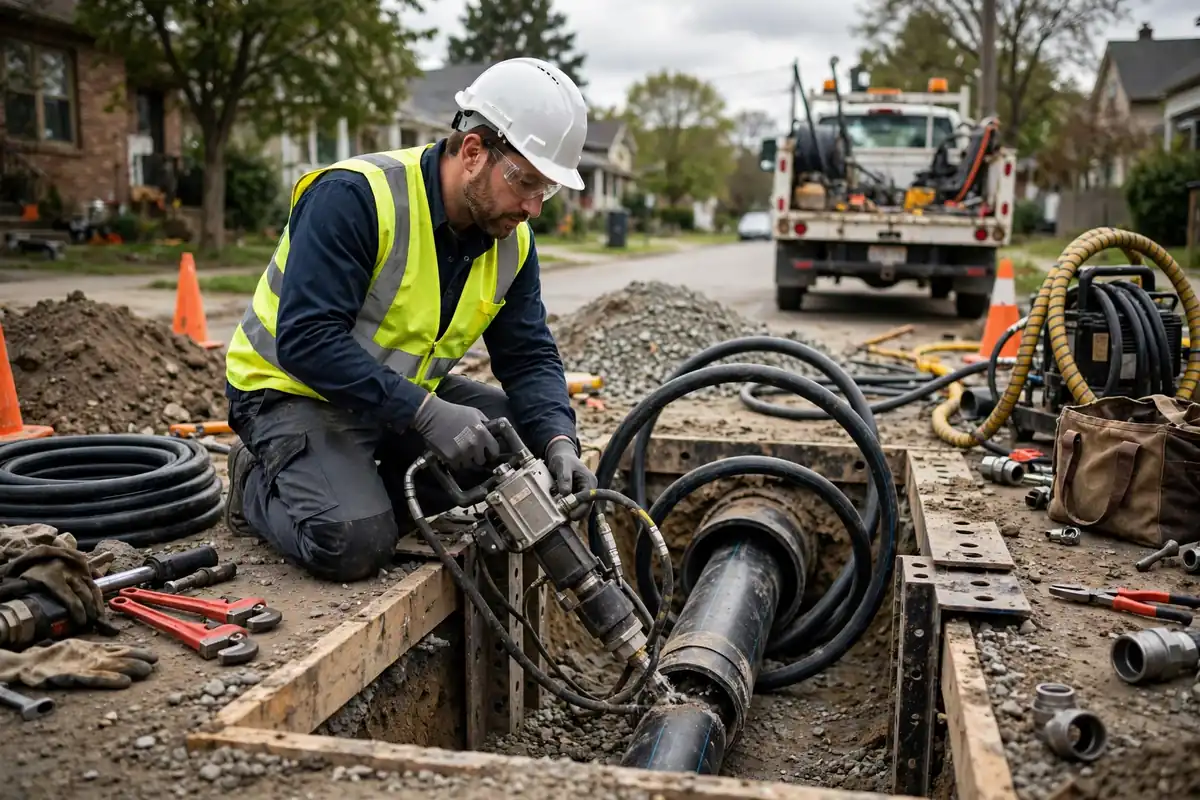
When a sewer line is too far gone for cleaning or lining — collapsed, shattered by roots, or undersized for the home — the traditional answer was an open trench from house to street. Pipe bursting offers the same result, a brand-new line, without the trench. It is a trenchless replacement method that uses the old pipe's path as a guide for the new one.
The process is straightforward in concept and precise in execution. Two small pits are dug: one where the new pipe enters, one where the bursting equipment pulls from. A hardened steel bursting head is drawn through the existing line, breaking the old pipe outward into the surrounding soil while a new HDPE pipe follows directly behind it, taking the old line's place in a single continuous run.
For Perth Amboy homeowners, where 1920s-to-1960s clay-tile laterals are reaching the end of their service life under driveways, mature trees, and patios, pipe bursting is often the most practical way to get a new line without dismantling the property above it.
How pipe bursting replaces a line without digging it up
Everything starts with a camera inspection and a utility locate, so the crew knows the line's path, depth, and what surrounds it. Then two pits are excavated: a launch pit at one end of the run and a receiving pit at the other, each just large enough for equipment and pipe entry. Sections of HDPE pipe are fused together above ground into one continuous length — the heat-fused joints become as strong as the pipe wall itself, leaving no seams for roots to exploit. A steel cable or rod is threaded through the old line and attached to the bursting head, with the new HDPE pipe connected behind it. A hydraulic puller then draws the assembly through: the head's expander cone fractures the old pipe outward into the soil while the new pipe slides into the opened bore directly behind it. Once the pull is complete, the new line is connected to the home's plumbing at one end and the public main or septic tie-in at the other, the pits are backfilled, and the surface is restored. The old pipe is gone; a seamless new line occupies its path.
When pipe bursting is the right choice
Pipe bursting earns its keep in specific situations. The clearest is a collapsed or severely broken pipe — when the line has lost structural integrity, lining has nothing to form against, but bursting doesn't need the old pipe to hold anything; it just needs a path to follow. Heavy root intrusion that has destroyed joints along a clay-tile run is another classic case: cutting roots buys months, bursting buys a new line. Undersized lines are a third — many older Perth Amboy homes run on four-inch clay laterals that struggle with modern fixture counts, and bursting can upsize to a larger diameter in the same pull. It also shines wherever the surface above the line is valuable: driveways, patios, walkways, mature landscaping, additions, or detached garages that would cost a fortune to demolish and rebuild after open-cut digging. Long runs amplify the advantage — the longer the trench you avoid, the more bursting saves in excavation and restoration.
When pipe bursting is not the answer
Bursting is powerful but not universal, and an honest contractor will tell you when it doesn't fit. The main limitation is grade: the bursting head follows the old pipe's path, so a severe belly — a sagging low spot that holds water — will be faithfully reproduced in the new line. Bellies need regrading, which means excavation or a reroute. Sharp bends, severe offsets, or sections where the pipe has shifted sideways can also stop a bursting head that needs a reasonably straight run. Extremely shallow lines may not have enough soil cover for the expansion, and lines running very close to other buried utilities need careful evaluation, because displacing soil outward can disturb neighboring pipes or cables. In those cases the answer might be a targeted excavation, a reroute, or lining instead. The camera inspection before any trenchless job exists precisely to sort lines into the right method — and to keep anyone from promising bursting where it can't deliver.
What a pipe bursting job looks like at your home
On the day of the job, expect a compact, organized operation rather than a construction site. The crew marks utilities, digs the two pits, and stages the HDPE pipe for fusing. Fusing takes some time — each joint is heated, pressed, and cooled to form a seamless connection — but it happens above ground while pit work continues. The pull itself is the dramatic part and usually the fastest: the bursting head advances steadily through the old line with the new pipe following, and on a typical residential lateral the pull is measured in hours, not days. After the pull, connections are made at both ends, the line is tested, and the pits are backfilled and compacted. Landscaping or pavement patches over the two pits are restored, and the rest of the yard looks untouched. Most homeowners are surprised by how little evidence remains — two restored patches where a trench used to be the expectation.
Why the replacement pipe is usually HDPE
Nearly every bursting job installs high-density polyethylene, and the reasons are practical. HDPE arrives in sections that are heat-fused into a single continuous pipe — no bell-and-spigot joints, no couplings underground, which means no joints for tree roots to invade. The material itself is flexible enough to handle minor ground movement without cracking, shrugs off the corrosion that eats cast iron, and has a smooth interior that resists scale buildup and keeps flow efficient. Because it's pulled as one piece, there are no weak segments mid-run. For Perth Amboy's clay soils and freeze-thaw cycles, that combination — jointless, flexible, corrosion-proof — is exactly what the next several decades of service call for. It's the reason bursting doesn't just replace the old line but upgrades it.
Pipe bursting service across the Perth Amboy area
Sewer Line Repair Group performs pipe bursting throughout Perth Amboy, NJ 08861 — including Chickentown, Hall Avenue, the Amboy Avenue section, and Spa Springs — and in surrounding Keasbey, Metuchen, Rahway, Sayreville, and South Amboy. A camera inspection first confirms your line qualifies.
Service Areas
Ask a Pro
One call connects you with a local sewer professional serving Perth Amboy, NJ — day or night.
Ask a Pro: (833) 713-2101Frequently Asked Questions
How is pipe bursting different from pipe lining?
Bursting replaces the pipe entirely — the old line is fractured outward and a new HDPE pipe takes its place. Lining leaves the old pipe in place and forms a new pipe inside it. Bursting is the choice when the old pipe is collapsed, undersized, or too damaged to serve as a host; lining fits pipes that are cracked but still structurally standing.
Does pipe bursting work on clay tile pipes?
Yes — clay tile is one of the most common candidates. The bursting head is designed to fracture brittle materials like clay, cast iron, and concrete outward into the surrounding soil. Perth Amboy's older neighborhoods are full of clay laterals that burst cleanly, which makes replacement straightforward.
Will pipe bursting damage my driveway or landscaping?
That is exactly what it avoids. Only the entry and exit pits are excavated, so a driveway, patio, or garden above the line's path stays in place. The crew locates the line and plans pit positions to minimize surface impact, then backfills and restores the pits afterward.
Can the new pipe be larger than the old one?
Yes — upsizing is one of pipe bursting's distinct advantages. The bursting head can expand the bore as it travels, allowing a larger-diameter HDPE pipe to replace a smaller original. This helps homes where the original line is undersized for current drainage demands.
How long does a pipe bursting job take?
Most residential bursting projects are completed within a day or two, depending on the line's length, depth, and soil conditions. Because there is no long trench to dig and backfill, the schedule is far shorter than open-cut replacement, and surface restoration is limited to the two pits.
How do I know if my line qualifies for pipe bursting?
A sewer camera inspection determines qualification. The technician checks the pipe's material, the extent of damage, the line's grade and alignment, and the location of nearby utilities. Lines with severe bellies or sharp offsets may need a different approach — the camera shows which.