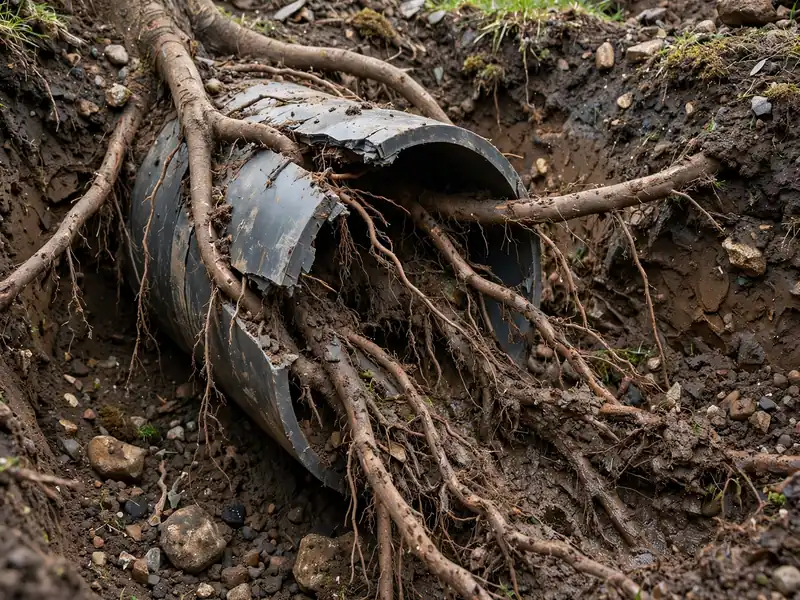
How Roots Find and Enter Your Sewer Line
Roots do not break into healthy pipes; they exploit weaknesses that already exist. Clay-tile laterals, standard in homes built from the 1920s through the 1960s, were laid in short sections joined with mortar. Over decades, that mortar deteriorates, ground movement shifts the sections, and tiny gaps open at the joints. Each gap weeps a small amount of moisture into the soil.
Tree roots are extraordinarily sensitive to moisture gradients. Fine feeder roots detect the damp soil around a weeping joint and grow toward it. A root hair thin enough to pass through a gap you could barely see enters the pipe, and once inside, it finds a constant supply of water and nutrients. Growth accelerates dramatically.
The species matters less than homeowners think. Maples, oaks, willows, and elms are the usual suspects because they are common street and yard trees with aggressive root systems, but any established tree or large shrub within 20 to 30 feet of a lateral can reach it. Even the stump of a removed tree can send new growth toward a known water source.
The Warning Signs of Root Intrusion
Root damage announces itself in stages. The earliest sign is seasonal: drains that run fine in winter but slow down in spring and summer as roots grow most actively. If your home has a yearly rhythm of sluggish drains that worsens through the growing season, roots are almost certainly involved.
As the root mass thickens, the symptoms become constant. Toilets gurgle when other fixtures drain. The lowest drain in the house — often a basement floor drain or laundry tub — backs up first. Snaking the line brings temporary relief, sometimes for months, but the problem always returns because cutting roots does not seal the openings they came through.
The advanced signs are structural. Roots exert tremendous hydraulic pressure as they grow, and a root mass inside a clay-tile joint can crack the tile, offset the sections, and eventually collapse the pipe. At that point the symptoms shift from slow drainage to sewage odors in the yard, soggy spots along the lateral's path, and backups that snaking can no longer clear.
Why Snaking Alone Never Finishes the Job
A drain snake or root-cutting auger clears the immediate blockage by shredding the root mass inside the pipe. Flow returns, the drains run, and it feels like the problem is solved. It is not. The cutter removes the roots inside the pipe but leaves the entry points — the cracked joints and gaps — wide open. Worse, cutting stimulates regrowth: like pruning a hedge, it encourages the roots to branch and return denser than before.
This is why homes with root problems fall into a snaking cycle, calling for clearing every six to eighteen months. Each visit buys time but the intervals shrink as the entry points widen and the root system grows more aggressive. Meanwhile, the pipe itself keeps deteriorating.
Snaking has its place as emergency relief and as preparation for a real repair — a root-choked line must be cleared before it can be lined, for example. But as a long-term strategy, repeated cutting is the most expensive way to manage roots because you pay for the same job over and over while the underlying damage worsens. Breaking the cycle means addressing the pipe itself, which is the focus of professional tree root removal service.
What Actually Works: Clearing Plus Repair
The durable fix has two parts. First, the root mass is cleared — mechanically cut, hydro jetted, or both — to restore full flow and expose the true condition of the pipe. Second, the entry points are eliminated so roots cannot return.
For pipes that are still structurally sound, cured-in-place lining is the ideal second step. The liner creates a seamless new pipe inside the old one with no joints at all — and joints are where roots enter. A lined lateral is effectively root-proof at every lined section, which is why lining is the go-to answer for root-damaged clay tile that has not yet collapsed.
For pipes too damaged to line — collapsed sections, severely offset joints — replacement is the answer, either by pipe bursting or excavation. The new continuous pipe, whether HDPE or PVC, has far fewer joints than the old clay tile, and properly installed joints with modern gaskets resist root penetration. Either way, the goal is the same: a pipe with no openings for roots to exploit.
Preventing Root Problems Around Your Lateral
If your line has been repaired or lined, a little prevention protects the investment. Know where your lateral runs — the camera inspection footage or the repair crew can tell you — and be strategic about what grows near it. Avoid planting thirsty, aggressive species like willows, silver maples, and poplars within 20 feet of the line. When landscaping near the lateral's path, choose smaller ornamental species with less invasive root systems.
For existing trees you want to keep, root barriers can help. These are physical membranes buried vertically between the tree and the pipe that deflect root growth downward and away. They are most effective when installed before roots reach the line, but they can slow an advancing root system too.
Chemical root treatments exist, but treat them as a supplement, not a solution. Foaming root killers applied through a toilet can suppress fine root hairs inside the pipe for a season, but they do nothing for the cracks that let roots in, and they can harm desirable plants if overused. They buy time; they do not fix pipes.
The Perth Amboy Factor: Old Clay and Mature Trees
Perth Amboy's older neighborhoods are prime territory for root intrusion, and the reasons stack up. Much of the housing stock predates 1960, which means clay-tile laterals with aging mortar joints. The streets are lined with mature maples and oaks planted decades ago, whose root systems are now extensive and powerful. The soil holds moisture well, supporting vigorous root growth through the long growing season.
Spring is when the problem accelerates. As trees leaf out, root growth surges, and a lateral that drained acceptably through winter can slow noticeably by May or June. Homeowners who notice this seasonal pattern year after year are watching root intrusion in real time.
If that pattern sounds familiar, do not wait for the next backup. Late spring, after the first growth surge, is an ideal time for a camera inspection — the roots are visible, the entry points are clear on video, and you have the whole summer to plan the repair. See how the options compare in our guide to trenchless sewer repair in Carteret and nearby towns, where the same clay-tile and mature-tree combination drives the same root problems.