Trenchless Sewer Repair in Carteret, NJ — Built for Waterfront Ground
Trenchless sewer repair in Carteret, NJ replaces old clay laterals with sealed, jointless pipe — no open trench across the property. That matters here: the borough sits low along the Arthur Kill and Rahway River, where tidal flooding and a high water table test every pipe joint. Pipe bursting and cured-in-place lining both deliver pipe that seals groundwater out.
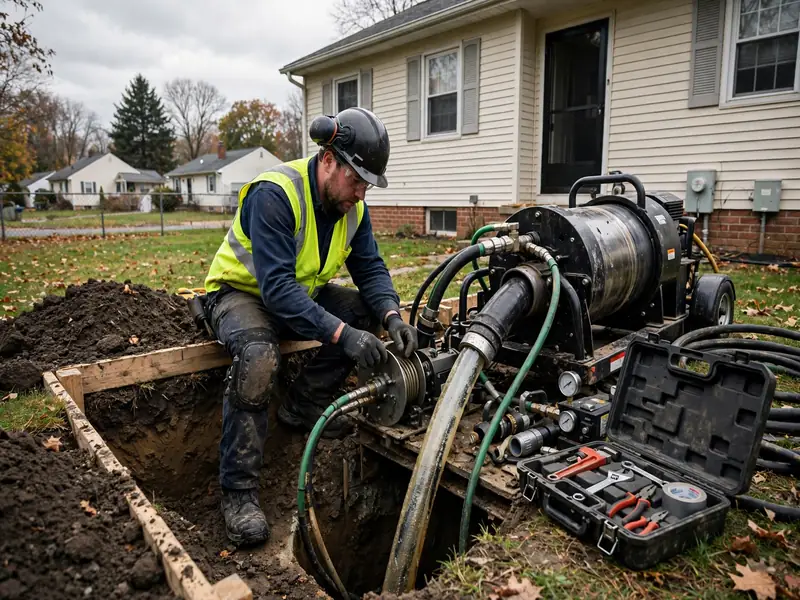
Carteret is a waterfront borough in the truest sense — bordered by the Arthur Kill to the east and the Rahway River to the north, with more than a tenth of its area covered by water. Much of its housing dates to the 1950s and 60s: Cape Cods, colonials, and older worker housing along the Washington Avenue and Roosevelt Avenue corridors, with newer apartment complexes added in the 2000s. The sewer laterals serving the older stock are clay tile of exactly the age that fails — joints loosened by decades of freeze-thaw, roots intruded, and in some tracts, pipe from an era with known material weaknesses.
What sets Carteret apart from inland suburbs is what surrounds those pipes. Low elevation, tidal influence from the Arthur Kill, and flood exposure along the waterfront mean laterals here do not just age — they sit in water. Groundwater infiltration through cracked joints is a constant pressure, and during nor'easters or tropical remnants, storm surge and heavy rain can surcharge the system from both directions.
Trenchless repair answers both halves of that problem. The no-dig installation avoids tearing up properties in a dense borough, and the finished product — a continuous, jointless, watertight pipe — is specifically the defense a waterfront lateral needs. There is also a quieter local factor: near the Arthur Kill waterfront and former industrial ground, excavation can run into remediated soils and deep legacy utilities, making minimal-dig methods the more predictable path.
Waterfront Ground: Why Carteret Laterals Need Watertight Pipe
A sewer lateral fails in two directions: sewage leaks out, and groundwater leaks in. In most suburbs the first direction dominates the conversation. In Carteret, the second direction matters just as much. The borough's eastern blocks sit near 13 feet of elevation beside a tidal strait, and the water table runs high year-round. Every open joint in a 1950s clay lateral is a place where groundwater enters the sewer.
Infiltration is not a minor nuisance. Water entering through joints carries fine soil with it, gradually washing out the bedding that supports the pipe and allowing sections to settle into bellies. During heavy rain, the infiltrating volume can overwhelm the lateral's capacity, and the line that normally drains away from the house starts pushing back toward it. Basements in the pre-1970 stock — and flooded crawlspaces in the lowest blocks — sit directly in harm's way.
Both trenchless methods produce a jointless pipe: bursting pulls a fused HDPE line with no seams, and lining cures a continuous resin tube inside the old pipe. Sealing every joint shuts the infiltration pathway. For a waterfront borough, that watertight quality is not a bonus feature — it is the core requirement the replacement has to meet.
Pipe Bursting Through Aging Clay — and Why Digging Is Harder Here
Carteret's 1950s and 60s laterals are textbook bursting candidates: clay tile with full-length joint failure, root intrusion, and in some cases pipe from an era known for deformation and delamination. The bursting process — launch pit at the house, receiving pit at the curb, a bursting head fracturing the old pipe outward while new HDPE follows — replaces the entire lateral in a day without exposing the run.
There is a Carteret-specific reason to prefer that minimal excavation beyond the obvious yard savings. The waterfront and former industrial areas carry a legacy of remediation zones, deep utility runs, and fill soils where open excavation gets complicated fast: dewatering a trench in a high water table, managing spoils, and working around undocumented legacy lines. Trenchless methods move a fraction of the earth and keep the work within the old pipe's established path.
None of this removes the need for careful utility locating — in fact it raises the stakes for it. Before any pull, the crew should verify exactly what shares the ground along the lateral's route, particularly on parcels near the Arthur Kill waterfront or the older industrial corridors. The old pipe's path is proven ground; staying in it is the safest line through complicated soil.
Cured-in-Place Lining for Lines That Are Cracked but Standing
Where the camera shows a lateral that is cracked and root-invaded but still structurally round, lining rehabilitates the pipe without any excavation at all. A resin-saturated liner is installed through a cleanout, inflated against the old pipe walls, and cured into a smooth, rigid, jointless new pipe inside the old one.
For Carteret homeowners, lining's appeal is twofold. First, the zero-dig installation: on tight borough lots where the lateral may pass under additions, sheds, or paved parking pads, avoiding excavation entirely removes a whole category of access problems. Second, the finished liner is watertight along its full length — directly addressing the infiltration pressure that waterfront ground puts on every joint of the old system.
The honest limits apply: lining follows the existing pipe's shape, so it cannot fix bellies or collapsed sections, and it trims a little internal diameter. In this borough's housing stock, the strongest lining candidates are the 1950s–60s clay laterals whose tiles are cracked at the joints but have not yet shifted or sagged. The camera footage makes that call unambiguous.
Storm Surge, Nor'easters, and Sewer Backups
Carteret's weather exposure is a sewer story as much as a weather story. Nor'easters and tropical remnants push tidal surge up the Arthur Kill while dumping heavy rain at the same time — water arriving from the river and from the sky simultaneously. The borough's older pipes, including laterals with combined-era connections in the oldest sections, can surcharge under that combined load.
A surcharged lateral behaves badly: flow reverses toward the house, basement drains become entry points, and the lowest fixtures in the home take the brunt. Homeowners in the low-lying eastern blocks know this pattern from experience. While no lateral replacement controls the municipal main or the tide, a sealed, jointless private lateral removes the homeowner's side of the vulnerability — groundwater cannot infiltrate a pipe with no joints, and a smooth, full-diameter HDPE line drains faster than a root-choked clay one.
There is a related step worth discussing with the technician: backwater protection on the building's lowest drains. In flood-exposed blocks, a properly specified valve or overhead arrangement on basement fixtures complements the new lateral. The pipe replacement fixes the line; the backwater device guards the entry points. Together they are the complete answer for surge-prone streets.
Reading the Signs: When a Carteret Lateral Is Failing
The symptoms of lateral failure are consistent, and Carteret's housing stock produces them on schedule. Drains that slow down throughout the house at once — not just one sink — point to the main lateral rather than a branch line. Gurgling from toilets or tub drains when another fixture runs suggests air trapped by a partial blockage. Sewage odors in the yard, especially near the lateral's path to the street, mean effluent is escaping through broken pipe. And backups that return within months of a cleaning mean the cleaning addressed the symptom while the pipe kept deteriorating.
One waterfront-specific sign deserves attention: backups or slow drainage that correlate with heavy rain or high tides rather than with household usage. That pattern points to infiltration and surcharging — groundwater and stormwater overwhelming the line — rather than a simple clog. It is also the pattern most responsive to a watertight trenchless replacement, since sealing the pipe removes the infiltration pathway entirely.
Do not wait for a catastrophic backup to act on these signs. A lateral that is seeping sewage into the surrounding soil is an environmental problem as well as a plumbing one, and in a borough bordered by two waterways, what leaves a broken lateral does not stay on the property.
Permits, the Curb Connection, and What the Job Includes
A lateral replacement in Carteret ends at the municipal main, and the work near the curb or street typically falls under borough right-of-way rules. Permits and inspection of the connection are standard, and they should be arranged before excavation begins — not discovered mid-job. Ask who handles the permit and confirm it in writing.
A complete trenchless job has a clear scope: initial camera inspection with footage you can keep, utility locating along the lateral's path, the burst or lining installation, a post-installation camera pass showing the finished pipe, backfill and compaction of the access pits, and surface restoration to rough grade. The connection at the main should be verified on camera as part of the final pass.
For properties near the waterfront or former industrial ground, add one more line to that scope: confirmation that excavated material from the pits is handled appropriately for the area's soil conditions. Trenchless keeps that volume small — two pits, not a trench — which is precisely why it is the lower-risk method on complicated ground.
Local Insight
Carteret changes the trenchless calculation in three ways that all trace back to water. First, the borough's Arthur Kill and Rahway River frontage, low elevation, and high water table make infiltration — groundwater entering through failed joints — as destructive as any root intrusion; the watertight, jointless result of bursting or lining is therefore a functional requirement here, not an upgrade. Second, the 1950s–60s housing stock sits in the clay era with possible weaker-era pipe in some tracts, so full-length joint failure is the norm and bursting is frequently the right method — while remediated waterfront soils and deep legacy utilities near the Kill make open excavation the riskier, less predictable option. Third, nor'easter storm surge plus heavy rain can surcharge the system from both directions, so the replacement should be paired with a conversation about backwater protection for basement fixtures in the lowest blocks. In Carteret, trenchless is not just about saving the yard — it is about sealing the house against the water that surrounds the borough.
Call Now
One call connects you with a local sewer professional serving Perth Amboy, NJ — day or night.
Call Now: (833) 713-2101Frequently Asked Questions
Does trenchless sewer repair hold up in a high water table?
Yes — it is arguably the ideal option for it. The finished pipe, whether fused HDPE from bursting or a cured liner, is jointless and watertight. That seals out the groundwater that was infiltrating through the old clay joints, which is exactly the failure mode waterfront ground creates.
My street floods during nor'easters. Will a new lateral stop basement backups?
A sealed lateral removes infiltration and gives wastewater a clear, full-diameter path out, which handles the most common backup mechanisms. For surge-driven events, pair the replacement with backwater protection on basement fixtures — the pipe fixes the line, the valve guards the entry points.
Is pipe bursting safe near old industrial ground by the waterfront?
Bursting stays within the old pipe's established path and moves minimal earth, which is an advantage where soils are complicated. Thorough utility locating beforehand is essential, and any pit spoils should be handled per local requirements for the area's soil conditions.
How can I tell if groundwater is getting into my sewer line?
Watch for drainage problems that track weather rather than usage — slow drains and backups that appear during or after heavy rain or high tides. A camera inspection during wet conditions can show active infiltration: water visibly entering through cracks and joints.
Will trenchless work damage my neighbor's property on a tight lot?
No. The work stays within your lateral's path between two small pits on your property and the curb connection. Bursting displaces soil only in the immediate envelope of the old pipe, and lining requires no excavation at all.
What happens to my old clay pipe during bursting?
The bursting head fractures the brittle clay outward into the surrounding soil as it passes, and the new HDPE pipe follows immediately into the space created. The fragments remain harmlessly in the ground around the new line — nothing needs to be hauled away.