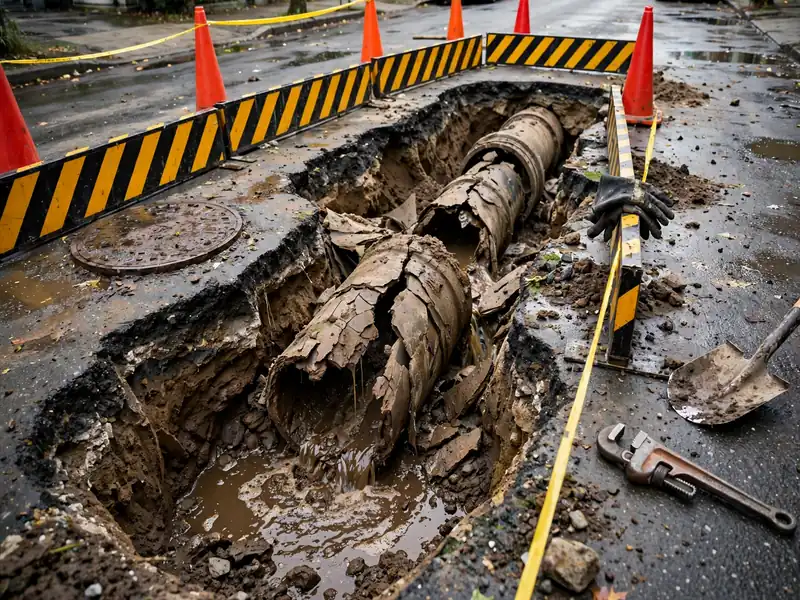
1. Drains That Slow Down Across the Whole House
One slow sink is usually a local clog — hair in a trap or grease in a single branch line. But when the kitchen sink, the upstairs shower, and the basement floor drain all slow down at the same time, the choke point is not in any one fixture. It is in the main lateral, the single pipe everything drains into.
A failing line narrows from the inside. Grease and soap residue coat the walls, mineral scale builds up on older cast iron, and tree roots push through loose clay joints. Each of these shrinks the usable diameter of the pipe. Water still gets through, but slowly, and the slowdown appears everywhere at once because every fixture shares the same exit.
This is the earliest and most ignored warning sign. Homeowners often live with it for months, adjusting to sluggish drains as the new normal. Do not. A whole-house slowdown means your lateral is losing capacity, and the next stage is usually standing water and backups.
2. Gurgling Sounds From Toilets and Drains
Gurgling is air moving where water should be. When a sewer line is partially blocked or has lost its proper slope, wastewater cannot flow smoothly to the street. Air trapped in the line gets pushed back up through your fixtures, producing the bubbling, burbling sound you hear in the toilet after a shower drains or in the kitchen sink when the dishwasher runs.
The sound tells you the pipe is struggling. A healthy lateral carries water and air together in a continuous, quiet flow. A failing one fights itself: water piles up behind a restriction, air pressure builds, and the pressure escapes through the path of least resistance — your drains.
Pay attention to which fixtures gurgle and when. A toilet that gurgles every time the washing machine drains points squarely at the main line rather than the toilet itself. Note the pattern, because a technician will use it to decide where to run the camera first.
3. Sewage Odors Inside or Outside the Home
Sewer gas smells like rotten eggs or raw sewage, and a working plumbing system keeps it sealed inside the pipes and vented out through the roof. When you smell it persistently — in the basement, near a floor drain, or outside along the path where your lateral runs to the street — the seal has been broken somewhere.
Inside the home, dried-out drain traps are the usual suspect in rarely used bathrooms. But a sewage smell that does not go away after running water through every fixture suggests a cracked pipe, a broken joint, or a vent line that has separated. Outside, the smell means raw wastewater is leaking into the surrounding soil, which also explains soggy, foul-smelling spots in the yard.
Odors deserve immediate attention. Beyond the unpleasantness, sewage carries bacteria and gases that do not belong in your living space. Persistent smells call for professional sewer leak detection to pinpoint the break without unnecessary digging.
4. Lush Green Patches or Soggy Spots in the Yard
A section of lawn that grows noticeably faster, greener, and taller than the rest is rarely a lawn-care victory. Wastewater is a fertilizer. When a sewer lateral cracks or a joint separates underground, the nutrient-rich water feeds the grass and plants directly above the break. That suspiciously thriving strip often traces the exact path of your sewer line.
Soggy or sunken spots tell the same story with more urgency. Wastewater pooling around the break saturates the soil, and the saturated ground settles, creating dips or depressions in the yard. In Perth Amboy's older neighborhoods, where clay-tile laterals run through heavy soil that drains slowly, these wet spots linger and expand.
Walk your yard after rain and compare. Normal yards drain evenly; a yard with a broken lateral stays wet in one specific line or zone. Mark the spot, because knowing where the surface shows damage helps the crew know where to look underground.
5. Backups in Low Fixtures: Tubs, Showers, and Floor Drains
When wastewater backs up into a basement floor drain, a first-floor shower, or a laundry tub, the blockage is almost always in the main lateral — and it is usually serious. Low fixtures are the first to fill because gravity sends backup water to the lowest open point in your system.
Early backups recede on their own once the fixture stops running. Many homeowners mistake this for a fix; it is not. The blockage is still there, partial and growing. The next time a load of laundry and a shower coincide, the same drain overflows again, a little worse than before.
Recurring backups in low fixtures are the sign most likely to precede a full sewage event. If you have cleaned the same floor drain more than once in a season, the problem is beyond snaking — it needs a camera look and often a repair to the line itself.
6. Foundation Cracks, Settlement, or Pest Activity
A leaking sewer line does more than smell bad — it erodes the soil it sits in. Water escaping from a cracked lateral washes fine soil particles away over time, creating voids beneath slabs, patios, and even foundation footings. When the soil support disappears, concrete settles and cracks.
Watch for new cracks in basement floors, a patio that has started to tilt, or a section of walkway that sinks slightly lower than the rest. These changes are slow, and they are easy to blame on normal aging. But when they appear alongside any of the other signs on this list, an underground leak is the likely connection.
Pest activity can be a secondary clue. Rats and insects travel through damaged sewer lines and enter homes through breaks in the pipe. A sudden rodent problem near basement drains or a rise in drain flies can indicate the line has opened up in ways you cannot see.
7. Your Neighbors Have Had Sewer Work Done
This sign is circumstantial, but in Perth Amboy it is surprisingly reliable. Entire blocks were built in the same era with the same pipe materials, laid in the same soil by the same builders. When several neighbors on your street have had their laterals repaired or replaced, your line is running on borrowed time.
Clay-tile laterals from the mid-20th century fail in predictable waves. Roots exploit the same mortar joints on every property; soil conditions stress every pipe on the block equally; and freeze-thaw cycles heave them in unison. Your neighbor's repair is a forecast, not a coincidence.
If work trucks have been digging on your street, treat it as your cue. A preventive camera inspection now is far less disruptive than an emergency repair later — and catching the problem early keeps trenchless sewer repair options on the table, since lining and bursting require a pipe that still holds its basic shape.
What to Do When You Spot These Signs
The single most useful step is a camera inspection. A technician feeds a waterproof camera through a cleanout or pulled toilet and watches the inside of your lateral in real time. Cracks, root masses, bellies, offsets, and collapses all show up clearly on video, and the footage gives you an exact diagnosis instead of a guess.
With a diagnosis in hand, the fix follows the condition of the pipe. Localized damage can often be spot-repaired. Widespread cracking with an intact pipe shape is a strong candidate for trenchless lining. A collapsed or fully separated line needs replacement, either by pipe bursting or traditional excavation.
Do not wait for the situation to declare itself through a backup. Every sign on this list is cheaper and simpler to address than the one that follows it. If your home is showing two or more of these symptoms, call and describe what you are seeing — a short conversation with someone who works on Perth Amboy sewer lines every day will tell you whether you need an inspection now or just a watchful eye.