The Coverage Most Homeowners Don't Know They Lack
The most important thing to understand is the default: a standard HO-3 homeowners policy excludes damage from water that backs up through sewers or drains. This exclusion surprises people because the policy covers so many other water events — burst supply pipes, for instance. But sewer backup is specifically carved out.
The water backup endorsement (sometimes called sewer backup coverage) reverses that exclusion up to a stated limit. Limits are typically modest compared to the dwelling coverage — enough to handle a basement backup's cleanup and damaged belongings, though not unlimited. For homes with older laterals in Perth Amboy, this endorsement is arguably the highest-value addition to the policy.
Check your coverage before you need it. Pull your declarations page or call your agent and ask directly: do I have water backup coverage, and what is the limit? If the answer is no, adding it is usually straightforward. Discovering the gap during a claim is the expensive way to learn.
What Insurers Look For: Cause and Maintenance
Insurers distinguish between sudden events and maintenance failures, and your documentation determines which category your claim falls into. A backup caused by a municipal surcharge during a storm, or by a line failure despite reasonable maintenance, is a much cleaner claim than a backup from a line you knew was failing and ignored.
This is where maintenance records become claim assets. Receipts for professional cleanings, camera inspection reports showing the line's condition, records of root treatments — these demonstrate that you maintained the system responsibly. Keep them with your house documents, not in a drawer you will never find during a crisis.
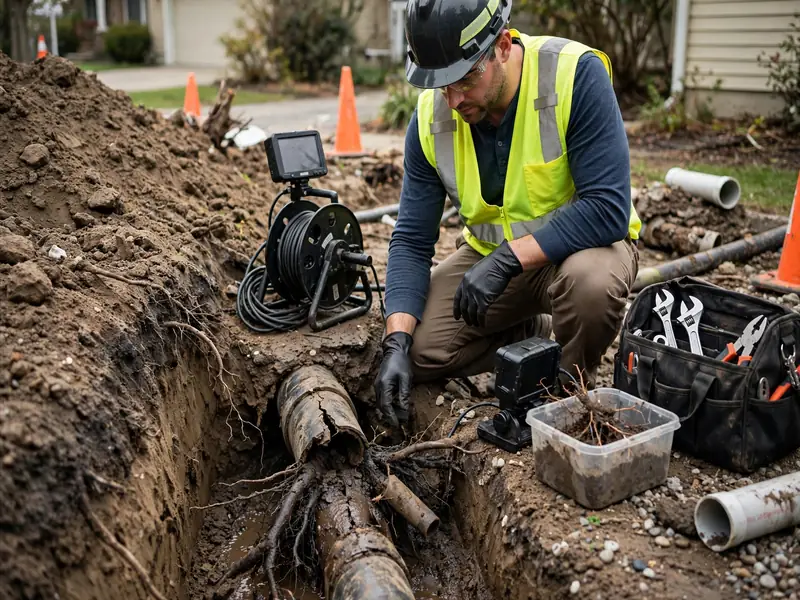
The adjuster will also want to establish the cause. A camera inspection after the backup (or the footage from a pre-existing inspection) showing a collapsed section, severe root intrusion, or a municipal-side issue helps the claim enormously. Cause documentation is what turns a disputed claim into a paid one.
The Claims Process Step by Step
When a backup happens, the sequence matters. First, stop using water and protect people — sewage is a health hazard. Second, document everything before cleanup begins: photos and video of the affected areas, the water level, damaged belongings, and any visible source. This documentation is the foundation of the claim.
Third, call your insurer's claims line promptly. Most policies require timely notice, and early reporting gets an adjuster assigned faster. Describe what happened factually — when you discovered it, what was affected, what you have done so far. Do not speculate about causes; that is what the investigation determines.
Fourth, mitigate further damage. Move undamaged belongings out, begin reasonable cleanup, and keep every receipt — emergency plumbing, water extraction, sanitizing, discarded items. Mitigation expenses are generally part of the claim, but only if documented. Then arrange the actual repair: the backup endorsement covers the resulting damage, and you will need a professional sewer repair to fix the underlying line problem so it does not happen again.
Mistakes That Get Claims Denied
The most common claim-killer is the maintenance exclusion: damage resulting from the homeowner's failure to maintain the system can be denied. This is not the insurer being difficult — it is the policy's plain language, and it is why the maintenance records discussed above matter so much.
Another pitfall is delayed reporting. Waiting days to call the insurer, or cleaning up completely before documenting anything, weakens the claim. The adjuster needs to see — or see photos of — what happened. A pristine basement and a verbal description are a hard sell.
Also understand the endorsement's limits before you assume full coverage. If your backup limit is modest and the damage is extensive, you will have out-of-pocket costs regardless. Some homeowners increase their backup limit after a first incident — a reasonable move for homes with aging laterals. And remember the distinction: the endorsement typically covers the damage the backup caused, not the cost of repairing or replacing the failed pipe itself. The line repair is generally on you; the ruined basement may be on them.