Backups That Keep Coming Back
The single most telling early sign of structural failure is backups that keep returning after cleaning. A root blockage that is cut out and stays clear for a year is a maintenance issue. A line that backs up again within weeks or months of a thorough cleaning is telling you the pipe itself is compromised — cleaning removes the symptom, but the broken pipe keeps catching debris.
The mechanism is straightforward: a cracked or partially collapsed section creates a jagged catch-point inside the pipe. Paper, wipes, and solids snag there and accumulate until flow stops. Cleaning clears the accumulation but not the catch-point, so the cycle repeats — each time a little faster as the damage worsens.
If you have had two or more professional cleanings in a year with diminishing results, stop treating it as a cleaning problem. It is a pipe problem, and it needs a camera diagnosis, not another cleaning. This pattern is the classic prelude to collapse.
Whole-House Drainage Changes
Pay attention to how your drains behave as a group. A single slow sink is a branch-line issue. But when toilets, showers, and sinks throughout the house all drain slowly — or when running the washing machine makes the shower drain gurgle — the problem is in the main lateral, and it may be structural.
What you are observing is the pipe's interior diameter shrinking. Scale buildup narrows cast iron gradually; a developing collapse narrows any pipe suddenly at one point. Either way, the whole house feels it because every fixture shares the same exit.
Gurgling is the sound of air being displaced by water struggling past an obstruction — it is the line telling you it is working too hard. Combined with whole-house slowness, gurgling points to a main-line restriction that cleaning may not resolve. A camera inspection at this stage shows whether you are dealing with buildup or with a pipe that is losing its shape.
What the Yard Tells You
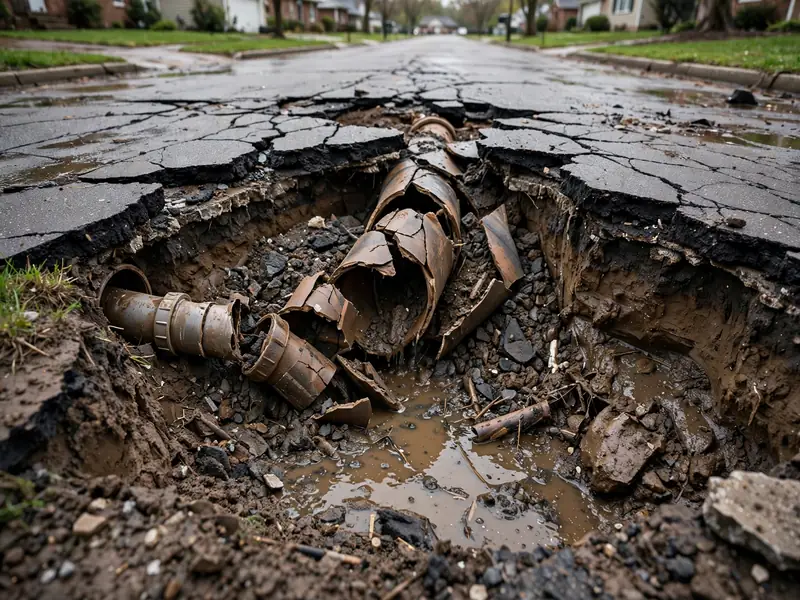
Some collapse warnings appear outside the house. A section of lawn that is persistently soggy, sunken, or strikingly greener than the surrounding grass — especially along the line's path from house to street — can indicate a break where wastewater is escaping into the soil. The nutrients in sewage fertilize grass dramatically; the escaping water softens and eventually undermines the ground above.
Sewage odors in the yard are another exterior sign. A healthy buried line is sealed; smells mean the seal is broken somewhere. In winter the odor may be fainter, in summer unmistakable — either way, a yard that smells like sewage has a line problem, not a landscaping problem.
Foundation cracks or settlement near where the lateral exits the house can also relate to line failure — escaping water erodes the soil supporting the foundation. This is the sign that turns a plumbing project into a structural concern, and it is worth taking seriously rather than attributing to normal settling.
From Warning Signs to a Repair Plan
When these signs point to structural failure, the camera inspection is not optional — it is the step that determines everything else. The footage shows the failure's nature and extent: a single cracked section, multiple offsets, a fully collapsed run, or a line that is ovaling along its whole length.
That diagnosis drives the repair choice. A localized collapse in an otherwise sound line may be a candidate for spot repair. Widespread failure usually means choosing between trenchless rehabilitation — pipe bursting for lines that have lost structural integrity, lining for lines that are damaged but still round — and full excavation and replacement.
The critical thing is timing. Every sign above is the line asking for attention while planned repair is still possible. Once the line fully collapses, the options narrow, the urgency spikes, and the sewage has nowhere to go but back into the house. If you recognize your home in these descriptions, the camera needs to go in now, not after the next backup.