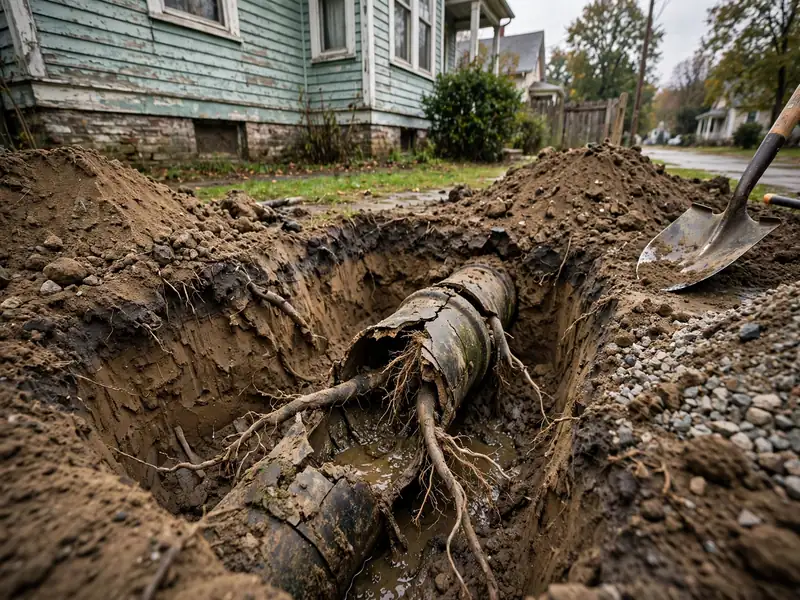
Clay Tile Laterals: Great Pipe, Failing Joints
Clay tile — vitrified clay pipe laid in short sections — was the standard residential sewer material from the 1920s through the 1960s. The pipe itself is remarkably durable; excavated clay tile can look nearly new after 80 years. The joints are the weakness. Each section was joined with mortar or simple bell-and-spigot connections, and over decades the mortar deteriorates, ground movement shifts the sections, and roots exploit every opening.
A clay-tile lateral in an older Perth Amboy home typically fails joint by joint. Roots enter at the weakest joints first, then at more of them as the years pass. Sections offset as soil settles unevenly. Eventually the line looks on camera like a string of separate pipes barely holding alignment, with root masses at every connection.
The irony is that the pipe material outlasts its connections. Clay tile does not corrode, but it cannot survive the failure of its joints. When the camera shows a clay line with root intrusion at most joints but no collapses, it is the textbook candidate for trenchless lining — which replaces all those failing joints with one seamless interior pipe.
Cast Iron: Corrosion From the Inside Out
Cast iron was the other standard, used especially for the interior portion of the drainage system and often for the lateral itself in mid-century homes. Unlike clay, cast iron fails from the inside out. Wastewater chemistry, hydrogen sulfide gas, and simple oxidation corrode the pipe walls, building up rough scale that narrows the interior and eventually perforating the wall entirely.
Scale is cast iron's signature problem. The rough, tuberculated interior catches everything flowing past — paper, grease, solids — accelerating blockages. A cast-iron line can lose half its effective diameter to scale while looking intact from the outside. Homeowners experience this as drains that slowly worsen over years, with snaking providing shorter and shorter relief.
Eventually the corrosion goes through the wall. Pinholes become cracks, cracks become missing sections, and soil enters the pipe while sewage exits it. A cast-iron lateral at this stage often shows channeling — the bottom of the pipe corroded away so wastewater flows through a soil trench rather than a pipe. Lining can still save cast iron with intact shape; once the bottom is gone, replacement is the answer.
Settlement, Bellies, and Separated Connections
Old neighborhoods settle — literally. Decades of traffic vibration, soil consolidation, and freeze-thaw heaving move the ground around buried pipes, and pipes move with it. Sections of lateral settle unevenly, creating bellies where wastewater ponds instead of flowing, and offsets where one section drops relative to the next.
Bellies are particularly insidious in old lines. The sagging section holds standing water and sediment permanently, and every flush adds a little more settled material. Over the years the belly deepens as the weight of the trapped water and the erosion around it compound the settlement. What the camera shows is a pipe that dips and rises like a roller coaster, with debris collecting at every low point.
Settling also stresses connections. The joint where the lateral meets the foundation wall is a classic failure point in older homes, as the house and the yard settle at different rates. The joint where the lateral meets the city tap can separate for the same reason. These connection failures are among the most disruptive because they sit at the two ends of the line, where repair access is hardest.
Outdated Connections and Improvised History
Older homes predate modern sewer codes, and their laterals often include features no one would install today. Some have no cleanout at all, making professional service difficult — the camera and cleaning equipment must go through a pulled toilet or a roof vent. Some connect to the municipal main with obsolete tap designs that are prone to root intrusion and separation.
Combined flows are another vintage feature. In some older setups, foundation drains or sump pumps tie into the sanitary lateral, sending groundwater into the sewer system. During heavy rain, this extra flow can overwhelm the lateral and contribute to backups. Modern codes separate these flows, but the old connections remain in homes that have never been updated.
Undersized or improvised repairs accumulate too. Decades of homeowners and handymen leave their mark: mismatched pipe materials joined with improvised couplings, buried cleanouts, abandoned sections. A camera inspection of an old lateral sometimes reads like an archaeological dig, with each era's repair methods visible in sequence. Sorting out this history is part of what the inspection is for.
Modern Fixes for Vintage Pipes
The good news is that old pipes are often excellent candidates for modern trenchless repair. Clay tile with joint failure but intact pipe shape is the ideal lining candidate — the liner eliminates every failing joint at once. Cast iron with scale and corrosion but no collapse can also be lined after descaling. Trenchless methods were practically designed for the failure modes of vintage pipe.
When trenchless does not fit — collapsed sections, severe bellies needing regrade, failed connections — modern replacement materials are a generational upgrade. PVC and HDPE laterals have watertight gasketed or fused joints, smooth interiors that resist buildup, and no mortar for roots to exploit. A replaced lateral in an older home is typically the last sewer project that property will ever need.
Do not forget the access improvements. Installing a proper exterior cleanout during any major sewer work pays dividends for decades — it makes every future inspection and cleaning simpler and cheaper. And separating any improper stormwater connections while the work is underway prevents rain-related backups. Old homes deserve modern sewer systems; the technology to give them one exists. See how the options apply locally in our guide to sewer line replacement in Woodbridge and nearby towns with the same vintage housing stock.