Sewer Line Replacement in Woodbridge, NJ 07095
Woodbridge Proper — downtown chartered 1669 — pairs pre-1940 buildings on 100+ year-old laterals with clay-rich mining soils that heave around old pipe. Full replacement means flexible jointless HDPE — usually trenchless bursting to keep Main Street open — bedded for expansive clay.
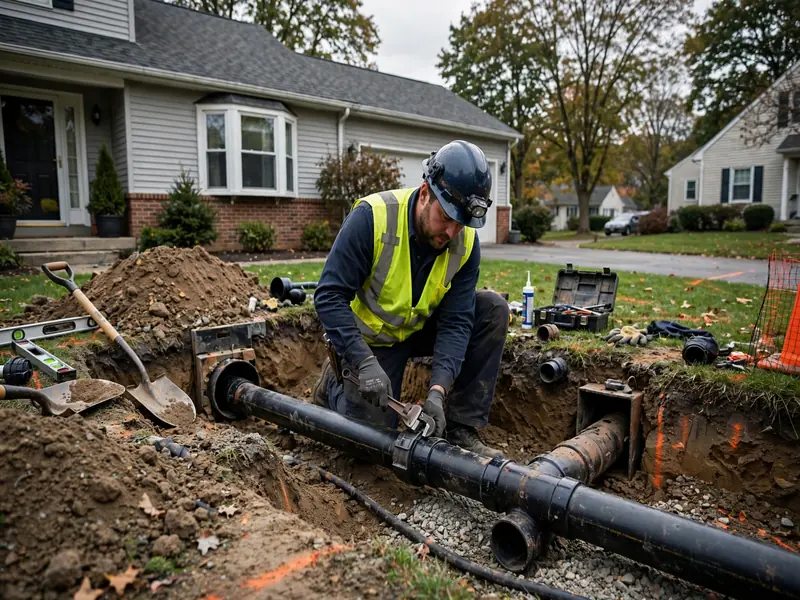
Woodbridge Proper is the original downtown of Woodbridge Township — the town chartered in 1669, the first incorporated township in New Jersey — and its Main Street district still reads like history: 2-3 story mixed-use buildings with ground-floor retail and upper-floor residential, the Barron Arts Center on Rahway Avenue (built 1877), the train station, and side streets of detached colonials, ranches, and Cape Cods. Under those buildings run some of the oldest laterals in the township: clay tile and cast iron, some 100+ years old.
And the ground itself is the story. Woodbridge was known for clay mining in the late 19th and early 20th centuries — the Woodbridge Center Mall opened in 1971 on a former clay pit — and the dense clay subsoils still grip and heave around every buried pipe. Freeze-thaw heave in that clay is what cracked the old tiles and offset the old joints. Our Woodbridge replacement service is specced for that soil: flexible jointless HDPE that rides out ground movement, proper stone bedding, compacted backfill — installed by trenchless bursting where the line qualifies so Main Street keeps doing business while we work.
Clay Soil, Clay Pipe: Engineering for Expansive Ground
Woodbridge's clay isn't just history — it's an active engineering factor. Dense clay subsoils grip buried pipe along its entire length, and when freeze-thaw cycles heave that clay, the ground moves the pipe with it. Rigid clay tile can't flex; its joints take the stress instead, loosening a fraction each winter until roots find the gaps and tiles crack under the accumulated movement. The town's old laterals didn't fail despite the clay soil — they failed because of it.
The replacement spec is written as the answer to that soil. Continuous HDPE pipe is flexible: it rides out ground movement and heave without cracking, where rigid tile would break. It's jointless along the run, so there are no seams for heaving soil to work open. And the installation details matter as much as the pipe — stone or sand bedding that drains instead of holding water against the line, and backfill compacted in lifts so the trench doesn't settle into a sunken strip across the property next spring.
The camera survey reads the soil's signature on the old pipe: offsets at the joints where heave worked them apart, cracks radiating from stress points, bellies where the bedding settled in the clay. That damage pattern confirms both the diagnosis and the spec — the new line has to be the kind of pipe that survives Woodbridge's ground, not just the kind that survives average ground. Flexible, jointless, properly bedded: that's the prescription the soil writes.
Main Street Access: Replacing Pipe Without Closing Shops
Main Street is a working commercial district — ground-floor retail with upper-floor residential, foot traffic, deliveries, storefronts that can't go dark for a week. A sewer replacement here is planned around the businesses, not through them. Trenchless pipe bursting is the method that makes that possible: two pits — one at the building, one at the curb — and the new HDPE line follows the old pipe's path underground, with no long open trench down the commercial block.
The staging is deliberate. Pits are positioned to keep entrances and sidewalks passable; barricades protect the work area without blocking the storefront; and the noisiest work is scheduled around business hours. Where the camera shows a section that truly needs open cut — a collapse, a severe belly, the city tap at the curb — that section is excavated, repaired, and restored promptly, with the sidewalk repoured to municipal standard.
For the mixed-use buildings themselves, the camera survey documents what each building sewer serves before any work is quoted. Shared lines between units or neighboring buildings get a coordinated replacement plan — one project, one mobilization, reconfigured to current standards with proper connections and cleanouts. The goal for every Main Street job is the same: a new watertight lateral with zero lost business days, which is entirely achievable when the project is planned around the street instead of through it.
Downtown's Oldest Laterals and the Project Closeout
Woodbridge Proper's pre-1940 buildings carry the township's oldest laterals — clay tile and cast iron, some 100+ years old, laid when the downtown was young. At that age the failure pattern is systemic: joints loosened by a century of clay-soil heave, roots at every seam, tiles cracked, cast-iron sections scaled shut. The camera footage on these lines confirms what the century predicts, and the answer is full replacement.
The postwar side streets — colonials, ranches, split-levels, Cape Cods — carry clay tile now 60-80 years old: the band where the camera does its most important work, deciding between spot repair and full replacement on the evidence. Isolated damage gets an honest repair recommendation; systemic damage gets a replacement. The footage keeps every quote honest across both eras.
Every replacement follows the same disciplined close: permits filed with Woodbridge Township, the new line inspected before backfill, trenches backfilled and compacted in lifts, disturbed ground restored — topsoil and seed or sod in yards, repoured concrete at sidewalks and curbs. A new exterior cleanout goes in at the building for future maintenance access. The finished lateral is watertight, root-proof, graded correctly, and bedded for Woodbridge's clay — the kind of underground infrastructure the downtown's next century can stand on.
Drainage Improvements With the New Line
Replacing the lateral is the right moment to fix the surface drainage that punished the old one. In Woodbridge's clay soils, water that ponds against the foundation or over the lateral's path saturates the ground the new pipe sits in — accelerating stress on even a flexible HDPE line. The project plan therefore looks upward as well as downward: where does roof water go, where does the yard drain, and where does it all end up?
Downspout extensions are the highest-value addition — simple, inexpensive, and transformative on clay ground that doesn't absorb water quickly. Routing roof water ten feet from the foundation instead of dumping it at the wall changes the moisture profile around the entire lateral. Where the yard grades toward the house, regrading the surface during restoration corrects it while the ground is already open.
These aren't extras for their own sake; they're protection for the investment. A new lateral in well-drained ground outlasts the same lateral in a swamp — the clay soil is a given, but the surface water is manageable. We flag the drainage issues we see during the project and fix what's practical while the equipment is there.
Your Project Documentation
When the backfill is compacted and the restoration is complete, you receive the project file — and on a replacement of this scale, that file matters. It contains the original camera footage showing the old line's condition, the footage of the finished installation, the as-built path of the new lateral with the cleanout location marked, the township inspection sign-off, and the permit records.
That documentation serves the property for decades. A future buyer sees proof of new underground infrastructure, not a claim. An insurer sees a permitted, inspected replacement. If a utility project ever digs near the lateral, the as-built path shows exactly where the line runs. And if any question ever arises about the installation, the footage answers it.
We also walk you through the practical contents: where the cleanout is and how to access it, what the backwater valve maintenance involves if one was installed, and what to watch for in the restored ground over the first season. The project ends with you knowing exactly what's under your yard — which, for most homeowners, is the first time that's ever been true.
Local Insight
Woodbridge Proper's replacement work is defined by its soil as much as its pipe age. The town's clay-mining history — late-19th/early-20th-century workings, the mall sitting on a former clay pit — left dense clay subsoils across the downtown, and those subsoils are active: they grip buried pipe and heave with freeze-thaw cycles, stressing joints and cracking tiles. That's the mechanism behind much of the old lateral failure here, and it's why the replacement spec leads with flexibility — jointless HDPE that moves with the ground instead of fighting it — plus stone bedding that drains and backfill compacted in lifts that won't settle.
The pipe stock matches the downtown's age: pre-1940 buildings on clay-tile and cast-iron laterals some 100+ years old (systemic failures, full replacements), postwar side-street homes on clay tile (the repair-versus-replace band), and mixed-use buildings with shared building sewers that need documenting before any work is scoped. The camera survey sorts every property before quoting.
Main Street access is the third fact: ground-floor retail that can't shut down for a week, tight downtown parcels, public sidewalk at the curb connection. Trenchless pipe bursting is the practical default — two pits, new line along the old path, shops open throughout — with open-cut sections limited to what the camera proves necessary and staged around business hours. A Woodbridge replacement is engineered for clay soil, historic buildings, and a working Main Street all at once.
Talk to a Specialist
One call connects you with a local sewer professional serving Perth Amboy, NJ — day or night.
Talk to a Specialist: (833) 713-2101Frequently Asked Questions
How do I know my Woodbridge lateral needs replacement instead of repair?
The camera footage: roots at most joints, cracked or offset tiles, heavy cast-iron scaling, or collapsed sections along the majority of the run. Pre-1940 downtown laterals at 100+ years are usually systemically failed; postwar side-street lines get the repair-versus-replace evaluation. We show you the footage before quoting.
How does the clay soil affect the replacement?
It's the defining soil factor here. Dense clay subsoils grip the pipe and heave with freeze-thaw cycles, stressing joints and cracking tiles — which is exactly how the old clay laterals failed. The replacement spec answers with flexible jointless HDPE that rides out soil movement, proper stone bedding that drains, and compacted backfill that won't settle.
Can you replace a lateral on Main Street without shutting down the shops?
Yes — that's what trenchless pipe bursting is for. Two pits, one at the building and one at the curb, and the new HDPE line follows the old pipe's path underground with no long trench through Main Street. Open-cut sections are limited to spots where the camera shows collapse or where the city tap needs direct work, staged around business hours.
My mixed-use building shares a sewer line. How is that handled?
The camera survey checks what each building sewer serves before any work is quoted. Shared lines need a coordinated replacement plan with the affected owners — scoped as one project in a single mobilization, reconfigured to current standards with proper connections and cleanouts.
Do I need permits for a Woodbridge replacement?
Yes — sewer lateral work in Woodbridge Township requires municipal permits and inspections, with the new line inspected before backfill. Main Street work also coordinates curb and sidewalk restoration to municipal spec. We handle the permits and inspections as part of the project.
Will replacement stop the recurring backups?
It should. A new watertight lateral with proper grade and sealed connections eliminates the root entry points and infiltration paths that caused the backups. If the building has foundation drains tied into the sewer, we evaluate that connection separately during the project — inflow through drains is a different issue from a failed lateral.