How Traditional Excavation Works
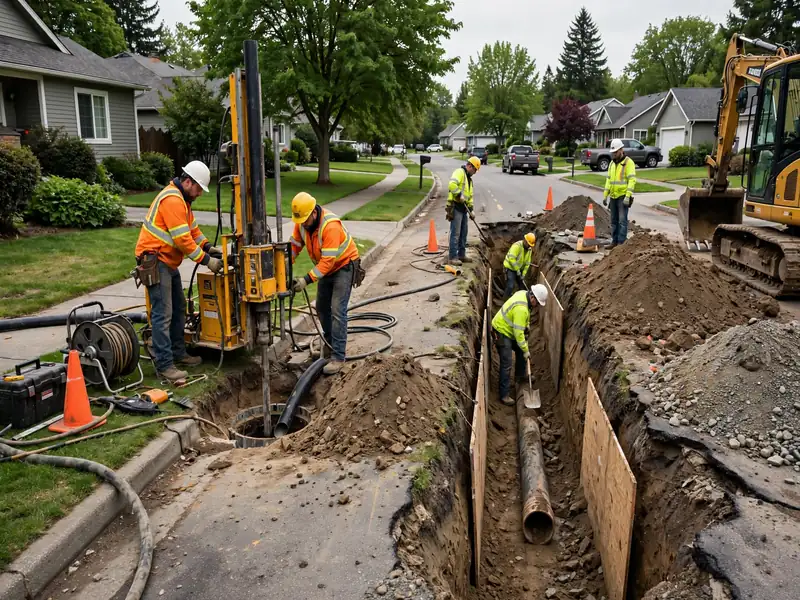
Traditional repair is the method everyone pictures: an excavator opens a trench from the house to the street, the old pipe comes out, new pipe goes in at the correct slope, the trench is backfilled and compacted, and the surface is restored. It is direct, thorough, and completely visible — the crew sees every inch of the line and the surrounding soil.
Its greatest strength is universality. A collapsed pipe, a severely offset joint, a line full of bellies, a bad connection at the city main — excavation handles all of it. There is no qualification test. Whatever condition the line is in, digging it up and replacing it works.
The cost of that universality is disruption. Everything above the pipe is affected: lawns, gardens, driveways, walkways, patios, and sometimes street pavement. Deep lines mean deep trenches with shoring. The project timeline includes not just the pipe work but full restoration afterward, and your yard looks like a construction site for the duration.
How Trenchless Methods Work
Trenchless repair comes in two main forms. Cured-in-place pipe lining inserts a resin-saturated liner into the existing pipe through an access point, then cures it into a rigid new pipe inside the old one. The host pipe stays in the ground and becomes a form for its own replacement. Only one or two small access points are needed.
Pipe bursting pulls a cone-shaped bursting head through the old line, fracturing the existing pipe outward while dragging a new pipe — typically seamless HDPE — into place behind it. Entry and exit pits are dug at each end, but the ground between them stays intact.
Both methods leave your landscaping, driveway, and hardscaping essentially undisturbed. Projects often finish faster because there is little excavation and almost no surface restoration. The tradeoff is qualification: the existing pipe must be a candidate. Lining needs a host pipe with enough structural integrity to support the liner; bursting needs a line the bursting head can travel through without encountering impassable bends or collapses. Our walkthrough of the pipe lining process shows exactly what lining requires step by step.
Disruption: The Deciding Factor for Many Homes
For most homeowners, disruption is where the comparison bites. Traditional excavation tears up the yard along the entire run. If your lateral passes under a new paver patio, a mature landscape, a concrete driveway, or an addition, open trenching means demolishing and rebuilding those features. Restoration is real construction work with real scope.
Trenchless methods sidestep almost all of that. A lining job might disturb a single patch of lawn at the access point. A bursting job needs two pits, but the 40 or 60 feet between them stay untouched. For properties with expensive hardscaping, limited access, or simply a yard the homeowner loves, this difference alone often settles the question.
But disruption cuts both ways. Excavation gives the crew full visual access to the line and the soil around it. They can correct grading problems, remove bellies, upgrade the connection at the foundation wall, and verify the tie-in to the city main directly. Trenchless methods work blind by comparison, guided by camera footage and measurements. When the underground picture is uncertain or complex, the visibility of excavation has genuine value.
When Traditional Excavation Is the Right Call
Some situations leave no real choice. A fully collapsed pipe cannot be lined — there is no open channel for the liner — and may not be burstable if the bursting head cannot pass. Severely separated joints, large voids around the pipe, and lines with multiple sharp bends or diameter changes often fall outside trenchless qualification.
Grade problems also point to excavation. A lateral with bellies — sagging sections that hold standing water — needs its slope corrected, and trenchless methods follow the existing path. If the pipe's alignment is the problem, only digging it up and re-laying it at the proper grade fixes the underlying issue.
Finally, excavation is the right call when you need certainty. If previous repairs failed, if the line's location is uncertain, or if the connection at the city main needs rebuilding, opening the ground removes all guesswork. It is the most disruptive option and the most definitive one.
When Trenchless Is the Right Call
Trenchless shines when the pipe is damaged but structurally viable: cracked clay tile with root intrusion, corroded cast iron with scale, leaking joints, and moderate offsets. These are the classic candidates for lining. When the pipe is too far gone for lining but still passable, bursting steps in as the trenchless replacement option.
Properties with high-value surfaces above the line are the natural trenchless customers. Driveways, patios, mature trees, retaining walls, and additions all argue against open trenching. So do tight urban lots where heavy excavation equipment cannot maneuver, and situations where the homeowner needs the project done quickly with minimal mess.
Seasonal timing can also favor trenchless. A lining or bursting project in the middle of winter avoids the worst of frozen-ground excavation, and in summer it sidesteps weeks of torn-up lawn during the months you actually use your yard. In Perth Amboy's older neighborhoods, where laterals run beneath decades-old landscaping, trenchless is often the first option worth evaluating.
Lifespan and Performance Compared
A common misconception is that trenchless repairs are somehow less durable than a brand-new excavated line. The materials tell a different story. Cured-in-place liners create a seamless, jointless pipe within the old one, with no joints for roots to exploit — often the very joints that failed in the original clay tile. HDPE pipe installed by bursting is similarly seamless and highly resistant to root intrusion and corrosion.
Traditional replacement with modern PVC or HDPE, properly bedded and graded, is equally durable. Both paths, done correctly, give you a line that should serve for decades. The durability difference between methods is far smaller than the durability difference between a good installation and a sloppy one.
What matters more than the method label is the quality of the execution: correct slope, solid bedding, proper connections, and verified tie-in at the main. A well-installed liner outlasts a poorly graded excavation every time. Choose the contractor as carefully as you choose the method.
How to Make the Decision
Start with the camera. No honest comparison is possible without seeing the inside of your pipe. The video shows cracks, offsets, bellies, collapses, root masses, and the condition of the connection — the evidence that determines which methods qualify.
Then weigh three things: qualification, disruption, and the property above the line. If only excavation qualifies, the decision is made. If both qualify, ask how much surface restoration each option requires on your specific property, and how the timelines compare. Get both options scoped in writing when both are viable — a contractor who only offers one method may not be giving you the full picture.
Finally, talk through the what-ifs. What happens if the liner encounters an obstruction? What if excavation reveals a worse connection at the main? The contractor's answers reveal how well they have thought through your specific job. For a closer look at one trenchless path, read our explainer on how pipe bursting replaces sewer lines.