Why a Leaking Lateral Smells: The Underground Chemistry
The most common cause is a cracked or separated lateral leaking wastewater into the soil. Clay-tile pipes with deteriorated joints, cast iron with corrosion holes, and any pipe damaged by ground movement all release sewage slowly into the surrounding earth. The waste itself mostly stays buried, but the gases — hydrogen sulfide, methane, ammonia — rise through the soil and reach the surface.
Heat amplifies everything. Bacterial decomposition speeds up in warm soil, producing more gas, and hot air holds and carries odor more effectively than cold air. That is why a leak that has been developing for months often becomes noticeable during the first real heat wave of summer. The leak is not new; your nose is just finally able to detect it.
Soil type matters too. Perth Amboy's heavier soils drain slowly and hold moisture, which keeps leaking sewage near the surface longer instead of percolating deep. Sandy, well-drained soil lets waste sink away faster, reducing surface odor. In clay-heavy yards, even a modest leak can produce a strong smell because the sewage has nowhere to go.
Other Causes: Vents, Traps, and Cleanouts
Broken vent stacks are the second most common cause. Your plumbing vents run up through the roof, carrying sewer gas safely above the house. If a vent pipe cracks, separates, or gets blocked — by a bird nest, ice, or debris — gas can escape at ground level or be forced out through drains and yard cleanouts.
Vent problems smell different from lateral leaks. A vent issue often produces odor near the house foundation or around a specific cleanout cap, and the smell may come and go with wind and fixture use. A lateral leak produces a broader, more consistent odor zone that tracks the pipe's path to the street.
Dry traps in outdoor fixtures are the simplest cause. Floor drains in garages, basement utility sinks that rarely run, and outdoor shower drains can all dry out, breaking the water seal that blocks sewer gas. Before assuming the worst, run water through every drain you can find, inside and out, and wait a day. If the smell persists, the problem is bigger than a dry trap.
Narrowing Down the Source Yourself
You can narrow the source before calling. Walk the yard on a hot, calm day and map where the smell is strongest — near the house, mid-yard, or by the street. The odor concentrates above the leak, and its position roughly indicates how far along the lateral the damage sits. Mark the spot.
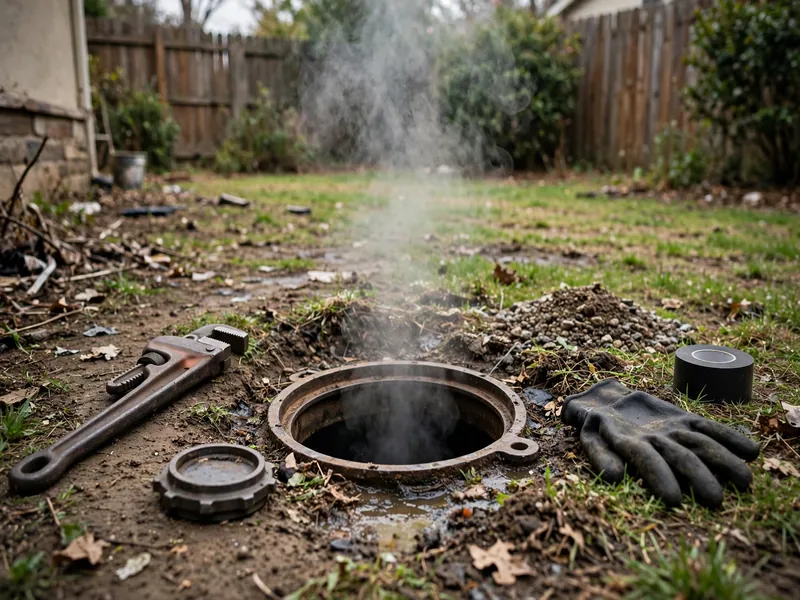
Check the cleanouts. A sewer cleanout is a capped pipe, usually near the foundation or along the lateral's path. Carefully remove the cap — standing water or sewage visible inside, or a strong smell blasting out, confirms the line has a problem. Do not leave the cap off; replace it immediately after checking.
Look at the grass. A leaking lateral fertilizes the soil above it, producing a strip of unusually green, fast-growing grass. Soggy spots that never quite dry, or slight depressions in the lawn, mark where sewage is saturating the ground. The combination of smell plus green strip plus sogginess is a near-certain diagnosis of a lateral leak.
Confirming the Break and Fixing It
Guessing the leak's location from the surface is useful, but the repair needs precision. A camera inspection shows the break from inside the pipe — the crack, the separated joint, the root mass — and a locator maps its exact position and depth on the surface. That precision determines whether the fix is a small spot repair or a longer section replacement.
The repair depends on what the camera finds. A single broken joint in an otherwise sound line is a candidate for a spot repair through a small excavation. Widespread cracking along a clay-tile run argues for trenchless lining, which seals the entire pipe with no joints for future leaks. A collapsed section needs replacement, either by bursting or open excavation.
Do not delay once the source is confirmed. A leaking lateral does not stabilize; it deteriorates. Escaping wastewater erodes the soil around the pipe, creating voids that let the pipe settle and crack further. What starts as one leaking joint becomes a sagging, multi-break failure. Early repair contains both the smell and the scope.
What to Do While You Wait for Repair
While waiting for the repair, there are sensible interim steps. Keep children and pets away from the smelly area — raw sewage carries bacteria and parasites. Avoid digging in the area yourself; you risk damaging the pipe further or contacting contaminated soil. Do not pour chemicals down drains hoping to fix an underground leak; nothing you pour reaches the break in useful concentration.
If the smell is severe and you have standing sewage on the surface, that is a health situation, not just a plumbing problem. Limit contact, keep the area clear, and get professional help promptly. Surface sewage can contaminate soil and, in heavy rain, wash into storm drains.
Long-term, the most effective prevention is the same maintenance that protects every lateral: periodic camera inspections to catch developing cracks, prompt repair of small defects before they become leaks, and awareness of what grows above the line. A lateral that is inspected and maintained does not surprise you with a summer of sewage smell. For ongoing protection, consider scheduled sewer maintenance in Perth Amboy that includes regular camera checks of your line's condition.