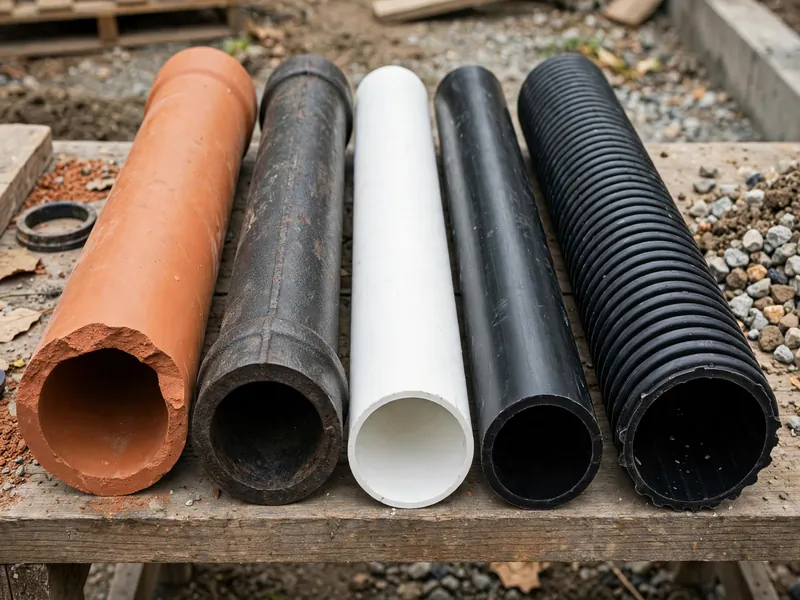
Clay Tile: The Pre-War Standard
Vitrified clay tile was the default sewer pipe from the early 1900s through the 1960s, which makes it the most common material in Perth Amboy's oldest neighborhoods. Clay itself is remarkably durable — the pipe walls can last a century. The weakness is the joints: clay tile comes in short sections, and every joint is a potential entry point.
Tree roots exploit those joints relentlessly. A clay lateral under a mature tree will have roots at joint after joint, and each intrusion widens the gap a little more. Ground movement shifts the short sections independently, creating offsets where waste catches. Over decades, the line becomes a chain of root masses and misaligned joints.
Clay lines respond well to regular root maintenance, and structurally sound clay is a candidate for trenchless pipe lining, which seals all those vulnerable joints from the inside in one pass. But clay that is extensively offset or collapsed has moved beyond what lining can fix.
Cast Iron: Strong but Corrodible
Cast-iron pipe served from roughly the 1930s through the 1970s, valued for its strength and quiet operation. Underground, cast iron's enemy is corrosion — from the outside in wet soils and from the inside via hydrogen sulfide gas produced by wastewater. Over decades, the pipe wall thins, scales, and eventually develops holes and cracks.
The characteristic failure of cast iron is internal scaling that progressively narrows the pipe. A four-inch line can scale down to an effective two inches, and the rough scale catches everything passing through. Homeowners notice this as drains that have gotten gradually slower over years — the frog-boiling version of sewer failure.
Descaling with hydro jetting can restore flow in cast iron that is still structurally sound, buying years of service. But once the wall is perforated or the bottom has rusted through — the classic cast-iron failure — replacement is the only durable answer.
Orangeburg: The Pipe to Replace on Sight
Orangeburg — bituminized fiber pipe, essentially tar-soaked paper — was used from the 1940s through the 1970s as a cheap alternative to clay and iron. It was a bad idea that lasted three decades. Orangeburg deforms under soil pressure, going oval and then collapsing, and it deteriorates from the inside out.
If a camera inspection reveals Orangeburg, the recommendation is straightforward: plan for sewer line replacement. There is no maintenance strategy that saves Orangeburg, no lining that reliably bonds to its failing structure. It is the one material where the question is not whether it will fail but when, and the answer is usually soon.
The silver lining is that Orangeburg replacement is well-trodden ground. Trenchless pipe bursting was practically made for this scenario — fragmenting the old fiber pipe while pulling a new line through the same path, with minimal digging.
PVC: The Modern Standard
PVC (and its cousin ABS) has been the standard for new sewer lines since the 1980s, and for good reason. It does not corrode, roots cannot penetrate its fused or gasketed joints easily, and its smooth interior resists the scaling and grease adhesion that plague older materials. A properly installed PVC lateral should serve for many decades with minimal attention.
PVC is not indestructible. Poor installation — inadequate bedding, improper slope, or damage during backfill — causes bellies and separations that plague the line from day one. And PVC can be damaged by heavy equipment driving over shallow sections. But these are installation failures, not material failures.
For homeowners with older materials, PVC is almost always what the replacement line will be. When comparing replacement quotes, the pipe material should be specified — a new PVC lateral with proper bedding and slope is a generational fix, and it is worth confirming those details rather than assuming them.
How to Find Out What You Have
The surest way to identify your pipe material is a camera inspection — the technician can usually tell clay, cast iron, Orangeburg, and PVC apart on sight, and will note transitions between materials. The home's age gives a strong hint but is not definitive, since partial replacements over the decades create mixed-material lines.
Municipal records sometimes help. Perth Amboy's building department may have permits on file for past sewer work, which can reveal when sections were replaced and with what. It is worth a call before you pay for investigation — though records for very old work are often incomplete.
Knowing your material changes the conversation. Clay with moderate roots? Maintain and monitor. Cast iron with heavy scale? Descale and watch. Orangeburg of any condition? Start planning replacement. PVC with a belly? Fix the installation defect. The material is the context that makes every other decision smarter.