What the Camera Actually Shows You
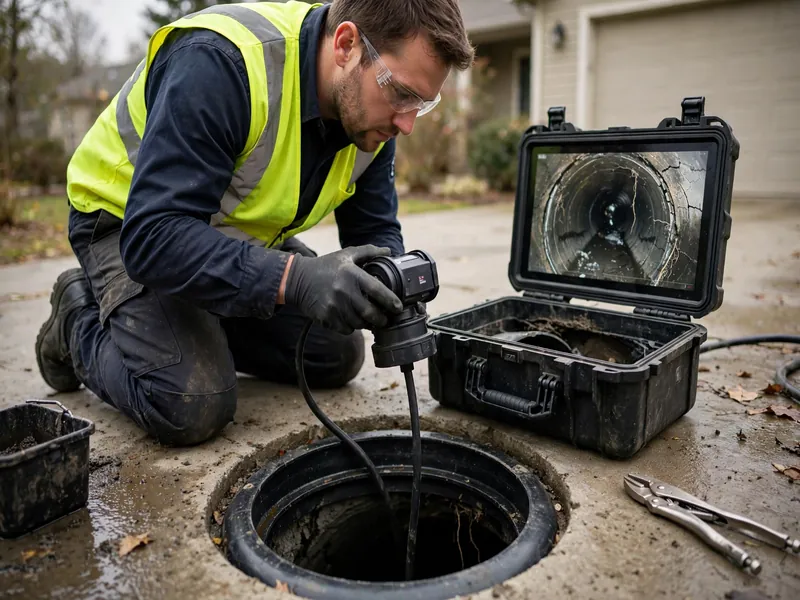
The camera reveals the pipe's interior in continuous video as it travels from the access point — usually a cleanout, a pulled toilet, or a roof vent — to the municipal main. You see the pipe material and its condition: intact clay tile with aging joints, cast iron with scale buildup, or PVC from a previous repair. Every defect appears in context, with its exact location measured in feet.
Technicians look for specific conditions. Cracks and fractures show as dark lines or displaced edges. Root intrusion appears as fibrous masses entering at joints. Bellies — sagging sections where the pipe loses slope — show standing water that the camera must push through. Offsets appear as steps where one pipe section has shifted relative to the next. Collapses are unmistakable: the camera cannot pass.
Just as important is what a clean inspection shows. A line with minor scale, sound joints, and proper slope is a line that needs maintenance, not repair. That negative result has real value — it tells you to stop worrying about replacement and focus on cleaning and prevention.
When It Is Clearly Worth It
Recurring drain problems are the clearest case. If you have snaked the same line twice in a year, if multiple fixtures slow down together, or if backups keep returning to the same low drain, you are treating symptoms without a diagnosis. The camera finds the cause — and the cause determines whether the next step is cleaning, lining, or replacement.
Before any major sewer work, an inspection is non-negotiable. No contractor should propose lining, bursting, or excavation without camera evidence of the pipe's condition. The method must match the defect: lining a collapsed pipe fails, and excavating a line that only needed cleaning wastes thousands. If a contractor quotes major work without scoping the line first, get a second opinion.
Home purchases are the other classic case. A sewer lateral is one of the most expensive hidden components of a house, and standard home inspections do not examine it. In Perth Amboy's older housing stock, a pre-purchase camera inspection can reveal a failing clay-tile lateral before you inherit it — giving you leverage to negotiate or walk away.
When You Can Reasonably Skip It
Not every drain issue needs a camera. A single slow bathroom sink with a pop-up stopper full of hair is a fixture problem, not a lateral problem. A garbage disposal that jams is a disposal problem. When the symptom is isolated to one fixture and the rest of the house drains normally, the main line is almost certainly fine.
Newer homes with documented recent sewer work are also lower priority. If your lateral was replaced or lined within the last decade and you have the paperwork, and your drains run well, there is little for a camera to discover.
That said, the threshold is low. If you are unsure whether a problem is local or systemic, the inspection is the fastest way to find out. An hour of video beats months of guessing — and guessing wrong about a sewer line is how small problems become emergencies.
What Happens During the Visit
The technician starts by locating an access point. An exterior cleanout — a capped pipe stub near the foundation — is ideal. Without one, the camera can go through a pulled toilet or, less commonly, a roof vent. If your home has no accessible entry, the technician may recommend installing a cleanout, which pays for itself in easier future service.
The camera, mounted on a flexible push rod, travels the length of the lateral while the technician watches the live feed and narrates what they see. A locator device above ground tracks the camera's position and depth, so every defect is mapped to a surface location. The whole process typically takes 30 to 60 minutes for a residential lateral.
You should watch the monitor and ask questions. A good technician explains what you are seeing in plain language — this is a crack, that is a root mass, here is where the pipe bellies. Ask for a copy of the video; it is your evidence for any future repair decision and useful documentation if you sell the home.
How the Footage Prevents Expensive Mistakes
The inspection's real value is in the decisions it improves. Consider the homeowner with recurring backups who assumes the line needs replacement. The camera might show a single offset joint 40 feet out — a spot repair, not a full replacement. Or it might show a line so deteriorated that repeated cleanings are throwing money away, making replacement the honest recommendation.
It also determines trenchless eligibility. Lining requires a host pipe with structural integrity; bursting requires a passable line. Only video can confirm either. Approving a trenchless repair without a qualifying inspection risks a failed installation — and a failed liner is far more expensive to fix than the original problem.
For real estate transactions, the footage functions as negotiation evidence. A video showing a collapsed lateral is concrete proof of a five-figure problem, which carries far more weight with sellers than a plumber's verbal opinion. Buyers in Perth Amboy's older neighborhoods should treat the inspection as standard due diligence, like the home inspection itself.
Making the Most of Your Inspection
Schedule strategically. If you suspect roots, late spring shows them at their most visible after the growth surge. If you are buying a home, inspect during the contingency period while you can still negotiate. If drains are slow now, do not wait for the seasonal pattern to confirm what the camera can show you today.
Prepare the property. Clear access to the cleanout, move vehicles from above the lateral's path, and make sure someone is home to watch the monitor and ask questions. Note your symptoms in advance — which fixtures, how often, what season — so the technician knows what to focus on.
Keep the video and the written report. File them with your home records. The next time a drain acts up, or the next time you consider selling, that footage is the baseline everything gets compared against. A documented healthy line is also a selling point; buyers pay attention to sewer evidence in older New Jersey homes. If the inspection reveals damage, our comparison of trenchless sewer repair in Sewaren and nearby areas shows what the repair paths look like once you have video in hand.