How Stormwater Overwhelms the Sanitary System
Sanitary sewers are designed for wastewater, not stormwater. But in practice, rain gets in. Cracked laterals, separated joints, and deteriorated manholes let groundwater and stormwater infiltrate the system — engineers call it inflow and infiltration, and older systems like Perth Amboy's have plenty of it. During a heavy storm, this extra water can multiply the flow in the sanitary system several times over.
When the municipal main cannot carry the combined flow, it surcharges — the pipe fills completely and pressurizes. At that point, water seeks any available relief, and the path of least resistance is often backward through private laterals into basements. Your home's lateral becomes an inlet instead of an outlet.
Your own lateral contributes to the problem too. A cracked or root-infiltrated line does not just leak sewage out — during storms, it lets groundwater in, adding your property's stormwater to a system that is already drowning. A sound lateral keeps stormwater out of the sanitary system; a failing one invites it in.
Backwater Valves: Your Main Line of Defense
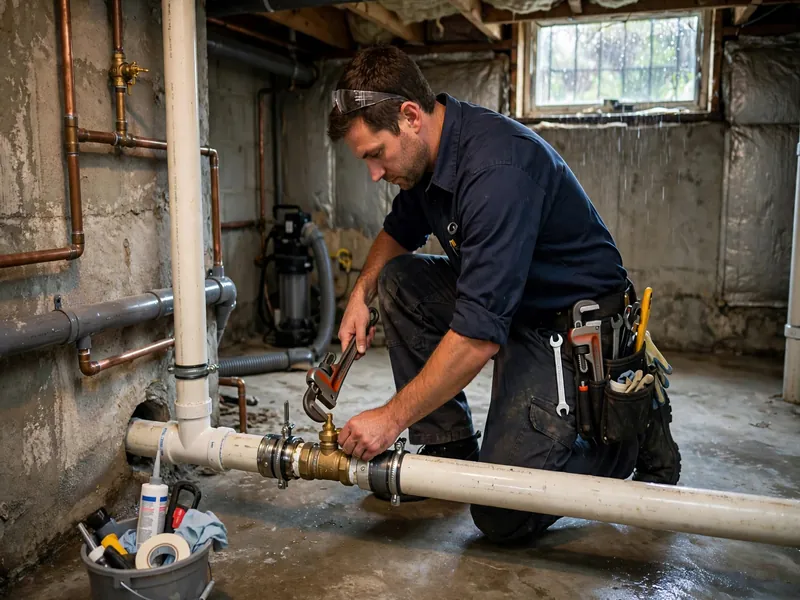
The most effective single defense against rain-driven backups is a backwater valve — a one-way valve installed on the lateral that lets wastewater flow out but slams shut when flow tries to reverse. When the municipal main surcharges, the valve closes and the storm stays in the street instead of entering your basement.
Backwater valves are not exotic technology; they are standard plumbing devices, and in flood-prone areas they are sometimes required by code for below-grade fixtures. Installation involves exposing the lateral — usually in the basement or just outside the foundation — and fitting the valve inline. It is a moderate project, far smaller than a line replacement.
Like any mechanical device, a backwater valve needs occasional attention: the flapper must move freely and the valve must be accessible for inspection. Debris can prevent full closure. But a maintained backwater valve is the difference between a street full of surcharging sewers and a dry basement. For homes with a history of storm backups, it is the first upgrade to consider.
Drainage Habits That Reduce Your Risk
Beyond the valve, reduce the stormwater reaching your system in the first place. Downspouts should discharge well away from the foundation — not into the ground near the lateral, and never tied into the sanitary line. Grading should slope away from the house so surface water runs off instead of pooling over the lateral's path.
Sump pumps deserve a specific warning: they must discharge to the yard or the storm system, never to the sanitary sewer. Pumping groundwater into the sanitary lateral during a storm is exactly the kind of inflow that overloads the system — your own pump contributing to your own backup risk, and a code violation in most municipalities.
Inside the house, know where your lowest drain is and keep the area around basement floor drains clear during storm season. If water does start coming up, you want to see it immediately, not discover it hours later behind stored boxes. Early detection limits damage even when prevention falls short.
Why Line Condition Is Storm Protection
Here is the connection most homeowners miss: the condition of your private lateral directly affects your storm vulnerability. A sound, sealed line keeps groundwater out and gives surcharge pressure nothing to exploit. A cracked, root-filled, offset line is a stormwater inlet that also happens to carry your sewage.
This is why a camera inspection is smart storm preparation, not just general maintenance. The camera reveals the cracks, separations, and root intrusions that become infiltration points during heavy rain. Fixing them — through lining, spot repair, or cleaning — is backup prevention in the most literal sense.
If your drains slow down during every heavy rain, that pattern is diagnostic: something in your line is interacting with stormwater. Do not dismiss it as normal. A professional line cleaning and inspection before storm season addresses the defects that storms exploit, and it is far cheaper than the cleanup after a backup. Rain will keep coming; the question is whether your line is ready for it.