Grease: The Restaurant Killer
Grease is the number one enemy of commercial sewer lines, and restaurants are ground zero. Even with a grease trap — which New Jersey food establishments are required to maintain — fats, oils, and grease escape into the building drain and the lateral. In a residential line, grease builds slowly. In a restaurant line, it accumulates at industrial speed.
Grease traps help but they are not a complete solution. Traps that are undersized, poorly maintained, or pumped on too long an interval let grease pass straight through. And grease does not only come from fryers — dishwashers emulsify fats and carry them past the trap, where they cool and solidify downstream in the lateral.
The fix is a combination of proper trap sizing and maintenance, staff training on what goes down drains, and scheduled line cleaning. A commercial sewer service that understands food-service waste streams can set a cleaning interval matched to the kitchen's actual output — not a generic schedule that lets grease win.
Volume Overload in Older Buildings
Many of Perth Amboy's commercial buildings predate modern plumbing codes. Their laterals were sized for the fixtures and occupancy of decades ago. When a building's use intensifies — a quiet office becomes a busy restaurant, a single storefront becomes three units — the sewer line does not get the memo.
The symptoms of an undersized or overtaxed line are distinctive: backups that happen during peak hours but not at quiet times, multiple fixtures backing up simultaneously, and problems that cleaning fixes only temporarily. If the line is simply too small for the load, no amount of cleaning changes the underlying math.
The answer in these cases is upsizing or sewer line replacement with a properly sized pipe. It is a bigger project than a cleaning, but for a business losing revenue to recurring backups, it is the only real fix. A camera inspection combined with a flow assessment tells you whether cleaning will do or the line itself is the problem.
Shared Lines and Neighbor Problems
Commercial properties often share sewer infrastructure — a strip mall on one lateral, a mixed-use building with residential tenants upstairs, neighboring buildings tied into the same connection. Shared lines mean shared problems: one tenant's grease or wipes become everyone's backup.
This creates both practical and legal complications. Whose responsibility is the blockage? Who pays for the cleaning? In multi-tenant buildings, the answer should be in the lease, but often it is not — which is discovered at the worst possible moment.
Property managers should know exactly where their building's line runs, where it connects, and who shares it. A baseline camera inspection documents the line's condition before problems start, which makes the responsibility conversation much easier later. Regular maintenance of shared lines, with costs allocated by agreement, beats emergency finger-pointing every time.
Health Codes and Compliance Pressure
For food service, healthcare, and childcare businesses, a sewer backup is not just unpleasant — it is a regulatory event. Health inspectors can and do shut down operations when sewage contamination is involved, and reopening requires documented remediation. Every hour closed is revenue lost plus the cost of the fix.
This compliance pressure is actually a strong argument for preventive maintenance. A documented schedule of inspections and cleanings demonstrates due diligence, and — more importantly — it prevents the backup that triggers the inspection in the first place. Some businesses learn this the expensive way: after one shutdown, a maintenance plan suddenly looks very reasonable.
Keep records of all sewer work. Dates of cleanings, camera footage, trap pumping receipts — this paper trail protects the business if questions arise and helps technicians diagnose recurring issues faster.
Planning Work Without Closing the Business
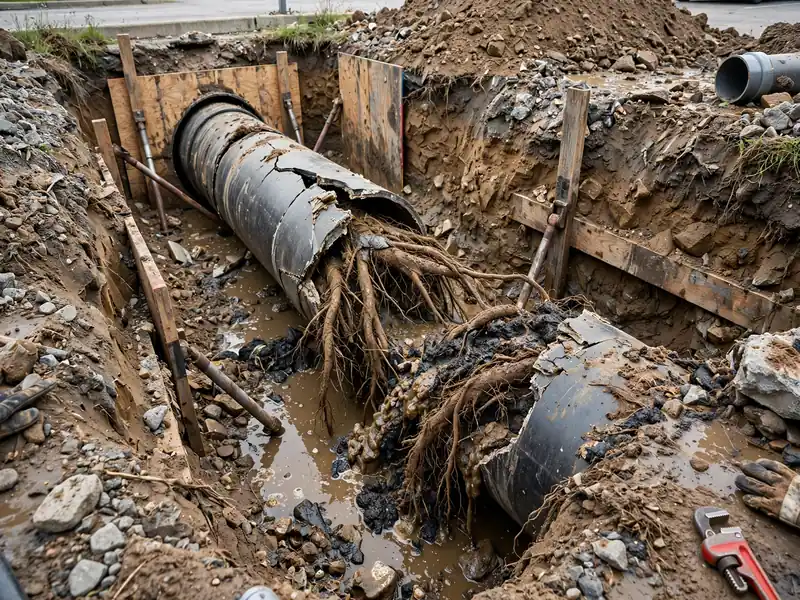
The biggest fear commercial owners have about sewer work is downtime. Nobody wants to close for a week while the parking lot is torn up. This is where modern methods earn their keep: trenchless options like pipe lining and pipe bursting can rehabilitate a line with minimal surface disruption, often in a fraction of the time of open-trench replacement.
Even when excavation is unavoidable, the work can usually be phased — nights, weekends, or section by section — to keep the business running. The key is planning the project before it becomes an emergency. Emergency work happens on the emergency's schedule; planned work happens on yours.
If your building's sewer line is showing its age — frequent clogs, slow drainage during busy periods, odors near floor drains — get it assessed now. A planned project during a slow season beats an emergency excavation during your busiest week. Businesses that plan sewer work like they plan every other capital expense stay open; businesses that ignore it eventually close, temporarily, on someone else's terms.