Trenchless Sewer Repair in Woodbridge, NJ — Old Town, New Pipe, No Trench
Trenchless sewer repair in Woodbridge, NJ renews downtown's aging clay laterals without tearing up Main Street. Pre-1940 buildings carry clay and cast-iron lines up to a century old, set in the town's clay-rich soils — old mining ground that grips and heaves around pipes. Pipe bursting and lining replace them through small pits or interior cleanouts, specified for soil movement.
Woodbridge Proper — the original downtown of Woodbridge Township, chartered in 1669 as New Jersey's first township — centers on a historic Main Street district of two-to-three-story mixed-use buildings with ground-floor retail and upper-floor residential, ringed by detached colonials, ranches, split-levels, and Cape Cods on the side streets. The sewer laterals beneath the pre-1940 downtown buildings are clay tile and cast iron up to a century old; the postwar side streets carry mid-century clay.
What makes Woodbridge geotechnically distinctive is its soil: the town is literally built on its old clay-mining ground — the Woodbridge Center Mall itself opened in 1971 on a former clay pit — and the dense clay subsoils are expansive, gripping pipes and heaving with moisture and freeze-thaw cycles. Old clay laterals in expansive clay soil face a double jeopardy: the pipe is brittle and jointed, and the ground around it moves.
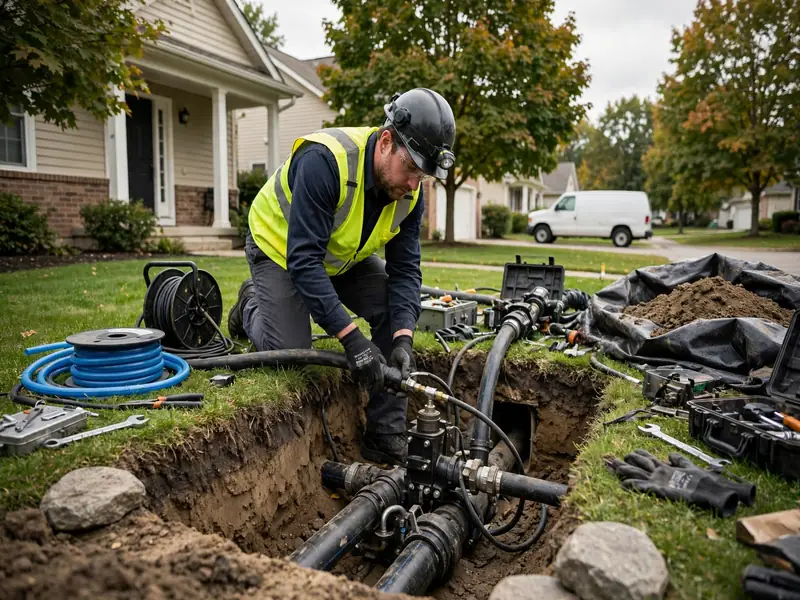
Trenchless renewal answers both. The no-dig installation avoids open excavation on a Main Street that cannot absorb it — no trench through the transit village, no torn-up sidewalks — and the replacement pipe, jointless HDPE or cured liner, is specified for soil movement: flexible where the old pipe was rigid, continuous where the old pipe was jointed. Old town, expansive ground, no trench — the method fits the place.
Clay Soil, Clay Pipe: Woodbridge's Double Jeopardy
Most towns have either difficult soil or aging pipe; Woodbridge Proper has both, and they interact. The dense clay subsoils — the legacy of the town's 19th and early-20th-century clay mining — are expansive: they swell when wet and shrink when dry, gripping buried pipe and working it with every moisture cycle. Freeze-thaw adds a second movement axis, heaving the ground each winter.
A jointed clay-tile lateral is the worst pipe for this ground. Every joint is a hinge where movement concentrates: the soil shifts, the rigid tiles cannot flex, and the joints open a little more each cycle. Roots exploit the openings; tiles displace; sections collapse. The expansive soil does not just surround the failure — it drives it, year after year, with mechanical patience.
The replacement must therefore be specified for movement, not just for age. Fused HDPE — the pipe installed by bursting — is flexible, bending with soil shifts instead of cracking at joints it does not have. Cured-in-place liner, set hard against the old pipe's interior, creates a continuous structural tube without seams. Both eliminate the hinges that expansive soil attacked. In Woodbridge, the material choice is geotechnical engineering, not just plumbing.
Main Street: Renewal Without Disrupting the District
Downtown Woodbridge's Main Street is a transit village — the train station, the Barron Arts Center in its 1877 National Register building on Rahway Avenue, ground-floor retail with residents above. An open-trench sewer replacement here would be a civic disruption: torn sidewalks, closed pedestrian paths, commercial entrances blocked, the station-area streetscape excavated. The district's economy cannot pause for a sewer trench.
Trenchless methods keep the district running. Lining through a basement cleanout — and the older mixed-use buildings commonly have cellars or basement retail space — renews the lateral with zero exterior excavation: no sidewalk opened, no curb lane closed, no storefront blocked. Bursting needs only two small pits, at the building and the curb, each restorable the same day.
For the mixed-use buildings themselves, the business-continuity math is compelling. A lining job scheduled during off-hours renews the building's sewer with fixtures offline for hours, not days; even bursting completes in a single working day. In a downtown where every storefront's week matters, the method that finishes in a day — invisibly, from inside the building — is the only one that respects the district.
Pre-1940 Downtown Laterals: A Century in Expansive Ground
The pre-1940 downtown buildings — the Main Street mixed-use blocks and the oldest side-street homes — carry laterals up to a century old: clay tile outside, cast iron at the building transitions, some possibly serving shared building sewers in the mixed-use properties. A century in expansive clay soil is about the hardest service a clay lateral can see.
The camera footage shows the compounded damage: joints opened along the full run by soil movement, root intrusion at every seam, tiles displaced where the ground heaved differentially, cast iron corroded at the transitions. This is comprehensive failure — the pipe needs whole-run renewal, and the renewal must be movement-tolerant.
Pipe bursting is the frequent answer: the bursting head fractures the failed clay while new fused HDPE follows — flexible, jointless, and specifically suited to ground that moves. Where the camera shows a line that still holds its shape, lining provides the continuous interior with minimal excavation. Either way, the specification names expansive-soil tolerance explicitly: the new pipe must outlast the ground's movement, not just the old pipe's age.
The Postwar Side Streets: Mid-Century Clay, Same Soil
Beyond Main Street, Woodbridge Proper's side streets — the Woodbridge Manor and Woodbridge Lawns subsections, the detached colonials, ranches, split-levels, and capes — carry mid-century clay laterals 55 to 80 years old in the same expansive clay subsoil. The failure pattern is the peak-clay signature accelerated by ground movement: full-length joint failure, root intrusion, and bellies where the heaving soil has let sections settle unevenly.
The trenchless playbook runs in standard form on these suburban lots: camera inspection establishing material, condition, and defect locations; bursting for structurally failed runs with jointless HDPE specified for soil movement; lining for cracked-but-standing pipe, often through a cleanout with minimal excavation. The lots offer room to stage and flexible pit placement — simpler logistics than Main Street, same geotechnical specification.
One side-street consideration: the expansive soil makes grade stability a long-term question, not just an installation detail. Bellies form where support is lost; proper bursting technique and, where pits are dug, proper backfill and compaction protect the new pipe's grade against the soil's movement. The camera's grade readings during inspection — and the final camera pass after installation — document that the line drains true. In expansive ground, grade is not a one-time achievement; it is the thing the installation must defend.
Mixed-Use Buildings: Shared Sewers, Coordinated Work
Main Street's mixed-use buildings — retail below, residential above — often share building sewers serving both uses, and that sharing shapes the sewer job. A failing building sewer affects the business's restrooms and the residents' fixtures simultaneously; the repair must be scheduled around both, with clear communication to tenants and the commercial operator.
Trenchless methods compress the coordination window. Lining through a cellar or basement cleanout can often be completed with the building's drainage offline for hours — scheduled overnight or during the retail space's closed hours. Bursting, at a single working day, is nearly as compact. Either beats the multi-day open excavation that would close restrooms, disrupt the business, and displace residents.
The scope for a mixed-use building should map every connection: which fixtures serve the retail space, which serve the residences, where the building sewer meets the municipal main. The camera survey covers the full shared line, and the written plan states the hour-by-hour fixture outage schedule. In a building where the sewer serves two economies — commercial below, domestic above — the repair is a logistics project that happens to involve pipe, and it should be planned like one.
What Expansive-Soil Installation Gets Right
Installing a trenchless replacement in Woodbridge's clay soils involves details that matter more here than in forgiving ground. For bursting: the new HDPE's flexibility is the primary defense — it rides soil movement that would crack rigid pipe — but the installation must also avoid creating new stress points, with smooth pit transitions and proper pipe handling during the pull. For lining: the cured tube's continuous structure resists the joint-opening forces the soil applies, but only if the cure is complete and uniform along the full run.
Backfill and bedding, where pits are dug, are structural decisions in expansive soil. Select material properly compacted around the new pipe gives it the consistent support that prevents differential settlement — the mechanism behind new bellies. The final camera pass should verify not just continuity but grade: the line draining true along its full length, with no ponding that the soil will exploit.
The long-term maintenance posture acknowledges the ground honestly: periodic camera checks every few years verify the line still holds grade as the soil moves through its cycles. A movement-tolerant pipe in expansive ground is the right installation; verifying it stays true is the right stewardship. In Woodbridge, the soil is a permanent condition — the sewer plan treats it as one.
Local Insight
Woodbridge Proper's trenchless requirements are geotechnical as much as they are plumbing, and the area card provides the geology. First, the soil: dense, expansive clay subsoils from the town's historic clay-mining ground — the old mining pits the township is literally built on — that grip buried pipe and heave with moisture and freeze-thaw cycles, mechanically working open every joint in a rigid clay lateral. The replacement must therefore be specified for movement: flexible jointless HDPE via bursting, or continuous cured liner — eliminating the hinges expansive soil attacks. Second, the downtown: pre-1940 Main Street mixed-use buildings on up-to-century-old clay and cast-iron laterals, some with shared building sewers, in a transit-village district where open excavation would be a civic disruption — making lining-through-cleanout or two-pit bursting a business-continuity measure. Third, the side streets: mid-century clay on the same expansive soil, following the peak-clay failure pattern accelerated by ground movement, with grade stability as the long-term watch item. Fourth, the installation details the soil demands: smooth pit transitions, select compacted backfill, and final camera verification of grade — not just continuity. In Woodbridge, trenchless is geotechnical engineering delivered without a trench.
Schedule Your Visit
One call connects you with a local sewer professional serving Perth Amboy, NJ — day or night.
Schedule Your Visit: (833) 713-2101Frequently Asked Questions
Why does Woodbridge's clay soil damage sewer pipes?
Expansive clay swells when wet and shrinks when dry, gripping buried pipe and working it with every moisture cycle — plus freeze-thaw heave each winter. Rigid jointed clay cannot flex, so the movement concentrates at the joints, opening them progressively. Flexible jointless replacement pipe rides the movement instead of fighting it.
Can sewer work be done on Main Street without disrupting businesses?
Yes with trenchless methods. Lining through a basement or cellar cleanout needs no exterior excavation at all and can be scheduled during off-hours; bursting is typically a single day with small pits. Confirm the hour-by-hour fixture schedule in the written plan.
My building has retail below and apartments above. How is the sewer handled?
The camera survey maps the full shared building sewer and every connection first. Then the work — usually lining or bursting — is scheduled around both uses, with the outage window communicated to tenants and the business operator in advance. One coordinated day beats a week of open excavation.
Will the new pipe stay straight in soil that keeps moving?
That is what the material specification addresses: flexible HDPE or continuous cured liner tolerates ground movement without joint failure. Proper installation — smooth transitions, select compacted backfill — and periodic camera checks verifying grade complete the defense. The soil moves; the pipe moves with it.
Is pipe bursting safe next to my 100-year-old foundation?
Bursting works along the old pipe's existing corridor and displaces soil only in the immediate envelope of the pipe — it does not excavate beside the foundation. The launch pit is small and shored. Confirm pit placement during the estimate; on historic buildings, the plan should explicitly address foundation proximity.
How often should I camera-check my lateral in expansive soil?
Every few years as preventive stewardship, plus after any symptom change. The checks verify the line still holds grade as the soil cycles — catching any developing belly early, while lining or adjustment is still simple. In expansive ground, grade verification is the long-term watch item.