Trenchless Sewer Repair in Harbortown, NJ — Modern Pipes, Targeted Fixes
Trenchless sewer repair in Harbortown, NJ looks different than in older neighborhoods: the 1999-era townhome community was built with PVC laterals that rarely need full replacement. Sewer work here centers on camera inspection, blockage clearing, joint settlement, and locating lines beneath slab foundations. When repair is needed, trenchless spot methods fix the defect without disturbing the community's manicured grounds.
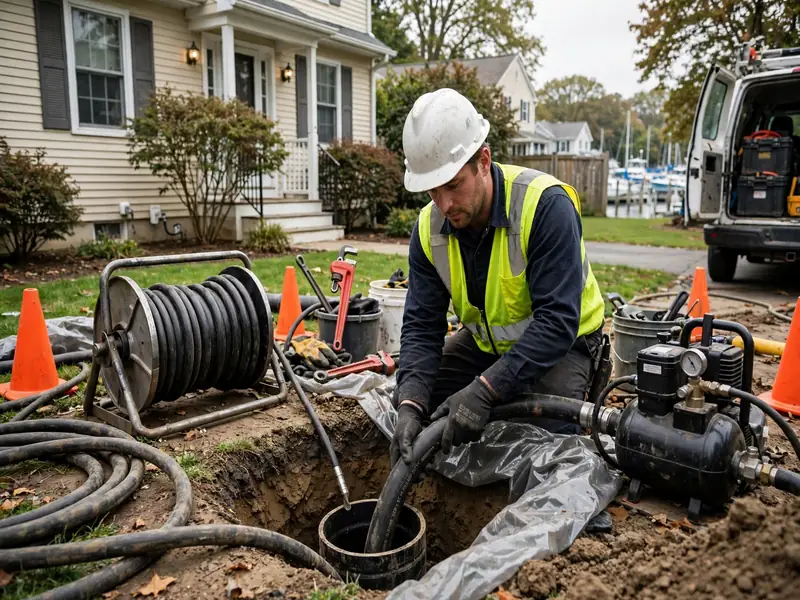
Harbortown is Perth Amboy's modern waterfront community — townhomes and condo buildings from around 1999 along Harbortown Boulevard, with slab-on-grade or garage-level foundations, two-car garages, and the kind of manicured common grounds that define planned developments. The sewer infrastructure matches the era: PVC and ABS drainage with PVC laterals, installed to modern standards less than thirty years ago.
That youth changes the entire sewer conversation. Where older neighborhoods battle century-old clay, Harbortown's pipes are barely into their service lives. The material itself — PVC — does not corrode, does not crack from age, and has fused or gasketed joints far more reliable than clay tile. Full lateral replacement, the headline trenchless job elsewhere, is rarely the answer here.
What Harbortown does need is precise diagnostics and targeted repair. Blockages from wipes, grease, or foreign objects. Joint settlement where waterfront fill soils have shifted. Root intrusion at the occasional compromised joint. And the particular challenge of slab foundations, where the building drain runs beneath concrete and locating the lateral's path requires skill. Trenchless methods serve all of these — but as precision tools, not as full replacements.
Why 1999 PVC Rarely Needs Replacing
PVC sewer pipe has an expected service life measured in many decades — the material does not rust, rot, or chemically degrade in normal soil conditions, and its joints are far more reliable than the mortar joints of clay tile. A Harbortown lateral installed in 1999 is, by pipe standards, young. Barring physical damage or severe settlement, the pipe itself should serve for generations.
This matters because it reframes what a sewer call means here. In a 1920s neighborhood, a backup often signals structural pipe failure. In Harbortown, a backup far more often signals a blockage — wipes, grease accumulation, or an object — in an otherwise sound pipe. The fix is clearing and verification, not replacement, and any recommendation for full replacement of 1999 PVC should be met with skepticism and a second camera opinion.
The honest scope of trenchless work in this community is therefore narrower and more precise: camera inspection to locate the real problem, mechanical or hydro-jet clearing of blockages, and trenchless spot repair — a short liner section — for the occasional defective joint. The big methods exist in the toolkit, but the pipe's youth means they stay in the case most of the time.
Camera Inspection: The Primary Service
In Harbortown, the camera inspection is not just the first step — it is often the whole job. A color camera through the lateral reveals blockages, joint conditions, settlement, and the pipe's path beneath the slab, answering the only question that matters: what is actually wrong. Most findings here are correctable without pipe replacement.
The inspection has a second function specific to slab-on-grade construction: mapping. With the building drain beneath concrete, knowing exactly where the lateral runs — its depth, its turns, where it exits the foundation — is essential for any future work and valuable for the homeowner's records. A camera with a locator sonde traces the line from above ground, marking its path without breaking concrete.
Ask for the recording and a written summary. In a community where units change hands regularly, a documented inspection showing a sound PVC lateral is a clean bill of health that simplifies future sales. And if the camera does find a genuine defect — a settled joint, a cracked section — the footage with distance markings is what scopes the targeted repair precisely.
Blockages: The Real Culprit in Modern Laterals
The most common sewer call in Harbortown is also the most mundane: a blockage. Modern PVC laterals clog for modern reasons — so-called flushable wipes that do not disintegrate, cooking grease poured down kitchen sinks, and the occasional foreign object. The pipe is fine; its contents are the problem.
Clearing is straightforward: mechanical augering for soft blockages, hydro-jetting for grease and scale buildup. Hydro-jetting deserves a note — high-pressure water scours the pipe interior back to clean PVC without chemicals or abrasion, and the camera verification afterward confirms the line is fully clear, not just punched through.
Prevention is where the lasting value lies, and it is entirely behavioral. Wipes go in the trash regardless of packaging claims. Grease goes in a container, not the drain. In townhome communities with shared building sewers, one unit's habits affect the neighbors — a point worth raising at community level, since a grease blockage in a shared line is a shared problem. The pipe will outlast everyone; the habits determine whether it does so quietly.
Settlement and Joint Issues in Waterfront Fill
Harbortown's one genuine pipe vulnerability comes from its ground, not its age. The community sits on redeveloped waterfront — fill soils at low elevation near the Arthur Kill and Raritan Bay, with a high water table. Fill settles differentially, and when the ground beneath a lateral settles unevenly, joints can offset or sections can belly.
The camera catches this as steps at joints or standing water in sagged sections — in a pipe whose material is otherwise perfect. The fix is targeted: a short cured-in-place sectional liner spanning the defective joint, installed trenchlessly through a cleanout, restores a smooth continuous interior across the offset without replacing the sound pipe on either side.
This is trenchless repair at its most surgical: a few feet of liner fixing a few feet of problem, with the 1999 PVC on both sides left in service. For isolated settlement defects, it is the proportionate answer — full replacement would be massive overkill, and open excavation in a manicured townhome community would be absurdly disruptive for a joint-scale problem.
Slab Foundations: Working With What's Under the Concrete
Slab-on-grade construction, typical for Harbortown's townhomes, puts the building drain beneath concrete — which changes how sewer work is approached. There is no crawlspace to enter, no basement cleanout to open; access comes through fixtures, exterior cleanouts, or, where necessary, carefully planned interior access.
For most Harbortown sewer issues, the slab is irrelevant — blockages clear through fixtures or exterior cleanouts, and camera inspections run the same way. The slab only matters if the defect is beneath it: a settled joint under the garage floor, for example. Even then, trenchless sectional lining can often rehabilitate the section through the pipe itself, avoiding concrete cutting entirely.
Where interior access cannot be avoided, it should be surgical: a located, minimal slab opening directly over the defect, not exploratory demolition. The camera-with-locator mapping done beforehand is what makes that precision possible. Any plan that starts with breaking concrete before locating the defect on camera has the sequence backward.
Storm Surge and the Waterfront Lateral
Harbortown's waterfront position brings one exposure that pipe youth does not prevent: storm surge. Nor'easters pushing water up the Arthur Kill and Raritan Bay can surcharge low-elevation sewer systems, and townhome communities with garage-level living space have fixtures close to the level where backups arrive.
The defense here is not pipe replacement — the PVC is sound — but system protection. Backwater valves on the building's lowest drains prevent surcharged flow from reversing into the home. Knowing the exterior cleanout location matters too: in a surcharge event, a cleanout with a relief cap can give rising flow a path outside rather than through the home's fixtures.
Community-level awareness helps as well. In a townhome development, the building sewers and their connections to the municipal system are shared infrastructure in practice if not in ownership. After major surge events, a community-wide camera survey of the shared lines is prudent — surge-borne debris and sediment can partially obstruct even sound pipe. Individual vigilance plus community maintenance keeps the modern system performing as designed.
Local Insight
Harbortown inverts the usual trenchless story, and the area card explains why. First, pipe age: the community's 1999-era PVC and ABS laterals are barely into their service lives — the material does not corrode or crack with age, so full replacement is almost never indicated and any such recommendation deserves a second opinion. Second, the real work: blockage clearing, camera inspection and mapping, and trenchless sectional spot-liners for the occasional settled joint — precision interventions rather than full-run renewal. Third, the ground: redeveloped waterfront fill soils at low elevation near the Arthur Kill, which can settle differentially and offset joints even in young pipe — the one structural vulnerability worth camera-monitoring. Fourth, the construction: slab-on-grade foundations that put drains beneath concrete, making camera-with-locator mapping the essential first step before any interior work. In Harbortown, trenchless is a diagnostic and spot-repair discipline, not a replacement program — and that restraint is exactly what the 1999 pipe calls for.
Call (833) 713-2101
One call connects you with a local sewer professional serving Perth Amboy, NJ — day or night.
Call (833) 713-2101: (833) 713-2101Frequently Asked Questions
My Harbortown townhome was built in 1999. Could my sewer lateral need replacement?
Very unlikely. PVC laterals from 1999 are young by pipe standards and do not deteriorate with age the way clay or cast iron do. Backups here are almost always blockages — wipes, grease, objects — in sound pipe. A camera inspection will confirm the pipe's condition directly.
What is a sectional liner, and when is it used?
A short cured-in-place liner spanning just the defective area — typically a settled or offset joint. It installs trenchlessly through a cleanout and restores a smooth interior across the defect, leaving the sound pipe on both sides untouched. It is the proportionate fix for isolated joint problems.
How do technicians find the sewer line under my slab foundation?
With a camera carrying a locator sonde: the camera travels inside the pipe while a receiver above ground traces its signal, marking the line's path, depth, and turns without breaking concrete. This mapping precedes any work beneath the slab.
Are 'flushable' wipes really a problem for my lateral?
Yes — they are the leading cause of blockages in modern PVC systems. They do not disintegrate like toilet paper; they snag, accumulate, and form masses. In townhome communities with shared building sewers, one household's wipes can block the neighbors too. They belong in the trash.
Should our townhome community inspect the shared sewer lines?
Periodically, yes — especially after major storm-surge events, which can drive sediment and debris into even sound pipe. A community camera survey of shared building sewers every few years catches settlement and partial obstructions before they become backups affecting multiple units.
What protects my garage-level fixtures during storm surge?
A backwater valve on the building's lowest drains prevents surcharged sewer flow from reversing into the home. Combined with knowing your exterior cleanout location, it is the practical defense for waterfront townhomes during nor'easters.