Trenchless Sewer Repair in Colonia, NJ — For Long Postwar Laterals
Trenchless sewer repair in Colonia, NJ addresses the area's problem: long clay laterals beneath deep postwar lots and mature oak root systems. Decades-old clay develops root intrusion at every joint and sags into bellies along its length. Pipe bursting replaces the run with jointless HDPE through small pits, while cured-in-place lining rehabilitates sound-but-leaking pipe — both without trenching the lawn.
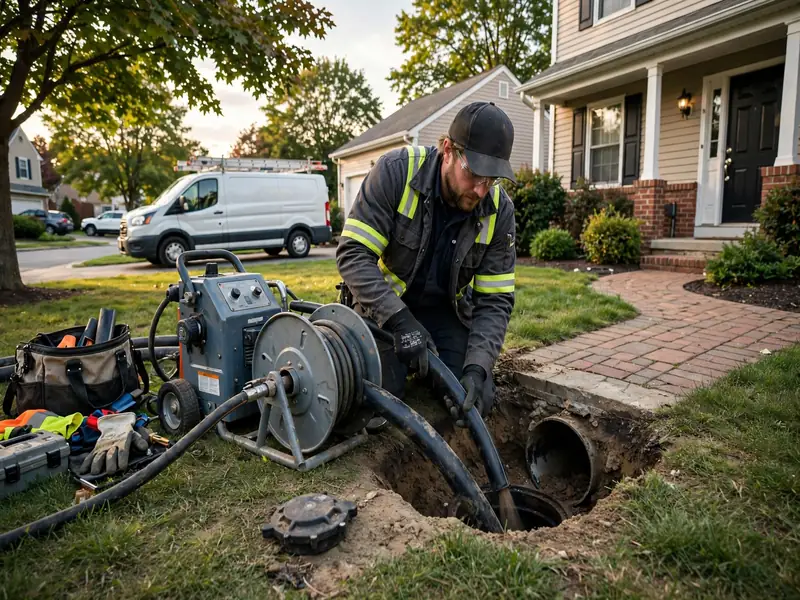
Colonia, the northernmost section of Woodbridge Township, is defined by its postwar housing: roughly seven in ten homes were built between the 1940s and 1960s, overwhelmingly owner-occupied single-family ranches, Cape Cods, and split-levels on generous lots. Many are still held by the generations that bought them new or inherited them — which means the sewer laterals beneath them are, in a great many cases, the original pipes installed when the subdivisions went in.
Those originals are clay tile, and they share two enemies that Colonia supplies in abundance: time and trees. Seventy years of freeze-thaw has worked the joints loose, and the mature oaks that make these streets so attractive have spent the same decades sending roots toward the moisture at every open joint. Because the lots are deep, the laterals are long — more pipe, more joints, more exposure.
Long laterals change the repair economics. An open trench across a deep Colonia lot means a long excavation through established lawn, possibly under a driveway extension or patio, with correspondingly long restoration. Trenchless methods scale far better with length: bursting pulls new pipe through the full run from two pits regardless of how long it is, and lining rehabilitates long runs in a single installation. For this neighborhood's housing, no-dig is not just less disruptive — it is the method that actually fits the geometry.
Long Lots, Long Laterals: Colonia's Core Sewer Challenge
A sewer lateral's failure risk scales with its length. Every joint is a potential failure point, and a lateral running a hundred feet or more beneath a deep Colonia lot has far more joints than a short city run. When that pipe is 1950s clay tile, the arithmetic is unforgiving: decades of joint separation, root entry at joint after joint, and mid-run bellies where the long pipe has settled unevenly.
Bellies deserve special attention on long runs. A belly is a section where the pipe has sagged below its design slope, so wastewater ponds instead of flowing. Solids settle out in the ponded section, the effective diameter shrinks, and the line that once drained a whole house starts backing up under normal use. On a long lateral, there can be more than one. The camera reveals them as stretches where it travels through standing water.
This length factor is also what makes trenchless so compelling here. Open-cut cost and disruption scale with trench length — every additional foot is more excavation, more spoils, more restoration. Trenchless cost scales far more gently: the burst or liner covers the full run from the same two access points whether the lateral is forty feet or a hundred and forty. For Colonia's deep lots, that scaling difference often decides the method on its own.
Mature Oaks vs. Clay Joints: The Root Equation
Colonia's established oak canopy is a defining neighborhood asset and the primary threat to its clay laterals. A mature oak's root system extends well beyond its drip line, and in dry periods roots actively forage for moisture — exactly what a leaking clay joint provides, twenty-four hours a day. The result, visible on camera after camera in this area, is root intrusion at joint after joint along the full lateral.
What makes oaks particularly destructive to old clay is persistence. Fine roots enter a hairline joint, thicken over seasons, and exert hydraulic-like pressure as they grow, gradually wedging joints further apart. A joint that started as a minor seep becomes a major offset. By the time drains back up, the structural damage is usually well advanced.
The trenchless answer removes the contest entirely. A jointless replacement — fused HDPE via bursting — presents no seams for roots to find, and the new pipe's path is the same established corridor the old line occupied, so no trench severs the root systems homeowners want to keep. Lining achieves the same joint elimination from the inside where the pipe's shape still allows it. Either way, the oaks stay, the lawn stays, and the sewer stops participating in the root system.
Bursting the Full Run: What a Long Pull Involves
Pipe bursting on a long Colonia lateral follows the same principles as a short one, with the pull simply covering more ground. After the camera maps the full run — length, depth profile, defect locations — pits go in at the foundation exit and at the curb. A cable threads the old line, the bursting head and new HDPE pipe attach, and hydraulic power draws the assembly through, fracturing the old clay outward while the new pipe takes its place.
Long pulls demand proper equipment sizing: the puller must handle the friction of a hundred-plus feet of pipe, and the HDPE must be fused into a single continuous length before the pull begins. An experienced crew stages this routinely. The new pipe's jointless construction is especially valuable on long runs — a hundred-foot clay lateral might have had thirty joints, each a former leak point; the replacement has none.
Grade control matters on long runs too. The bursting head follows the old pipe's path, which means it follows the old pipe's bellies as well. Where the camera showed significant sagging, the crew should discuss whether bursting alone suffices or whether the approach needs adjustment — in some cases a combination of bursting with localized grade correction at the pits. The camera footage, reviewed before work starts, is where that plan gets made.
Lining Long Runs: Rehabilitation Without Excavation
When a long clay lateral is cracked and leaking but still holding its shape and slope, cured-in-place lining can rehabilitate the entire run in one installation — often with no excavation at all, working through an existing cleanout. For Colonia's deep lots, the appeal is obvious: a hundred-plus feet of pipe renewed without disturbing a hundred-plus feet of lawn, plantings, and possibly hardscaping.
The process scales well. The liner is measured to the full lateral length, saturated with resin, installed by inversion or pull-in, and cured with hot water, steam, or UV. The result is a continuous structural pipe within the old one — smooth, jointless, and resistant to both root intrusion and the internal corrosion that roughens old clay and cast iron.
Length does impose one discipline: the liner must be continuous and properly cured along its entire run, which requires correct resin saturation and cure control from end to end. And the same shape limitation applies as anywhere — lining follows the old pipe, so bellies and collapses rule it out. On long Colonia laterals, the camera survey needs to be meticulous precisely because there is more pipe to evaluate; a single missed collapse mid-run can compromise the plan.
Generational Homes: Sewer Planning for Long-Held Properties
Colonia has an unusual ownership pattern: many postwar homes have been held by the same families for decades, passing between generations. That continuity is wonderful for the neighborhood and quietly hazardous for sewers, because a lateral that has never been inspected can deteriorate for thirty years without anyone knowing — until the backup that announces it.
For long-held homes, the smart move is a baseline camera inspection before there is a crisis. The footage establishes what the lateral is made of, how it has aged, and whether the right move is monitoring, lining, or full bursting. Catching a lateral at the 'cracked but sound' stage keeps lining on the table; waiting until collapse forces bursting or, worse, an emergency dig.
There is also a transfer consideration. When a generational home eventually sells, the buyer's inspection will flag sewer condition — it is one of the most common late-stage deal complications in older suburbs. A documented trenchless replacement or lining, with before-and-after video, converts that liability into a selling point. In a neighborhood where original-owner homes are the norm, proactive sewer work is simply part of responsible long-term ownership.
Spotting Failure Early on a Long Lateral
Long laterals give earlier warnings than short ones, if you know what to watch for. Because there is more pipe to fail, the first symptoms often appear as intermittent quirks: a basement floor drain that gurgles when the washing machine discharges, a tub that drains slowly only when another fixture is running, or a faint sewage odor near the cleanout after heavy use. These are the sounds of a line operating at reduced capacity.
The progression is familiar: intermittent symptoms become regular slow drainage, regular slow drainage becomes backups that follow root-cutting appointments, and eventually the line fails between cleanings. Each stage is more expensive and more disruptive than the last. A camera inspection at the intermittent stage is the cheapest diagnostic in the whole sequence.
Colonia homeowners should also watch the yard. Unexplained lush patches or persistent sogginess along the lateral's path to the street indicate effluent escaping through broken pipe — a failure that is already environmental, not just plumbing. On deep lots, that path may run far from the house, so walk the line occasionally. What you find determines whether you are scheduling maintenance or scheduling replacement.
Local Insight
Colonia's trenchless story is written by three facts from its area card. First, the housing: roughly 71% built in the 1940s–60s as postwar ranches, capes, and split-levels on deep lots, many still held by original generations — meaning original clay-tile laterals, 60 to 80 years old, with full-length joint deterioration. Second, the setting: generous lots under mature oak canopies, so laterals are long and root pressure is constant; every extra foot of clay is another joint for roots to invade and another foot of trench that trenchless avoids. Third, the ownership pattern: long-held homes that may never have had a camera inspection, making baseline diagnostics unusually valuable here — catching a lateral at the lining stage rather than the collapse stage. The method choice follows the footage: sound-but-leaking long runs are ideal single-shot lining candidates, while root-destroyed or bellied runs get full-length bursting with jointless HDPE. Either way, the deep lawn, the oaks, and the patio all stay exactly where they are.
Call (833) 713-2101
One call connects you with a local sewer professional serving Perth Amboy, NJ — day or night.
Call (833) 713-2101: (833) 713-2101Frequently Asked Questions
My lateral runs over 100 feet to the street. Does trenchless still work?
Yes — length is where trenchless shines. Bursting pulls new pipe through the full run from two pits regardless of length, and lining rehabilitates long runs in a single installation. Open-cut cost and disruption scale with trench length; trenchless scales far more gently.
Can lining fix the bellies in my long clay lateral?
No. Lining follows the existing pipe's shape, so a sagged section stays sagged. Bellies show on camera as stretches of standing water. Lines with significant bellies need bursting — possibly with grade attention at the pits — rather than lining.
Will pipe bursting damage my mature oak trees?
Bursting works underground along the old pipe's path with only two small pits, so it does not trench through root zones or compact soil the way open excavation does. Pits can be sited to avoid critical roots. The trees keep growing; the new jointless pipe simply gives roots nothing to invade.
How do I know if my long-held home's lateral was ever replaced?
Check for a cleanout near the foundation — its presence and material can hint at past work — but the reliable answer is a camera inspection. The video shows the pipe's material and condition directly. Many Colonia originals are still on their first lateral.
Is a camera inspection worth it if my drains seem fine?
On a 60-to-80-year-old clay lateral, yes. Deterioration is invisible until it is not, and catching the line at the cracked-but-sound stage keeps the less invasive lining option available. The inspection is inexpensive compared to any repair it might prevent.
My yard has a soggy strip toward the street. What does that mean?
A persistently soggy or unusually lush strip along the lateral's path usually means effluent is escaping through broken pipe underground. Walk the line from house to curb after dry weather — if the strip stays wet, schedule a camera inspection promptly.