Tree Root Removal for Sewer Lines in Harbortown, NJ
Even Harbortown's 1999-era PVC laterals can suffer root intrusion at joints or where settlement has opened a gap. Professional root removal uses a camera inspection to find the entry point, then clears the roots with mechanical cutters or hydro jetting. Call if your townhome's drains are slowing down.
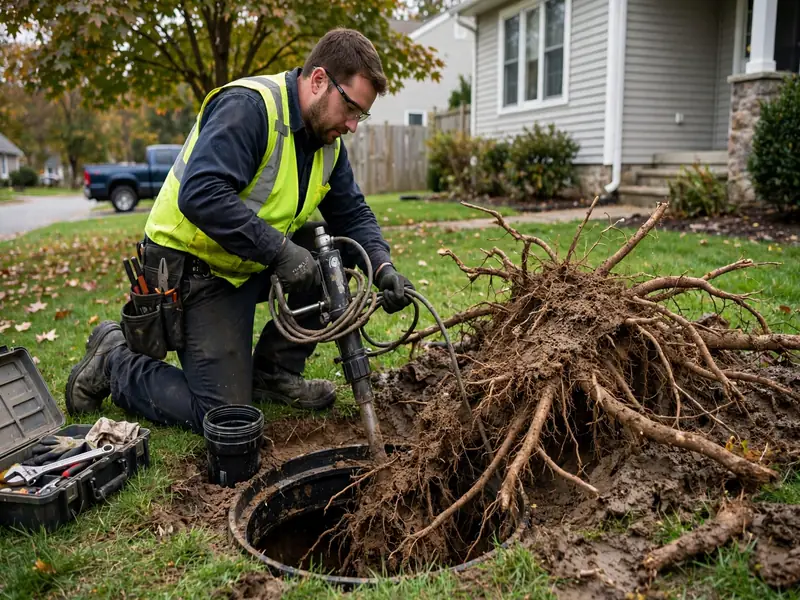
Harbortown is the exception in Perth Amboy's sewer landscape: a modern waterfront townhome community built around 1999, with PVC and ABS drainage and PVC laterals that are structurally sound. Root intrusion here is uncommon compared to the century-old clay lines elsewhere in the city, but it is not impossible. Roots can still exploit joints stressed by settlement or poor connections, so slowing drains in a Harbortown townhome still merit a camera inspection.
Root intrusion is one of the few sewer problems that literally grows back, which is why understanding the full cycle matters. Cutting removes the mass; the open joints and the living tree remain; regrowth begins. Managing that cycle intelligently is the difference between routine maintenance and repeated emergencies.
The professional process respects that cycle. It starts with a camera inspection that maps every intrusion, proceeds with thorough cutting rather than a quick punch-through, and ends with verification footage and an honest assessment of the pipe. Here is how each step works and what to expect.
How Tree Roots Get Into Sewer Lines
The biology is simple: roots grow where the resources are. A sewer lateral offers water, nitrogen, and phosphorus in abundance, all flowing past in a protected underground channel. Any root system within reach will eventually discover it if the pipe gives the roots a way in.
The way in is almost always deterioration rather than damage. Homeowners often assume roots broke their pipe, but in the vast majority of cases the pipe's joints were already failing. Clay tile joints lose their seal, cast iron hubs corrode, and small settlement cracks appear. Roots exploit these existing weaknesses and then make them worse as they thicken and wedge joints further apart.
This distinction matters for the fix. If the pipe is structurally sound apart from root entry at the joints, regular cutting can manage the problem for years. If the pipe is cracked, collapsed, or severely offset at the joints, cutting buys time but the line is telling you it needs replacement. A camera inspection is what separates those two situations.
Warning Signs of Roots in Your Sewer Line
Watch for patterns rather than single events. One slow drain is usually a local clog. Several slow drains at once, especially on the lowest level of the house, point to the main line, and roots are one of the most common causes of main-line restriction in older neighborhoods.
Recurring clogs are another hallmark. If the same line clogs every few months and a plunger or a small hand snake only provides temporary relief, something is growing back in the pipe. Roots do exactly that: cutting or punching through them restores flow briefly, then they regrow and the clog returns on a seasonal rhythm.
Outdoor signs can confirm the suspicion. An unusually lush, green patch of grass over the sewer line's path, or a spot that stays soggy when the rest of the yard is dry, can indicate a leaking joint feeding both the soil and the roots. A camera inspection connects these clues to the actual condition inside the pipe.
How Professionals Remove Tree Roots From Sewer Pipes
Modern root removal is a no-dig service in the great majority of cases. The equipment enters through existing access points, so there is no trench across the yard, no torn-up driveway, and no landscape restoration. For homeowners, that is one of the biggest advantages over the old approach of excavating to find the problem.
The camera does the diagnosing. It travels the full length of the lateral to the municipal connection, and the technician narrates what it sees: root tendrils at a joint, a dense mat filling half the pipe, a section where roots have wedged segments apart. Distance markers on the cable pinpoint each issue's location.
Cutting tools are matched to what the camera finds. Light, wispy intrusion might clear with a standard blade head. A dense, woody root ball calls for chain flails or hydro jetting. The goal is always the same: restore the pipe's full interior diameter and leave the walls as clean as possible, then verify with a final camera pass.
When Cutting Roots Is Enough — and When the Line Needs More
The decision framework is straightforward. First, is the pipe structurally sound? The camera answers this. Sound pipe with root entry means cutting and maintenance. Damaged pipe means planning for replacement.
Second, how extensive is the intrusion? Roots at one or two joints are easy to manage. Roots at every joint along the line suggest the pipe's seals have failed comprehensively, and while cutting still works, replacement deserves serious consideration.
Third, what is the trend? A line that needed its first clearing after twenty quiet years is different from one that needs clearing annually. Worsening frequency means worsening pipe condition. Replacement via trenchless pipe bursting installs a seamless new line with no joints to invade, which is the permanent end of the root cycle.
Keeping Roots Out of Your Sewer Line for Good
Every root strategy should be built on camera evidence. The footage shows how many joints are affected, how sound the pipe is, and how aggressive the regrowth is between visits. Those three facts determine whether maintenance or replacement is the right call, and no advice is credible without them.
For maintenance candidates, the plan is straightforward: thorough clearing with the right equipment, camera verification, and a sensible return interval. Professional root-control foam applied after clearing can extend that interval. The line stays functional and the homeowner stays ahead of the problem.
For replacement candidates, pipe bursting offers the permanent exit. A seamless HDPE lateral has no joints, so the mechanism of intrusion ceases to exist. It is a bigger project than a clearing, but it is a once-in-a-generation project, and it ends the cycle of cutting, regrowth, and worry for good.
What Happens During a Root Removal Visit
A root removal visit is a no-dig appointment in most cases. Everything happens through the cleanout or another existing access point, so there is no excavation, no torn-up landscaping, and no restoration work afterward. Most residential jobs are completed in a few hours.
The camera inspection leads. Before any cutting starts, the technician maps the lateral: root entry points by distance, the extent of each mass, and the pipe's structural condition. This survey determines the tooling and the approach, so the work is targeted rather than generic.
After clearing, verification matters as much as the cutting. The camera goes back through to confirm full-diameter flow and clean walls, and the technician documents the pipe's condition. That documentation is your basis for deciding between a maintenance schedule and a permanent replacement, and any reputable technician will share it openly.
Local Insight
Harbortown's root intrusion profile differs fundamentally from the rest of Perth Amboy because its pipe stock is fundamentally different. The community's townhouses were built in 1999, with 1,685 to 2,045 square foot units on slab or garage-level foundations, and their laterals are PVC, a jointless-over-long-runs material that roots cannot penetrate the way they do clay tile. Pipe material itself is sound here; failures tend to be joint issues, settlement, or blockages rather than corrosion.
That does not mean roots are impossible. Settlement in waterfront fill soils can stress PVC joints, and any gap that opens becomes a root entry like any other. The high water table at this low-elevation waterfront site keeps surrounding roots vigorous, and landscaping around the townhomes matures each year. But the baseline expectation is inverted from older neighborhoods: in Harbortown, roots are the unusual finding, not the default.
The practical implication is diagnostic discipline. When a Harbortown townhome's drains slow, the cause is more likely a blockage, a settled belly holding water, or a joint stressed by the fill soils than classic clay-tile root invasion. A camera inspection distinguishes these quickly, and when roots are found, they are typically limited to a specific compromised joint rather than systemic. Clearing is straightforward, and the fix targets the joint rather than the whole line.
Reach Out Today
One call connects you with a local sewer professional serving Perth Amboy, NJ — day or night.
Reach Out Today: (833) 713-2101Frequently Asked Questions
Can tree roots really get into my 1999 PVC sewer lateral?
It is uncommon but possible. PVC runs are jointless over long spans, but settlement in the waterfront fill soils can stress a joint or connection enough to open a gap, and roots will find any gap. The camera inspection shows exactly where the intrusion is. When roots appear in Harbortown laterals, they are usually limited to one compromised joint rather than systemic.
My townhome's drains are slow. Is it roots or something else?
In Harbortown, something else is statistically more likely: a blockage from debris, a belly where settlement has created a low spot, or a stressed joint. But only the camera distinguishes these. Do not assume roots just because drains are slow, and do not dismiss roots just because the pipe is PVC. The inspection gives you the actual answer in under an hour.
Does the high water table at the waterfront affect my sewer line?
It can contribute to settlement in fill soils, which stresses joints, and it keeps landscape roots vigorous. But a sound PVC lateral handles a high water table without issue. If the camera shows a joint opened by settlement with roots entering, the fix addresses that joint. The water table itself is a site condition to be aware of, not a defect.
How is root removal different in a townhome with slab foundation?
The clearing process is the same, camera through the cleanout, cut, verify, but access planning matters more with slab-on-grade construction and limited subfloor access. The technician will locate the right access point, often an exterior cleanout, and work from there. Interior disruption is minimal because everything happens through the access, not through the slab.
Should Harbortown homeowners worry about roots at all?
Less than owners of century-old clay lines, but awareness still pays. Landscaping matures, soils settle, and joints can be stressed over time. If you notice slow drains or gurgling, get a camera inspection rather than assuming the modern pipe is immune. Catching a single compromised joint early is a small job; ignoring it lets roots do what roots do.