Sewer Line Replacement in Keasbey, NJ
Keasbey splits between 1970s-90s apartments on PVC and 1960s capes on aging clay, all in Raritan River floodplain. Replacement starts with verifying the actual pipe by camera, then installs a watertight full lateral — bursting or dig — with industrial-adjacent ground verified first.
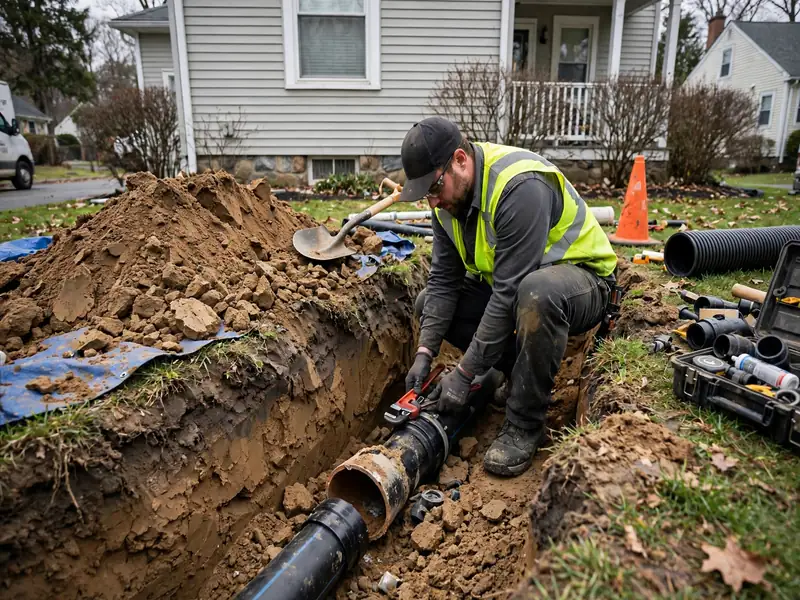
Keasbey is Woodbridge Township's southern riverfront community — about 3,000 residents on the Raritan River, with heavy industrial history stretching back to 1800s brick mining and manufacturing. That history gives the neighborhood a split personality underground: most of the residential stock is 1970s-90s apartments and small apartment buildings on PVC laterals, while scattered 1960s capes carry clay tile now 60+ years old. Same ZIP code, completely different sewer stories.
Add the geography — low-lying ground around 13 feet of elevation, nearly a fifth of the area covered by water, documented Raritan River flood exposure — and every Keasbey replacement has to account for floodwater infiltration as well as pipe age. Our Keasbey replacement service is built around verification: camera inspection to identify the actual pipe material and condition, utility verification near the industrial parcels, and then a full lateral replacement — trenchless bursting or open-cut dig — specced watertight for the floodplain. No assumptions, no era-guessing; the ground truth decides.
Two Pipes, One ZIP Code: Why the Camera Decides
In most neighborhoods, the housing era predicts the pipe. In Keasbey, it doesn't — or rather, it predicts two different pipes. The 1970s-90s apartment stock runs on PVC laterals that are typically in fine structural shape; their problems are isolated — a separated joint, a belly from settlement, a blockage — and the right answer is usually repair. The scattered 1960s capes run on clay tile now past sixty years old; their problems are systemic — roots at every joint, cracked tiles, infiltration — and the right answer is usually full replacement.
This is why the camera inspection isn't a formality here; it's the entire basis of the quote. The survey records the pipe material directly — long smooth PVC runs versus short jointed clay sections — and documents the failure pattern along the whole lateral. A sound PVC line with one bad joint gets a spot repair recommendation, honestly, even though a replacement would be a bigger job. A failing clay line gets a full replacement recommendation, with the footage to prove it.
Property owners should treat any Keasbey replacement quote that wasn't preceded by a camera survey as suspect. The neighborhood's split stock means era-based quoting is guessing, and guessing on a five-figure project is unacceptable. The footage takes twenty minutes and settles every question: what pipe, what condition, what fix. Everything downstream — method, permits, restoration — follows from what the camera shows.
Industrial-Adjacent Excavation: Verifying Before Digging
Keasbey's industrial history — brick mining and manufacturing since the 1800s, the Keasbey Brick Company, heavy industrial zoning along the river — means some parcels sit near deep legacy utilities, possibly combined lines, and soils that may carry contamination from a century of industry. Sewer work near that ground is planned differently from a standard residential replacement.
The pre-excavation survey gets extended: private utility locates beyond the standard one-call markings, review of the lateral's depth and surroundings against whatever records exist, and an excavation plan that accounts for fill soils, possible legacy lines, and soil handling requirements. Where the ground suggests remediated or fill soils, shoring and dewatering are planned from the start, not improvised mid-dig.
Method choice goes conservative near industrial parcels. Pipe bursting is efficient, but it runs blind — and blind is the wrong way to run past unknown legacy utilities. In these areas we favor open-cut sections with direct visibility, or we stage trenchless work only along verified-clear portions of the run. The extra planning costs time; striking an unknown line or mishandling suspect soils costs far more. For the purely residential streets away from the industrial ground, the standard playbook — camera, permits, bursting or dig — applies in full.
Building for the River: Watertight Laterals in the Floodplain
The Raritan River defines Keasbey's southern boundary, and the river defines its sewer risk. Low-lying ground at ~13 feet elevation with a high water table means laterals here don't just age — they flood. Every failed joint and crack in an old clay line is an entry point for river water and stormwater during flood events, and the line surcharges the house at exactly the moment the neighborhood is dealing with water everywhere else.
A Keasbey replacement is therefore specced watertight first and everything else second: continuous HDPE with no joints along the run, or gasketed PVC with sealed connections at the foundation and the city tap. The foundation penetration is grouted and waterproofed — it's a classic infiltration point and it gets treated as one. The finished lateral carries wastewater and nothing else.
The floodplain also shapes construction. Open excavations in high-water-table ground need dewatering pumps and shoring as standard equipment, planned before mobilization. Trenchless bursting sidesteps most of that — the tool works through wet ground along the existing grade — which is a practical advantage on riverside lots. Either way, the project is planned for the water that's actually in the ground, not the water in the textbook.
Apartment Buildings: Laterals Serving Multiple Units
Keasbey's 1970s-90s apartment stock means many laterals serve multiple units — larger-diameter lines carrying the wastewater of a whole building. Replacing a multi-unit lateral is a bigger project than a single-family line: more flow to handle during the changeover, more tenants affected by the work, and a building sewer that may connect to the city main differently than a residential lateral.
The camera survey for a multi-unit building maps the full system — which units feed which branches, where the lines combine, and the condition of the entire run. That map is the project scope: there's no point replacing the building sewer while a failing branch line upstream keeps backing up the ground floor.
Scheduling is coordinated with property management to minimize tenant impact. The changeover — the window when old connections are cut over to the new line — is planned as a single operation, usually during lower-use hours, so no unit is without drainage longer than necessary. Cleanouts are sized and placed for the building's maintenance needs, giving future service direct access without entering units. It's a bigger project, but the same discipline: camera first, plan second, one new system at the end.
Flood-Season Readiness for Riverside Homes
For Keasbey's riverside homeowners, the replacement project is also the right moment to think about flood-season readiness — because the new watertight lateral is only part of the defense. A backwater valve, installed on the lateral where it exits the building, is the single most effective addition: it lets wastewater flow out but slams shut when the city main surcharges backward, keeping river-driven sewage out of the basement.
The valve needs a compatible installation — which is exactly what a replacement project provides. Retrofitting a backwater valve into an old clay line is awkward; installing one as part of a new HDPE lateral is straightforward, with proper access for the periodic maintenance the valve requires. We discuss it with every floodplain-adjacent homeowner during the planning phase.
Beyond the valve, readiness is maintenance: cleanout caps sealed and at proper grade, the lateral's path marked for reference, and a post-storm camera check after any major flood event to confirm the system is intact. The new line is built for the river; the readiness plan keeps it that way season after season.
Local Insight
Keasbey's replacement work is verification work, because the area's facts refuse to generalize. The residential stock splits hard: roughly 75% of homes built 1970-1999 — mostly apartments and small apartment buildings on PVC laterals that are typically sound — against scattered 1960s capes on clay tile now 60+ years old and failing systemically. A replacement quote written from the neighborhood's age profile would be wrong half the time; the camera survey is what tells a sound 1970s PVC line (repair) from a failing 1960s clay line (replace).
The Raritan River is the second fact that shapes every job. Low-lying riverside land at ~13 feet elevation, nearly a fifth of the area under water, documented flood exposure — laterals here take on infiltration through every failed joint during flood events. That makes watertightness the non-negotiable spec: jointless HDPE or gasketed PVC with sealed connections, because a new line that admits river water hasn't fixed anything. High water table means dewatering and shoring are planned into every open excavation from the start.
Third is the industrial ground: brick manufacturing since the 1800s, heavy M-1/M-2 industrial zoning, deep legacy and possibly combined lines, and possible contaminated soils near the industrial parcels. Excavation near that ground gets private utility locates, careful review, and a conservative method choice — open-cut sections with eyes on the ground where bursting would run blind. Keasbey replacements are scoped per property, per pipe, per soil — because here, the lot next door can be a different project entirely.
Ask a Pro
One call connects you with a local sewer professional serving Perth Amboy, NJ — day or night.
Ask a Pro: (833) 713-2101Frequently Asked Questions
How do you know whether my Keasbey line needs replacement without guessing?
The camera inspection, every time. Keasbey's residential stock splits between 1970s-90s apartments on PVC and scattered 1960s capes on clay tile — and the two need completely different recommendations. The camera shows the material and condition directly, so the quote matches the actual pipe instead of the assumed era. Never accept a replacement quote here that wasn't preceded by a camera survey.
My building is from the 1970s. Could the line still be fine?
Sometimes — and that's exactly why the survey matters. A 1970s PVC lateral is usually sound and needs only repair for isolated defects. A 1960s clay lateral at 60+ years is often a systemic-failure replacement candidate. Same neighborhood, opposite answers; the camera is the only way to know which one applies to your property.
My property is near the industrial area. How do you dig safely there?
With extra verification: private utility locates beyond standard markings, review of the line's depth and surroundings, and an excavation plan that accounts for fill soils and possible legacy lines. Near complex industrial ground we favor open-cut sections with direct visibility, and we plan soil handling and shoring from the start rather than discovering conditions mid-dig.
Does the Raritan River flood risk change the replacement?
It changes the spec, not the possibility. Replacements in low-lying riverside ground must be watertight — jointless HDPE or gasketed PVC with sealed connections — because floodwater infiltration is the background condition here. Open excavations plan for dewatering and shoring from the start, given the high water table.
Do I need permits for a Keasbey replacement?
Yes — sewer lateral work in Woodbridge Township requires municipal excavation and plumbing permits, with inspections of the new line before backfill. Industrial-adjacent parcels may face additional review for excavation; we handle the permit process and coordinate it as part of the project.
Will a new lateral stop backups during river flooding?
It should, provided the replacement is specced for it: watertight pipe with no joints for floodwater to enter, sealed foundation penetration, and proper grade. A new lateral stops carrying river water the way the old failed line did — which is what ends the flood-season backups.