Sewer Line Replacement in Harbortown, NJ
Harbortown's 1999-built waterfront townhomes carry PVC laterals only about 25 years old — pipe that rarely needs full replacement. Most work here is camera diagnosis and targeted repair; full replacement happens only when the footage shows systemic failure along the run.
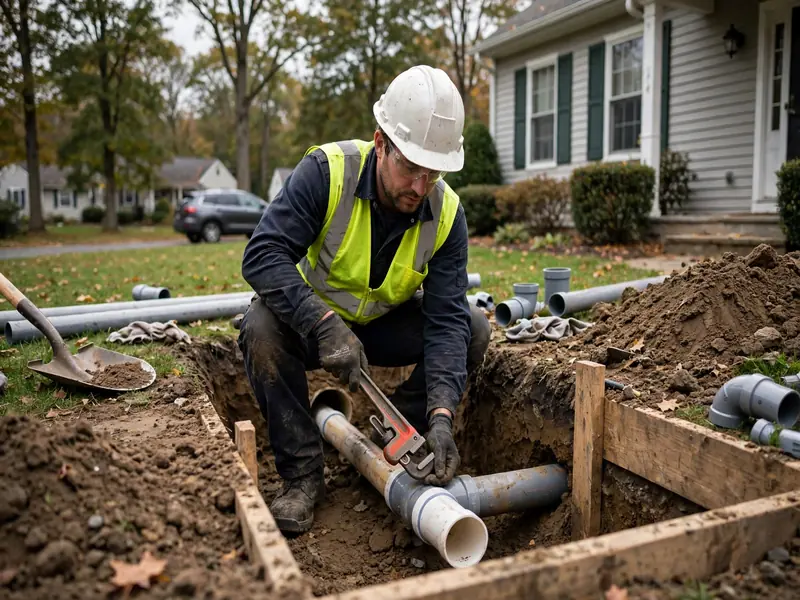
Harbortown is the outlier in the Perth Amboy service area: a modern waterfront townhome community on Harbortown Boulevard, with units built in 1999 and the community dating to roughly 1999-2007. These are 1,685-2,045 square foot townhouses with garages on slab or garage-level foundations — and their sewer laterals are late-1990s PVC, about 25 years old. That changes the entire conversation about replacement.
PVC doesn't corrode like cast iron, doesn't have joints every three feet like clay tile, and doesn't deform like Orangeburg. A 1999 lateral is barely into its service life. So when a Harbortown homeowner calls about a sewer problem, the honest starting position is repair, not replacement — and our service here is built around proving which one the line actually needs. We camera every lateral end to end, locate it electronically through the slab, and recommend replacement only when the footage shows systemic failure. Most of the time, it doesn't — and we'll tell you that straight.
1999 PVC: Why Replacement Is the Exception, Not the Rule
A 1999 PVC lateral is about 25 years old — roughly a quarter of its expected service life. The pipe doesn't corrode, doesn't scale shut, and doesn't have a joint every three feet inviting roots. So when a Harbortown homeowner experiences a backup, the cause is almost never 'the pipe is worn out.' It's something specific: a belly where fill soil settled under the line, a joint that separated as the ground moved, a blockage from grease or wipes, or roots that found one vulnerable joint near the waterfront landscaping.
Each of those has a targeted fix. A belly gets a sectional replacement on regraded bedding. A separated joint gets repaired or a short section replaced. A blockage gets cleared — and stays cleared, because the pipe itself is sound. Recommending a full lateral replacement for a 25-year-old PVC line with an isolated defect would be like replacing an engine for a flat tire, and we won't do it.
This is why the camera inspection is non-negotiable here. It distinguishes the smaller repair from the full replacement with footage you can see yourself — the belly holding water, the separated joint, the root mass at one seam. Most Harbortown inspections end with a repair recommendation and a line that works for decades more. The inspection protects you from paying for a replacement you don't need.
Working Through Slab Foundations: Locate First, Cut Once
Slab-on-grade and garage-level foundations — typical for Harbortown's townhomes — mean the sewer lateral runs under concrete, not through an accessible basement. Locating it requires indoor camera work: the camera goes in through an interior access point and its signal is traced electronically from above, marking the line's exact path through the slab. No guessing, no exploratory cutting.
When a section needs repair or replacement, access is surgical. The slab is cut precisely along the marked path — only where the work is needed — the pipe section is repaired or replaced, the bedding is corrected, and the concrete is restored. It's controlled, contained work, but it demands accurate locating first: a wrong cut in a slab is expensive and disruptive, so the mapping has to be right before the saw comes out.
For full lateral replacement — the rare case where the camera shows systemic failure — the project follows the same surgical logic at larger scale: the line's path is mapped end to end, sections are opened and replaced with proper bedding and grade, and every cut is restored. The waterfront fill soils get special attention in the bedding spec, since settlement in fill is what caused the original problem. A replacement that repeats the original bedding mistakes just schedules the next failure.
Waterfront Fill Soils: Speccing the Fix for the Ground
Harbortown sits on redeveloped waterfront ground at low elevation near the Arthur Kill and Raritan Bay — fill soils, not native ground, with a likely high water table. That geology is behind most of the community's sewer issues: fill settles unevenly, and a lateral bedded in settling fill develops bellies and separated joints that a line in stable native soil wouldn't.
Any replacement or sectional work here is specced against that geology. New pipe goes on proper bedding — compacted stone or sand that won't settle the way the original fill did — and the grade is verified end to end before backfill, because grade is what the original installation got wrong. Backfill is compacted in lifts so the ground above the line doesn't become the next settlement problem.
The high water table affects excavation planning: any open cut in low-lying waterfront ground needs dewatering and shoring, planned before the first shovel. In practice, most Harbortown work avoids open excavation entirely — trenchless sectional repairs and targeted digs keep the project small. But when a full replacement is warranted, the dewatering, bedding, and compaction specs are what make the new line outlast the old one, instead of repeating its mistakes in the same fill.
Townhome Laterals and Common Areas
In a townhome community like Harbortown, the sewer lateral doesn't always sit entirely on your lot — the run from the building to the city main may cross common areas, and the question of who owns and maintains each section matters before any work begins. The camera survey maps the full path, and we document which portions are the unit's responsibility versus the association's.
Where the work touches common ground, coordination with the HOA or property management comes first: access permissions, restoration standards for common-area landscaping, and scheduling that respects the community. The work itself is the same surgical process — locate precisely, open only what's needed, restore completely — but the paperwork runs through the association.
For unit owners, the practical advice is to get the camera inspection early and share the findings with the HOA. A documented lateral condition — sound, repairable, or failing — gives the association the facts it needs to approve work promptly, and it protects the owner from disputes about whether the problem was the unit's line or the common system. Facts first, then the fix.
Keeping the New — or Repaired — Line Clear
Most Harbortown sewer work ends with the 1999 PVC lateral repaired rather than replaced — and a sound PVC line stays sound for decades if it's treated right. The maintenance rules are simple but they matter: nothing down the drains except wastewater and toilet paper. Wipes labeled 'flushable' are the single most common cause of blockages we clear; they don't break down, and they snag on every joint and belly.
Grease is the other culprit. Poured down the kitchen drain, it cools and coats the pipe interior, narrowing the bore over time until flow chokes. It belongs in a container in the trash, not in the plumbing — and in a townhome where kitchen lines are shared or closely spaced, one unit's grease affects the whole run.
After any repair, we recommend a follow-up camera check at a sensible interval to confirm the fix is holding — particularly where settlement in the waterfront fill was the original cause. A repaired PVC lateral with good habits upstream is a decades-long asset; the habits are the cheap part of that equation.
Local Insight
Harbortown's replacement story is really a non-replacement story, and the area facts explain why. The community's units were built in 1999 — assessor records confirm 1999 construction across Harbortown Boulevard — which means the laterals are late-1990s PVC/ABS, roughly 25 years old. PVC pipe doesn't corrode, doesn't scale, and has gasketed joints every ten-plus feet instead of clay's three-foot joints. The pipe material itself is sound; failures here are installation or environment issues — settlement bellies in the redeveloped waterfront fill soils, separated joints from ground movement, or blockages — not end-of-life pipe.
The slab-on-grade and garage-level foundations shape how we work: locating a line means indoor camera work and precise electronic tracing through the slab, and any access requires controlled slab cuts rather than yard excavation. It's surgical, diagnostic work — not the full-lateral projects the 1920s neighborhoods need.
The waterfront setting adds the background conditions: low elevation near the Arthur Kill and Raritan Bay, redeveloped fill soils, and a likely high water table. Those factors matter for any excavation — dewatering, shoring, proper bedding to prevent new bellies — but most Harbortown jobs never get that far. The camera usually shows a repairable line, and the honest recommendation is a repair. Replacement stays on the table for the rare lateral that's systemically failed, and only then.
Call (833) 713-2101
One call connects you with a local sewer professional serving Perth Amboy, NJ — day or night.
Call (833) 713-2101: (833) 713-2101Frequently Asked Questions
My Harbortown townhome was built in 1999. Would I ever need a full replacement?
Rarely — and that's the honest answer for this community. Your 1999 PVC lateral is only about 25 years old, and PVC doesn't corrode or scale. Most Harbortown sewer calls are blockages, bellies from settlement, or joint issues, which are repairs, not replacements. We camera every line first, and if the pipe is sound we'll tell you it's a repair job — a contractor who recommends replacement on a healthy 1999 lateral isn't being straight with you.
What actually goes wrong with 1999 PVC laterals?
Settlement bellies, separated joints from ground movement, root intrusion at joints from waterfront landscaping, and blockages from grease or wipes. The pipe material itself is sound — the failures are installation- or environment-related, which is why the fixes are usually spot repairs or sectional work rather than full replacement.
When would a Harbortown lateral actually need full replacement?
When the camera shows the line is damaged along most of its length — for example, multiple separated joints from fill-soil settlement, or a lateral crushed by ground movement — spot repairs stop making sense. Full replacement then means a new continuous lateral on a properly bedded, regraded path. It's uncommon here, but it happens.
How do you access a sewer line under a slab foundation?
Through the slab with careful planning: indoor camera work to map the line, precise locating to mark its path, and a controlled slab cut only where access is needed. The slab is cut, the section repaired or replaced, and the concrete restored. It's surgical work — which is why accurate locating comes before any cutting.
Does the waterfront fill soil change how you'd do a replacement?
Yes — and the fill soils are exactly why. Redeveloped waterfront ground settles differently than native soil, so the replacement spec includes proper bedding and compaction to prevent the new line from developing the same bellies. We also verify the line's grade end to end before backfill, since grade is what failed the original installation.
Does the high water table affect sewer work here?
It can, in two ways. First, the camera survey checks for infiltration at joints — water entering the pipe is a sign of joint failure that replacement or repair must seal. Second, any open excavation in low-lying waterfront ground plans for dewatering and shoring, since the water table is high. Most Harbortown work is minimal-excavation, which sidesteps most of this.