Sewer Line Replacement in Edison, NJ 08837
Edison 08837 spans colonial-era pockets to 1980s subdivisions, so laterals range from pre-war clay tile to PVC. Full replacement is era-matched: camera inspection identifies the actual pipe, then trenchless bursting or dig installs one watertight lateral, house to curb.
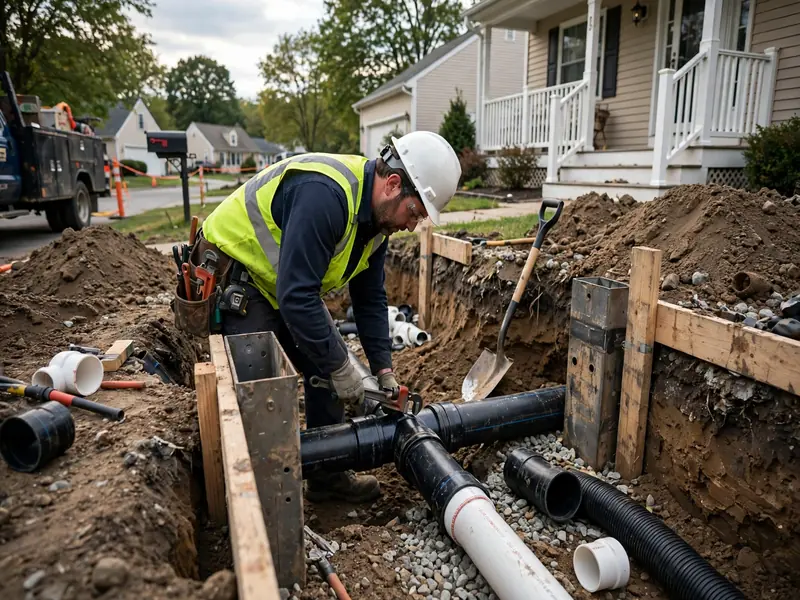
Edison is New Jersey's fifth-largest municipality, and its housing reads like a timeline: colonial-era pockets near Piscatawaytown, dense 1940-1969 suburban build around Pumptown Corners, mid-century capes and ranches, and modern townhomes. The 08837 area in the southern township near Raritan Center spans much of that range, with property records showing homes built from 1906 through 1984. No two streets — sometimes no two adjacent lots — have the same lateral story.
That variety is exactly why sewer line replacement in Edison starts with diagnosis rather than assumptions. A pre-1940 clay lateral is a systemic-replacement candidate; a 1960s line might be clay, Orangeburg-era fiber, or early PVC depending on the tract; a 1980s PVC lateral usually needs a spot repair, not a replacement. Our Edison replacement service cameras every line end to end, identifies the material and the failure pattern, and then replaces the whole lateral — trenchless pipe bursting where the path qualifies, open-cut dig where it doesn't — with watertight pipe matched to the property's flood and soil exposure. One project, one new line, no era left to guess about.
Diagnosis Before Dollars: Reading the Actual Pipe
Quoting a sewer replacement from a home's build year works fine in a single-era subdivision. In Edison, it fails — because the tract across the street may be thirty years newer or older than yours, and the pipe material follows the tract, not the town. The only reliable method is to look at the actual pipe: a camera survey that records material, joint condition, and failure pattern along the entire lateral.
The material tells us what failure to expect. Clay tile fails at joints — roots, offsets, cracks. Cast iron fails from the inside — scaling that narrows the bore until flow chokes. Orangeburg-era fiber pipe fails structurally — the tube itself deforms and collapses. Early PVC fails at isolated joints or from bad original bedding. Each material has a different replacement playbook, and misidentifying the material is how projects get misquoted.
Condition tells us whether replacement is even warranted. A 1960s clay line with roots at two joints is a repair; the same line with roots at every joint, bellies, and cracked tiles is a replacement. A 1980s PVC line with one offset joint is a spot repair — recommending full replacement there would be dishonest, and we won't do it. The camera footage, reviewed with you before any quote, keeps every recommendation honest and every project correctly sized.
Floodplain Laterals: Building for the River, Not Just the House
The Raritan River floodplain is Edison's defining underground risk. When the river rises — as it has in Floyd, Irene, Sandy, and every major nor'easter since — low-lying laterals take on water through every failed joint and crack. The line becomes a storm drain, surcharging the system and backing sewage into basements at exactly the moment the streets are flooding. A replacement that doesn't address infiltration hasn't addressed the actual problem.
Watertightness is therefore the first spec on any Edison replacement near the floodplain: continuous HDPE pipe with no joints along the run, or gasketed PVC with sealed connections at the house and the city tap. The foundation penetration gets grouted and waterproofed, because the wall exit is a classic infiltration point. The new lateral should carry wastewater and nothing else — no groundwater, no floodwater, no exceptions.
Flood exposure also shapes the excavation plan. Low-lying ground means a high water table, so open-cut sections need dewatering and shoring planned before the first shovel. Trenchless bursting avoids most of that — the tool works through wet ground along the existing grade — which is one more reason it's the default method on floodplain-adjacent lots. The camera survey notes the water table and soil conditions along the path so the method choice accounts for them.
Deep Laterals and Basement Exits: Why Depth Favors Trenchless
Basements are the norm across Edison's housing eras, and that puts most laterals deep — commonly eight or more feet below grade where the line exits the foundation wall. Depth changes the project economics: open-cut excavation at that depth needs trench boxes or shoring, dewatering, and a bigger equipment footprint, while trenchless pipe bursting works along the existing grade regardless of depth and needs only two pits.
That depth advantage is why bursting is the default recommendation for Edison's deep laterals when the camera shows a passable path. The tool doesn't care whether the pipe is four feet down or twelve — it follows the old line's corridor and installs the new HDPE at the same grade. The pits at the foundation and curb are the only excavations, and they're planned around the basement exit depth from the start.
Where open cuts are still needed — collapsed sections, severe bellies requiring regrade, or the city tap at the curb — depth is handled with proper shoring and staged excavation, not shortcuts. A deep trench in Edison's soils is an engineered excavation, and it's priced and planned that way: safe, inspected, and restored to grade with compacted backfill that won't settle into a sunken strip across the yard next spring.
Tying Into Existing PVC: Transitions Done Right
Edison's multi-era stock means we often find previous partial work — a section of PVC installed decades ago beside failing clay. When the camera shows that PVC is sound, the project becomes a partial replacement: new HDPE or PVC for the failed clay, tied into the sound existing pipe. The transition is where craftsmanship shows.
Clay-to-PVC and HDPE-to-PVC transitions use shielded couplings rated for the diameter change, installed with correct grade on both sides. A transition that's even slightly off-grade becomes a belly at the joint — the exact defect the project was meant to eliminate. We verify grade across every transition with the same care as the main run, and the connection is tested and inspected like any other joint.
The honest limit still applies: we only tie into pipe the camera proves sound. PVC with separated joints, bellies, or infiltration gets replaced, not preserved — connecting a new lateral to a failing section just moves the next project forward a few years. The footage decides what's kept and what's replaced, and the transitions are built to outlast both.
Separating Stormwater: Sump Pumps and Foundation Drains
Many Edison homes have sump pumps or foundation drains tied into the sewer lateral — a common configuration in the township's full-basement housing stock. During a replacement project, that connection gets evaluated on its own merits, because stormwater inflow is a different problem from a failed lateral, and a new pipe doesn't fix it by itself.
The distinction matters. Infiltration is groundwater entering through failed joints — the new watertight lateral eliminates that. Inflow is stormwater deliberately routed into the system through sump and drain connections — the new lateral carries it just as the old one did, and during heavy rain it can still surcharge the line. If the camera or the site review shows significant inflow, we discuss redirecting sump discharge to daylight or the storm system as a separate improvement.
This isn't upselling; it's hydraulics. A replacement sized for the home's wastewater shouldn't be asked to carry the neighborhood's stormwater too. Getting the inflow question right during the project — when the trench is open and the connections are exposed — is far cheaper than revisiting it later.
Local Insight
Edison's replacement work is era-matching work, and the 08837 area compresses the township's whole timeline into a few square miles. Pre-1940 pockets carry clay-tile laterals 80+ years old — systemic failures, full replacements. The dense 1940-1969 suburban band — center-hall colonials, capes, ranches — sits in the clay-to-early-PVC transition with possible Orangeburg-era installs in some tracts, which is where the camera earns its keep deciding between repair, bursting, and dig. Homes from the 1980s onward are typically on PVC that fails only at isolated defects and usually doesn't need replacement at all.
The Raritan River adds the second variable. Low land along the river floodplain — Johnson Park floods in large storms, and hurricanes have repeatedly pushed river water into the southern township — means laterals in low-lying areas take on infiltration through every failed joint during flood events. Replacements here must be watertight above all: jointless HDPE or gasketed PVC with sealed connections, because a new line that still admits floodwater hasn't solved the problem.
Basements are common across all these eras, putting laterals deep and making trenchless bursting the natural default — the tool follows the existing grade at any depth, while open cuts at eight-plus feet need serious shoring. Edison replacement quotes are built from the camera footage and the flood map together, not from the home's age alone.
Ask a Pro
One call connects you with a local sewer professional serving Perth Amboy, NJ — day or night.
Ask a Pro: (833) 713-2101Frequently Asked Questions
My street has homes from several eras. How do you quote a replacement without guessing?
By reading the pipe, not the paperwork. The camera inspection shows the material directly — clay tile, cast iron, Orangeburg fiber, or PVC — and its actual condition. We then match the method to the finding: bursting for failing clay with a passable path, dig for collapse or Orangeburg, and spot repair for sound PVC with an isolated defect. The era informs what we expect; the camera decides what we do.
Can you connect a new line to the PVC section a previous owner installed?
Yes — that combination is common where a 1940s home got a partial line replacement decades ago. We replace the failing sections and tie the new pipe into the sound PVC with proper transition couplings. But if the old clay portion is failing systemically, the project becomes a full lateral replacement — a new line connected to new pipe beats a new line connected to a future problem.
Is Orangeburg pipe a possibility in my Edison neighborhood?
It can be, in some 1940s-60s subdivisions — bituminous fiber pipe that deforms and collapses after decades underground. The camera identifies it by its flattened, oval profile. Confirmed Orangeburg means full open-cut replacement, since the pipe fails structurally along its length and can't be reliably burst or lined.
How does the Raritan River flood risk change the replacement?
The Raritan River floodplain exposure is the difference. Laterals in low-lying areas take on infiltration through failed joints during flood events, so replacements here must be watertight — jointless HDPE or gasketed PVC with sealed connections. A new line that isn't watertight just restarts the infiltration cycle at the next flood.
Do you treat a 1920s lateral differently from a 1980s one?
It changes the diagnosis, not the methods. Pre-1940 clay gets the full systemic-failure assessment — those lines are 80+ years old and usually replaced whole. 1980s+ PVC gets a repair-first evaluation, since the pipe itself is typically sound. The 1940s-70s middle band is where the camera does the most work, deciding between repair, bursting, and dig on the evidence.
How deep are Edison sewer lines, and why does it matter?
Basements are common across Edison's eras, which puts most laterals deep — often eight or more feet below grade at the foundation. Depth favors trenchless pipe bursting, since the tool works along the existing grade regardless of depth, and it raises the shoring and dewatering requirements for any open-cut sections. The camera survey measures depth at every point before we plan.