Sewer Line Replacement in Downtown Perth Amboy, NJ
Downtown Perth Amboy holds the area's oldest laterals — early-1900s clay tile, 100+ years old — on tight lots where open cuts barely fit. Full replacement is usually trenchless pipe bursting: one jointless HDPE lateral from two small pits, with storefronts and sidewalks undisturbed.
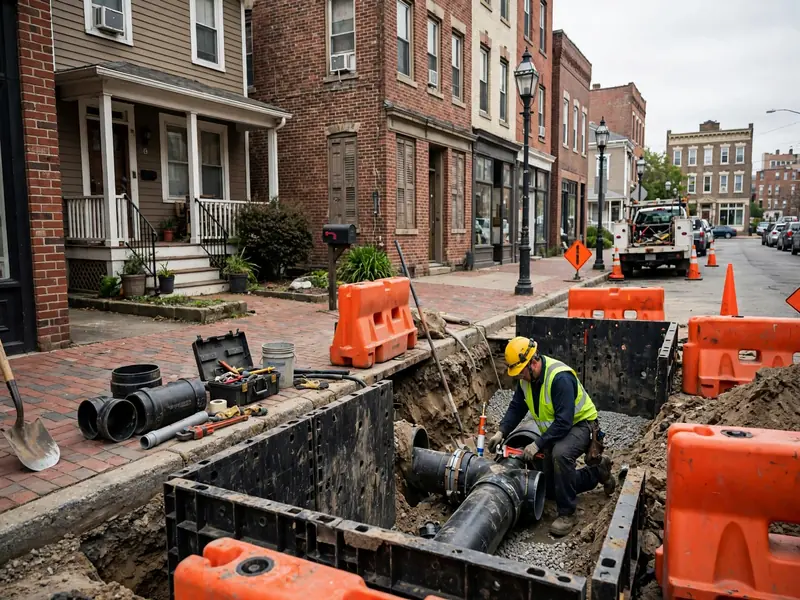
Downtown Perth Amboy is one of New Jersey's oldest urban cores — settled in 1683, incorporated in 1718 — and its sewer laterals are old enough to match. The dense blocks around Smith Street, Five Corners, and the Proprietary House carry late-1800s and early-1900s colonials, two-to-three-story mixed-use buildings, and rowhouses packed onto narrow lots. Some of the clay-tile laterals under these streets have been in the ground for a century or more, and a few properties may still tie into shared party-line arrangements laid when the blocks were built.
Replacing a sewer lateral downtown is an access puzzle as much as a plumbing job. Tight lots mean short runs but cramped working room; mixed-use buildings mean storefronts that can't shut down for a week; and the low elevation near Raritan Bay means high groundwater and urban fill in every trench. Our downtown replacement service is built around trenchless pipe bursting — new jointless HDPE pipe pulled through the old line's path from two small pits — with open-cut sections only where the camera survey proves they're needed. One project, one new watertight lateral, and the block keeps functioning while we work.
Century-Old Pipe: Why Nothing Is Worth Saving
A century-old clay lateral doesn't fail the way a fifty-year-old one does. After a hundred years of freeze-thaw cycles, the joints aren't just loose — they're gone in places, with sections offset by inches and tiles cracked clean through. Roots have had generations to colonize every seam. The pipe's bedding has settled into bellies that hold standing water. When we camera a downtown line from the early 1900s, the footage rarely shows a salvageable pipe; it shows an archaeological record of every decade since installation.
Cleaning a line like this is triage, not treatment. The blades clear roots but widen the joints they pass through; the jetting washes sediment out of bellies that refill within weeks. Each service call costs money and shortens the interval to the next one, until a section collapses completely and the line stops responding to equipment at all. At that point the choice isn't repair versus replacement — it's replacement versus sewage in the basement.
The case for full replacement on century-old lines is straightforward: nothing in the ground is worth saving. A new continuous lateral — jointless HDPE by bursting or gasketed PVC in an open cut — resets the clock to zero with materials rated for many decades. The project costs more than a cleaning, once, instead of costing cleaning money forever while the risk of a catastrophic backup grows every year.
Access Planning on Narrow Downtown Lots
On a downtown lot, the lateral run might be twenty feet — but those twenty feet sit under a sidewalk, a stoop, a basement stairwell, and a property line shared with the neighbor. Open-cut excavation here means heavy equipment in spaces it barely fits, with shoring against adjacent foundations and restoration of public sidewalk to municipal spec. It's doable, but every foot of open trench multiplies the logistics.
Pipe bursting sidesteps almost all of that. Two pits — one at the foundation wall, one at the curb — and the new HDPE line follows the old pipe's exact path underground, fracturing the failed clay outward as it goes. No trench through the sidewalk, no excavation under the stoop, no open cut along the property line. For mixed-use buildings, the pits can be staged to keep the storefront entrance clear, and the work scheduled around business hours.
The camera survey decides where bursting can run and where it can't. A fully collapsed section stops the bursting tool; a severe belly that needs regrading needs an open cut; the city connection at the curb sometimes needs direct work for a proper tap. Downtown hybrids are common: bursting for the building-to-sidewalk run, a short open cut at the curb where the tap and restoration happen. The method follows the footage, and the footage is shared with you before anything is scheduled.
Shared Party Lines: The Downtown Complication
Some downtown rowhouses were built with shared laterals — a single clay line serving two or more properties on its way to the city main. These party-line arrangements are a century old, undocumented, and easy to miss until a camera goes in and the footage shows wyes serving neighboring buildings. Finding one changes the project from a single-owner job to a coordinated one.
The first step is documentation: the camera survey maps exactly which properties the line serves and where it runs. Then comes the conversation — all affected owners need to understand that the shared line is failing and that replacement is a joint project. We scope it as one replacement with shared cost logic, replaced in a single mobilization rather than piecemeal, because digging up a shared line twice is the worst possible outcome.
If a shared line is replaced, the new lateral is typically reconfigured with proper individual connections or a correctly sized shared line with cleanouts — built to current standards instead of 1900s conventions. The camera footage makes the arrangement visible and undeniable, which is usually what it takes to get a shared project moving.
Coordinating the Curb Tap With the City
The downtown lateral ends at the city main under the street, and that connection is municipal work in every sense: permitted, inspected, and restored to the city's standard. The tap has to be made with approved fittings at correct grade — a poorly graded tap creates a permanent belly at the most inaccessible point in the system — and the connection is inspected before any backfill goes in.
Sidewalk and curb restoration follows the city's spec, not the contractor's convenience. Downtown sidewalk panels are public infrastructure with foot traffic all day; the restoration has to match grade, finish, and joint pattern so the repair disappears into the streetscape. We coordinate the inspection scheduling so the open cut at the curb is backfilled and restored promptly — nobody wants an open trench on Smith Street any longer than necessary.
For mixed-use building owners, the practical point is that the street work is handled as part of the project: permits filed, inspections scheduled, restoration completed. The building's new lateral connects to the city main correctly, the sidewalk looks like it always did, and the paperwork trail is clean for the property records.
Planning the Project as a Mixed-Use Owner
A downtown mixed-use building's sewer replacement is a capital project, and it pays to plan it like one. The camera survey and written scope give you documented evidence of the failure — useful for property records, insurance discussions, and tax planning — and the single-mobilization approach means one disruption instead of a repair now and a replacement later.
Phasing is worth discussing where the building's operation demands it. Trenchless bursting keeps the work compact: two pits, staged to keep entrances clear, scheduled around business hours. Where the camera shows sections needing open cut, those are sequenced so the building never loses drainage overnight — the changeover to the new line happens in a single planned window, not across days of improvisation.
The documentation you receive at closeout matters too: the camera footage, the as-built path of the new line, inspection sign-offs, and the cleanout location. For a building that will be maintained, refinanced, or sold, that file proves the underground infrastructure is new — which is exactly what the next owner, lender, or insurer will want to see.
Local Insight
Downtown's replacement jobs are shaped by three facts no suburban lot shares. First, the age: this is the oldest lateral stock in the service area, with clay-tile lines from the early 1900s now 100+ years old — pipes that have endured a century of freeze-thaw, soil settlement, and root intrusion, and that fail systemically rather than in spots. Second, the lots: dense, narrow parcels with houses packed close together mean lateral runs are short but access is cramped — open-cut digging that would be routine in the suburbs is often physically impractical here, which makes trenchless pipe bursting the default method rather than just an option.
Third, the ownership patterns: some downtown rowhouses share party-line laterals laid when the blocks were built, so a replacement project can involve more than one property and needs a coordinated plan, not a single-owner quote. The low elevation near Raritan Bay and the Arthur Kill adds high groundwater and urban fill to every excavation, so even the pits for a trenchless job are planned with dewatering and shoring in mind.
For mixed-use buildings on Smith Street, the project is also a scheduling exercise: storefronts stay open while the line is replaced from pits that avoid the retail frontage. Downtown replacement is equal parts plumbing, logistics, and municipal coordination — and the camera survey at the start settles the scope before any of it begins.
Get Help Now
One call connects you with a local sewer professional serving Perth Amboy, NJ — day or night.
Get Help Now: (833) 713-2101Frequently Asked Questions
My building is from the early 1900s and there's no record of the sewer line. How do you find it?
With a camera and an electronic locator, which trace the line's path, depth, and condition from above ground — no excavation needed to map it. Original records don't exist for lines laid in the 1900s, so electronic locating is the standard. We also check for shared party-line arrangements between rowhouses before planning, since those change the scope.
I own a mixed-use building on Smith Street. Can you replace the line without shutting down the storefront?
Trenchless pipe bursting is made for exactly this situation: it replaces the pipe along its existing path from two small pits, with no long trench through the storefront or sidewalk. Open-cut work is limited to short sections where the camera shows collapse or where the city connection needs direct access — and we plan those around business hours.
My rowhouse might share a sewer line with the neighbor. How is that handled?
Possibly — some downtown rowhouses share a party-line lateral to the city main. The camera survey checks which properties a line serves before any work is quoted. Shared lines need a coordinated replacement plan with the affected owners; we document the arrangement and scope the project accordingly.
Do I need permits for a downtown replacement?
Yes — sewer lateral replacement in Perth Amboy requires municipal permits and inspections, with the new line inspected before backfill. For downtown properties we also coordinate the curb and sidewalk restoration to municipal spec. We handle the permits, inspections, and restoration as part of the project.
How does trenchless replacement work on a lot with no room to dig?
It replaces the pipe along the same corridor it already occupies, from two pits — no long open trench. The old clay is fractured outward underground and the new HDPE line takes its place. On lots where open cutting was never practical, bursting is often the only method that can do the job at all.
Will replacement stop the backups that happen during storms?
A new watertight lateral with sealed connections stops both failure modes: no cracked joints for roots, no open joints for bay water. During heavy rain and tidal events, the new line carries only your wastewater instead of flooding from outside — which is what stops the backups that arrive with every nor'easter.