Sewer Line Replacement in Colonia, NJ
Colonia's postwar ranches and Capes — 70.9% built 1940s-1960s — carry clay-tile laterals running long under mature oaks. Decades of root intrusion and settling make them classic replacement candidates: trenchless bursting installs one jointless HDPE lateral with minimal yard disturbance.
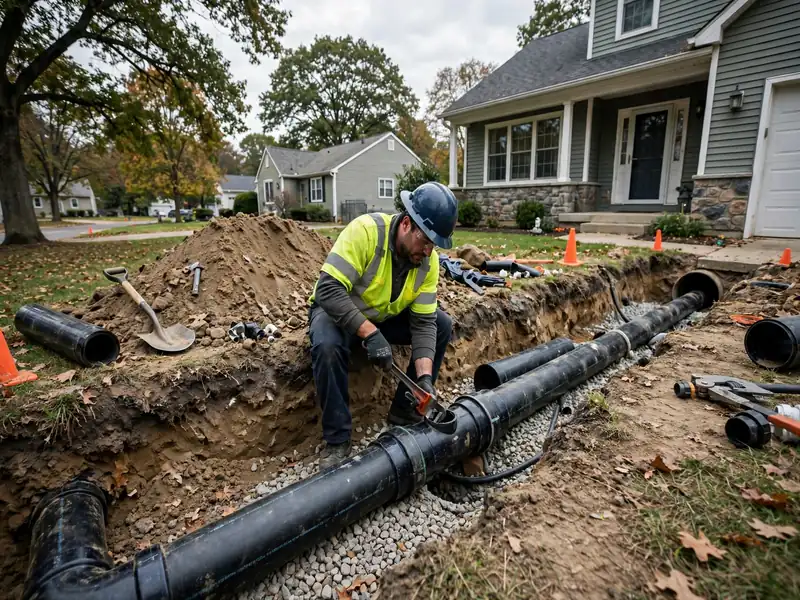
Colonia is the northernmost section of Woodbridge Township, pressed against the Union County line — a generational suburb where original postwar homes have been held for decades and passed down. Nearly 71% of the housing went up in the 1940s through 1960s: ranches, Cape Cods, and split-levels on generous lots under mature oaks. That is a beautiful setting and a hard one for sewer laterals, which run long distances through root-filled soil on their way to the street.
When a lateral under those conditions starts failing, it fails along its whole length — roots at every clay joint, bellies where the long run settled, cracked tiles under decades of soil movement. Cleaning buys shorter and shorter intervals until the line stops responding. Our sewer line replacement service in Colonia replaces the entire lateral in one project: usually trenchless pipe bursting, which installs a single jointless HDPE line along the existing path from two small pits, sparing the oaks, the lawn, and the driveway. Every project starts with a camera survey that documents exactly what the line looks like and exactly what the replacement will do about it.
Why Long Runs Under Oaks Fail Systemically
A Colonia lateral is typically a long run — the deep lots that make this neighborhood attractive also stretch the sewer line across sixty to ninety feet of root-filled ground. Every three-foot clay tile in that run is a joint, and after sixty years, most of those joints have something wrong: roots entering, offsets from soil settlement, cracks from freeze-thaw heave. The failure mode here is systemic by geometry — the longer the line, the more certain it is that problems aren't isolated.
Root intrusion under mature oaks deserves special attention. Oak roots are aggressive and persistent; once they find a clay joint, they expand it year after year, eventually filling the pipe and cracking tiles further apart. Cutting them buys a year if you're lucky. Under a canopy of mature trees, regrowth is vigorous, and each cleaning leaves the joints a little more damaged than before. The cycle ends only when the joints themselves are gone.
Soil settlement adds the second half of the damage. A long run crossing decades-old fill and natural soil develops bellies — low spots where water and solids pool instead of flowing. Bellies can't be cleaned away; they are a grade problem, and the fix is a new line installed at proper slope. When the camera shows bellies plus roots plus cracked tiles, the line isn't a candidate for repair. It's a candidate for retirement.
Pipe Bursting on Deep Lots: Maximum Line, Minimum Digging
Trenchless pipe bursting was practically designed for Colonia's lots. The method needs only two small pits — one at the foundation, one at the curb — and pulls a new continuous HDPE line through the old pipe's path, fracturing the old clay outward as it goes. For a ninety-foot run under mature oaks, the difference between bursting and digging is the difference between two holes and a ninety-foot trench through a half-century-old landscape.
The new HDPE line is jointless along its entire length. That single fact is what ends the root problem: roots entered through joints, and there are no joints anymore. The pipe is also flexible enough to handle soil movement without cracking and smooth enough to resist buildup. For the long, root-exposed runs typical here, it's the correct material, not just the convenient method.
Bursting does have limits the camera survey checks for: a fully collapsed section can stop the tool, and severe bellies that need regrading call for a short open-cut section instead. Many Colonia jobs end up as hybrids — bursting for the long straight run under the oaks, a brief open cut at the foundation where depth or the connection demands direct access. Either way, the property ends up with one new watertight lateral, and the yard ends up with grass instead of a scar.
The Orangeburg Wildcard in 1950s Tracts
Some of Colonia's 1950s tracts may contain Orangeburg-era pipe — bituminous fiber tube that was cheaper than clay when these subdivisions went up. It fails differently from clay: instead of joints loosening, the fiber pipe itself softens, deforms into an oval, and eventually collapses inward along its length. A collapsed Orangeburg line can't be cleared, lined, or burst in many cases; it has to be dug out and replaced.
The camera inspection identifies the material unambiguously. Clay tile shows as short jointed sections; Orangeburg shows as a deformed dark tube, often visibly flattened; early PVC shows as long smooth runs. We look for this explicitly on 1950s Colonia homes because the finding changes the entire project plan — from trenchless to open-cut — and we'd rather discover it on camera than mid-burst.
Homeowners sometimes ask whether Orangeburg can be lined instead of replaced. The honest answer is no: lining a deformed, collapsing fiber pipe doesn't restore its structure, and the failure continues underneath the liner. When Orangeburg is confirmed, full open-cut replacement with new PVC or HDPE is the fix that actually lasts — more digging than a burst, but the only method that addresses what Orangeburg does underground.
Protecting Mature Oaks During the Project
Colonia's mature oaks are the reason these laterals failed — and they're also the reason the replacement method matters. An open-cut trench through a root zone severs the structural roots a mature oak depends on, potentially destabilizing or killing a tree that's been growing for half a century. Trenchless pipe bursting avoids that damage by working underground along the existing pipe corridor, which the roots have already grown around.
The pits are positioned with the trees in mind. Where the lateral's path allows choice, we site the foundation and curb pits away from critical root zones — and where the path runs near a major tree, the pit is kept as compact as the work allows. Roots encountered in the pits are cut cleanly rather than torn, which gives the tree its strongest chance of compartmentalizing the wound.
The new HDPE line then ends the conflict permanently: jointless pipe gives roots nothing to enter, so the oaks and the sewer coexist from here on. Homeowners sometimes ask about root barriers as an add-on; with a jointless lateral they're unnecessary — the pipe itself is the barrier. The trees that caused the problem get to stay, and they stop being a problem.
Cleanout Placement on Deep Lots
On Colonia's deep lots, the lateral run can stretch eighty feet or more — and cleanout placement on a run that long deserves thought, not default. The standard single cleanout near the foundation gives access to the full run, but on very long laterals a second cleanout partway along the path can make future maintenance dramatically simpler, giving equipment a closer entry point to either half of the line.
Placement also considers the property's use. The cleanout should be reachable without crossing the patio or the garden beds — ideally in a lawn area near the lateral's path, marked and capped at grade. We walk the path with the homeowner before finalizing the location, because the cleanout will be there for the life of the line and its convenience matters.
For the longest runs, we discuss whether a second cleanout is warranted. It's a modest addition during construction — far cheaper than retrofitting one later — and on an eighty-plus-foot lateral it can be the difference between a routine service call and an expensive one. The goal is a new line that's as maintainable as it is durable.
Local Insight
Colonia's replacement work is defined by three facts from its housing profile. First, the era: 70.9% of homes built 1940s-1960s puts the residential lateral stock squarely in the clay-tile era, with some 1950s tracts possibly carrying Orangeburg-era fiber pipe — the kind that fails by collapsing rather than joint damage. Decades of unreplaced originals mean most jobs are true end-of-life replacements, not early interventions.
Second, the lots. Colonia's ranches and Cape Cods sit on generous deep lots, which means laterals run long — sixty, eighty, sometimes over a hundred feet — entirely under mature oak root systems. A long clay lateral is a long row of joints, and every joint is a root entry point and a potential offset. Root intrusion and sagging lines dominate the repair calls here precisely because the geometry maximizes exposure.
Third, the ownership pattern. Generational turnover means many of these homes have never had their lateral touched — the original pipe from the 1950s is still in the ground, now 60-70 years old and failing systemically. When the camera goes in, it finds the whole run compromised, which is why the answer here is so often full replacement by pipe bursting: one continuous jointless line, no more joints for the oaks to invade, minimal disturbance to a yard that's been maturing for half a century.
Call (833) 713-2101
One call connects you with a local sewer professional serving Perth Amboy, NJ — day or night.
Call (833) 713-2101: (833) 713-2101Frequently Asked Questions
My Colonia lateral is long. How do I know it needs full replacement instead of repair?
Measure the pattern: backups that return within a year, roots at most joints on the camera survey, bellies holding water, or cracked and offset tiles along most of the run. One root ball at a single joint is a repair. Systemic damage across a 60-80-foot run — typical on Colonia's deep lots — is a replacement. The camera footage makes the call objective.
Does a longer lateral make replacement harder?
Depth and length raise the stakes, not the feasibility. Longer runs mean more joints and more root exposure, which is why Colonia's lines fail systemically. Pipe bursting was made for this: it installs one continuous line along the whole run from two pits, regardless of length. A dig on a 90-foot run through oak roots is disruptive; a burst is two holes.
Could my 1950s home have Orangeburg pipe?
Often, yes. Many 1950s Colonia tracts used bituminous fiber (Orangeburg) pipe, which deforms into an oval and collapses after decades underground. The camera inspection identifies the material directly — Orangeburg looks like a flattened dark tube, nothing like clay tile. When we find it, full replacement is the only reliable fix.
What does the camera usually find under Colonia's oak trees?
Root intrusion, cracked and offset clay joints, and bellies where the long run has settled. Mature oaks on Colonia's generous lots send roots into every clay joint, and decades of soil settlement create low spots that hold water and solids. The camera survey maps all of it before we quote.
Do I need permits to replace my sewer line in Colonia?
Yes — permits are required for sewer lateral replacement in Woodbridge Township, including the excavation and the plumbing work, with an inspection of the new line before backfill. We prepare and file the permits and coordinate the inspections as part of the project, so nothing stalls.
After replacement, will the backups in heavy rain finally stop?
A new watertight lateral ends the backup cycle: no joints for roots to enter, no cracks for groundwater infiltration, proper grade with no bellies. If your home also has foundation or sump drains tied into the sewer, we evaluate that connection during the project — stormwater inflow is a separate issue from a failed lateral and gets its own fix.