Sewer Line Replacement in Chickentown, NJ
Chickentown's pre-1940 Perth Amboy homes almost always carry original clay-tile laterals, 80+ years old and root-ridden past the point where cleaning helps. Full replacement by trenchless pipe bursting or dig installs one jointless lateral from foundation to curb, ending the cycle.
Chickentown, the western Perth Amboy neighborhood named for its pre-WWII chicken farms, holds some of the oldest residential sewer lines in the service area. Many homes here were built in 1939 or earlier, with 1940-1969 infill around them — small-to-medium single-family homes and small apartment buildings, some with yards and garages, others packed close. Washington Park, the city's largest park, anchors the neighborhood with mature trees whose roots have had eighty years to find every clay joint in the ground.
In a neighborhood this old, sewer work is usually replacement rather than cleaning. An 85-year-old clay-tile lateral doesn't have a bad section; it has a bad life — joints loosened by eight decades of freeze-thaw, root masses at every seam, tiles cracked by soil settlement. Our sewer line replacement service in Chickentown starts with a camera inspection that documents the full story, then installs one new continuous lateral — trenchless pipe bursting where the line qualifies, open-cut dig where it doesn't — so the next eighty years start clean.
Eighty Years of Roots: Why Cleaning Stops Working
A root ball in a clay lateral is not like a clog in a sink. Tree roots enter through the tiny gaps at tile joints, then expand year after year, eventually filling the pipe and cracking the tiles further apart. Cutting them with a blade clears the flow for a while, but the roots remain alive in the joints outside the pipe — and they grow back thicker. In Chickentown, where mature trees around Washington Park and along the streets have been probing these lines for decades, the regrowth cycle can shrink to months.
The economics turn against cleaning once you're on a twice-a-year schedule. Each visit costs money and buys less time, while the underlying pipe keeps deteriorating: joints offset further, tiles crack wider, and sections begin to collapse. At some point the blade can't even pass — a fully root-choked or collapsed section stops the cleaning equipment cold, and that's usually the moment replacement becomes the only option left.
Replacement breaks the cycle permanently because the new pipe has no joints for roots to enter. Continuous HDPE installed by pipe bursting is a single seamless tube from house to curb; PVC installed in an open cut has gasketed joints every ten-plus feet instead of every three. Either way, the root highway that the old clay tile provided is gone, and the mature trees overhead become irrelevant to what's underground.
Matching the Method to a Pre-1940 Lateral
Pre-1940 laterals bring specific complications to a replacement project. The lines are old enough that original installation records don't exist, depths vary from house to house, and the path from foundation to street may jog around long-forgotten obstacles. The camera survey and electronic locating we do before quoting maps all of that — depth, direction, bellies, and the exact condition of every section.
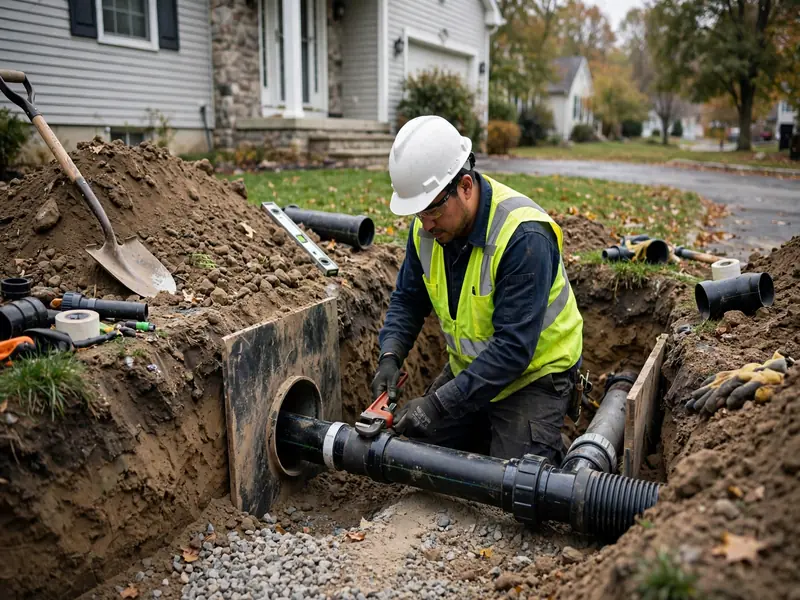
Trenchless pipe bursting is the workhorse for these jobs. It follows the old line's path exactly, which matters when the original route is the only verified-clear corridor through the yard, and it needs only two pits instead of a full trench. That keeps mature landscaping, fences, and driveways intact — a real consideration on Chickentown's established lots. Bursting handles clay tile and cast iron reliably, fracturing the old pipe outward as the new HDPE line pulls through.
Open-cut digging earns its place when the camera shows full collapse, severe bellies that need regrading, or a lateral path that crosses unmarked utilities. On some Chickentown properties we run a hybrid: bursting the long straight run, then a short open cut at the foundation where the line exits the basement wall or at the curb where the city tap needs direct work. The method follows the evidence, not a preference.
Cast-Iron Stacks and the Foundation Connection
In Chickentown's earliest homes, the interior drainage is often cast iron — heavy, durable pipe that served well for half a century and then began scaling shut from the inside. When we replace the exterior lateral, the connection point at the foundation wall deserves its own assessment: a new exterior line connected to a scaled-shut cast-iron stack just moves the bottleneck inside the house.
During the camera survey we inspect as far into the building drain as access allows. If the cast iron is heavily scaled or cracked, the replacement scope extends to that section — either descaling it with specialized chain-flail tools or replacing the compromised length. It's a smaller job than the lateral itself, but skipping it leaves the system's weakest link in place.
The foundation penetration also gets rebuilt properly: a sealed, watertight connection where the new line exits the basement wall, with the annular space grouted and waterproofed. In a neighborhood where basements are the norm and heavy rain is a fact of life, that seal is the difference between a dry basement wall and a slow seep every nor'easter.
Why Pipe Lining Isn't the Answer for These Lines
Homeowners researching trenchless options often ask about cured-in-place pipe lining — a resin sleeve installed inside the old pipe. It's a legitimate technology, but it has a strict prerequisite: the host pipe must be structurally intact enough to hold the liner. Chickentown's 80+ year-old clay laterals almost never meet that standard.
Lining doesn't fix collapsed sections, severe offsets, or bellies — it follows the old pipe's shape, defects included. A liner inside a bellied clay line is a lined belly: it still holds water and solids. And where tiles are cracked through or joints have offset significantly, there's no stable host for the liner to bond to. The camera footage on pre-1940 lines shows exactly the conditions lining can't fix.
Pipe bursting is the trenchless method that actually suits these lines, because it doesn't need the old pipe to be sound — it destroys the old pipe, fracturing it outward while pulling new HDPE through. The result is a brand-new structural pipe at correct grade, not a sleeve inside a failed one. Lining has its place on younger pipes with isolated defects; on Chickentown's century-old clay, replacement is the trenchless answer that works.
Yard Restoration: What Comes Back and When
After the new lateral is in and inspected, the property gets put back together — and the restoration sequence matters as much as the pipe work. Trenches and pits are backfilled in lifts, with each layer compacted before the next goes in. Skipping that compaction is how yards develop sunken strips six months later; we compact as we go so the ground stays where we left it.
Topsoil goes back over the compacted fill, graded to match the surrounding yard and sloped away from the foundation. Then the surface: disturbed lawn areas are seeded or sodded depending on the season and the homeowner's preference, with straw cover where needed to protect new seed. Plantings that had to be moved are replanted; fence sections removed for access are rehung.
The honest timeline: the ground work is done when we leave, but grass needs a growing season. Seeded areas fill in over weeks with watering; sod is immediate but needs consistent moisture for the first stretch. Within one season, the only visible evidence of the project should be the new cleanout cap — and drains that finally work the way they're supposed to.
Local Insight
Chickentown's age profile is the whole story on replacement work here. With many homes built in 1939 or earlier and the rest mostly 1940-1969 infill, the neighborhood's laterals are pre-1940 clay tile in the core — 80+ years old, root-riddled, with cracked and offset joints as the rule rather than the exception. That's why sewer work in Chickentown is usually root-driven replacement rather than simple cleaning: the pipes have aged past the point where maintenance restores them.
The mature trees are the second half of the equation. Washington Park — Perth Amboy's largest park — sits in this neighborhood, and the established street trees across these blocks have spent decades sending roots into every clay joint. Root intrusion isn't an occasional problem here; it's the background condition of the underground infrastructure, and it's why replacement pipe must be jointless or long-joint — anything with three-foot clay joints will just restart the cycle.
Finally, the housing mix matters for access planning: small-to-medium single-family homes, some with yards and garages, mixed with small apartment buildings. Trenchless bursting fits the single-family lots where landscaping and fences are established, while the denser parcels get careful staging plans. Every job starts with the camera, because on 80-year-old lines, assumptions are how projects go wrong.
Request Service Today
One call connects you with a local sewer professional serving Perth Amboy, NJ — day or night.
Request Service Today: (833) 713-2101Frequently Asked Questions
My plumber keeps clearing roots from my line. When is it time to replace instead?
When cleanings stop lasting. If roots return within a year — or within months, as happens with mature trees nearby — the pipe's joints are too far gone for maintenance to restore. Replacement with jointless HDPE removes the entry points entirely, so the roots outside the pipe can no longer get in. Repeated clearing on an 80-year-old line costs more over time than one replacement.
Will the new pipe really keep roots out?
Yes — that's the core advantage. Roots enter through joints and cracks; a continuous HDPE line installed by bursting has no joints at all along its run, and PVC has gasketed joints every ten-plus feet. The mature trees around Washington Park and your street stay where they are; they just lose their way into your sewer.
Do you replace the cast-iron pipe inside my house too?
We assess it during the camera survey. If the interior cast-iron stack is heavily scaled or cracked, we include descaling or partial replacement in the project scope — connecting a brand-new exterior lateral to a choked interior line leaves the bottleneck in place. The exterior lateral replacement is the main project; interior work is scoped only if the camera shows it's needed.
How do you find the sewer line if there are no records from the 1930s?
With the camera and an electronic locator. We push the camera through the line and trace its signal from above ground, marking the exact path and depth across the yard. Original records don't exist for pre-1940 installations, so electronic locating is the standard — and it's accurate enough to plan pits within inches.
Will my yard be torn up?
With trenchless pipe bursting, only two small pits are dug — at the foundation and at the curb. The rest of the yard, including landscaping and fences, stays intact. If an open-cut section is needed for a collapsed area or a regrade, we restore it afterward: compacted backfill, topsoil, and seeding or sod.
Does the replacement include a cleanout?
Yes. We install a new exterior cleanout as part of every full lateral replacement. It gives future maintenance direct access to the line without entering the house — a major convenience on older homes where the original installation predates cleanouts entirely.