Sewer Line Replacement in Carteret, NJ
Carteret's 1950s-60s Capes and colonials carry 60+ year-old clay-tile laterals, and the Arthur Kill waterfront adds tidal infiltration. Full replacement means a watertight HDPE lateral — usually trenchless bursting to avoid digging remediated soils — installed house to curb and restored.
Carteret is a working-class borough with deep roots — incorporated in 1906, renamed in 1922 — and a housing stock whose median build year sits around 1962. The 1950s Cape Cods and colonials along corridors like Wortylko Street, Washington Avenue, and Roosevelt Avenue are now served by clay-tile laterals six decades old, joined by the borough's defining geographic fact: it borders the Arthur Kill to the east and the Rahway River to the north, with more than a tenth of its area covered by water.
That combination — aging clay pipe plus tidal-flood exposure — is what makes sewer replacement in Carteret different from an inland job. Laterals here don't just fight roots and cracked joints; they fight infiltration every time a nor'easter pushes water up the Arthur Kill or heavy rain surcharges the low-lying system. When a line is failing along most of its length, the replacement has to be watertight above all else. Our Carteret replacements use continuous HDPE pipe — no joints for water or roots to enter — installed by trenchless bursting wherever the ground allows, with open-cut sections only where the camera survey demands them.
Why Watertight Matters More on the Waterfront
An inland clay lateral fails mostly from the inside out: roots enter joints, joints offset, the pipe cracks. A waterfront lateral in Carteret fails from both directions. Every joint and crack is also an entry point for groundwater and tidal infiltration, which means the line carries storm and tidal water it was never sized for. That surcharging backs sewage up into basements during the same nor'easters that flood the streets — the two problems arrive together.
This is why the replacement spec for Carteret is uncompromising on watertightness. Continuous HDPE pipe has no joints along its entire run — the only connections are fused or gasketed at the house and the city tap. Compare that to the old clay tile, where every three-foot section was a joint and every joint was a future leak. A watertight lateral does not just stop backups from roots; it stops the line from becoming a storm drain every time the Arthur Kill rises.
The camera survey for a waterfront job also checks for infiltration directly: we look for water entering the pipe between joints, staining that marks the high-water line inside the pipe, and sediment deposits that show where groundwater has been carrying soil into the line. That evidence shapes both the urgency and the method — a line taking on heavy infiltration is a line that needs replacement, not cleaning.
Digging Near Remediated and Waterfront Soils
Carteret's waterfront carries industrial history, and the brownfield remediation zones near the Arthur Kill mean excavation is not always straightforward. Deep legacy utilities run through the waterfront ground, and in remediated areas, digging can face additional review or handling requirements. This is a strong argument for trenchless methods on Carteret jobs: pipe bursting replaces the line along its existing path without opening a trench through soils you'd rather not disturb.
Where open cuts are unavoidable — at the foundation connection, at the curb tap, or where the old line is fully collapsed — the excavation plan is built around the ground conditions. Low-lying eastern blocks sit around 13 feet of elevation with a high water table, so trenches need dewatering and shoring rather than a simple open dig. We plan for that before the first shovel, with pumps staged and trench boxes sized for the depth.
Property owners near the waterfront should also know that parts of Carteret fall within mapped flood zones. The replacement itself doesn't change a property's flood designation, but the project is planned with it in mind: watertight pipe, sealed connections, and grading that doesn't create new low spots where stormwater ponds against the foundation.
From Diagnosis to Final Grade: The Project Sequence
Every Carteret replacement begins with a full camera inspection from the foundation to the city connection, recorded and reviewed with you. We document pipe material, joint condition, root intrusion, bellies, offsets, and any infiltration — the complete case for replacement in footage you can see yourself. Only then is a method chosen: trenchless bursting for lines with a passable path, open-cut dig for collapsed sections or regrade needs, or a hybrid of the two.
Permitting comes next. Sewer lateral work in the borough requires municipal permits and inspections of the new line before backfill, including the curb and sidewalk restoration at the street connection. We file the paperwork and coordinate the inspections so the project never stalls waiting on approvals.
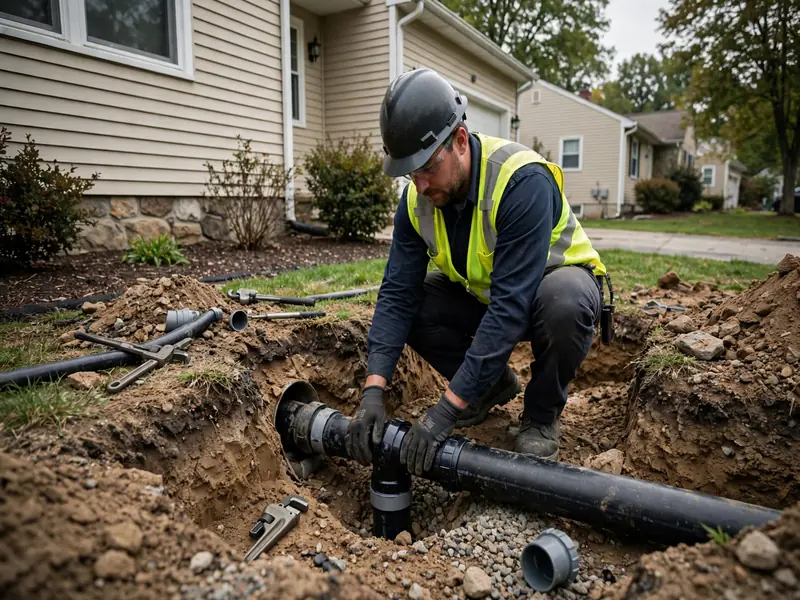
Installation day runs on a tight sequence: pits excavated, the new HDPE line burst or laid, connections made at the house and the city tap, a new exterior cleanout installed, and the line inspected before anything is buried. Then restoration: trenches backfilled and compacted in lifts, topsoil replaced, disturbed ground seeded or sodded, and sidewalk or curb sections repoured to municipal standard. The new lateral goes into service the same day the pipe work finishes — your drains work that evening.
Dewatering and Shoring on Low-Lying Blocks
Carteret's low-lying eastern blocks sit near 13 feet of elevation with a high water table — which means an open trench here fills with water faster than it can be dug. Dewatering isn't an contingency on these jobs; it's standard equipment, staged before excavation begins. Pumps keep the trench workable, and the water is managed so it doesn't undermine neighboring ground or flood the street.
Shoring is the other non-negotiable. Saturated soils won't stand in an open cut the way dry ground does, so trenches get trench boxes or hydraulic shoring sized for the depth — and Carteret's full-basement housing stock means that depth is often eight feet or more. This is engineered excavation, planned from the camera survey's depth measurements, not improvised at the trench edge.
Trenchless pipe bursting sidesteps most of this, which is one more reason it's the preferred method on waterfront-adjacent lots: the tool works through wet ground along the existing grade, needing only two pits. Where open cuts are unavoidable — the foundation connection, the curb tap, a collapsed section — the dewatering and shoring plan is built before mobilization. Safe trenches aren't slower; they're the only trenches worth digging.
Keeping Stormwater Out After the Project
A new watertight lateral solves infiltration through the pipe — but stormwater management around the property determines how much water pressures the system from outside. As part of every Carteret replacement, we review the grading and drainage that affect the new line: soil should slope away from the foundation, not toward it, and the trench backfill should be compacted so it doesn't become a channel directing water to the foundation wall.
Downspouts and sump-pump discharges deserve attention. If roof water or sump discharge dumps next to the foundation, it saturates the ground around the new lateral and the foundation penetration — exactly the infiltration pressure the replacement was meant to eliminate. Extending downspouts away from the house and routing sump discharge to daylight or the storm system keeps that water out of the equation.
The cleanout cap gets sealed and set at proper grade so surface water can't enter the system there. These are small details, but on low-lying waterfront blocks they're the difference between a lateral that stays dry inside and one that fights the same water table the old line lost to. The pipe is watertight; the property grading should respect that.
Local Insight
Carteret's replacement jobs are shaped by two forces no inland town shares: the age of its housing and the water around it. The borough's 1950s-60s Cape Cods and colonials — median build around 1962 — carry clay-tile laterals now six decades old, with some 1950s tracts possibly holding Orangeburg-era pipe that fails by collapse rather than joint damage. Those laterals are at the age where systemic failure, not isolated clogs, is the norm.
Then there's the Arthur Kill. The borough borders the Kill to the east and the Rahway River to the north, over a tenth of its area is water, and low-lying eastern blocks sit near 13 feet of elevation with a high water table. Laterals here take on tidal and storm infiltration through every failed joint, which means replacements must be watertight HDPE — jointless, sealed, infiltration-proof — not just structurally new. Parts of the borough fall in mapped flood zones, so dewatering and shoring are planned into every dig from the start.
The third factor is the ground itself. Waterfront remediation zones and deep legacy utilities near the Arthur Kill make trenchless pipe bursting the preferred method wherever the line qualifies — it replaces the pipe along its existing path without opening trenches through industrial fill or remediated soils. Open cuts are reserved for the spots the camera says truly need them.
Schedule Your Visit
One call connects you with a local sewer professional serving Perth Amboy, NJ — day or night.
Schedule Your Visit: (833) 713-2101Frequently Asked Questions
Why does my Carteret sewer back up during nor'easters but work fine otherwise?
Your lateral is taking on tidal and stormwater infiltration through failed joints and cracks. When the Arthur Kill rises or heavy rain surcharges the low-lying system, the extra water overwhelms the line and backs up into the house. A watertight replacement lateral with no joints eliminates that infiltration path — the line stops acting like a storm drain.
Is trenchless replacement really better near the waterfront?
Usually yes, for two reasons. Bursting replaces the pipe along its existing path without opening long trenches through waterfront fill or remediated soils, and the new continuous HDPE line has no joints for tidal water or roots to enter. Open cuts are still used where the camera shows collapse or where connections need direct access.
My home is from the 1950s. Could it have Orangeburg pipe?
It's possible — some 1950s tracts used bituminous fiber (Orangeburg) pipe, which deforms and collapses after decades underground. The camera inspection identifies the material directly. If Orangeburg is found, full replacement is the only reliable fix, since the pipe fails structurally along its length.
How do you dig safely with the high water table here?
Trenches in low-lying Carteret blocks are dewatered with pumps and supported with shoring or trench boxes — standing water in an open trench undermines the bedding the new pipe sits on. We plan dewatering before excavation starts, and the new line is bedded and inspected before backfill, so groundwater never compromises the installation.
Will the replacement disturb the sidewalk or street?
The lateral runs to the city connection, which usually means working at the curb and possibly under the sidewalk. We restore those areas to municipal standard — repoured sidewalk, restored curb, compacted backfill — and handle the permits and inspections the borough requires for street-adjacent work.
How long will my drains be out of service?
The actual changeover is quick. Once the new line is connected at both ends and inspected, it goes into service the same day — typically drains are back the evening the pipe work finishes. Planning and permitting take longer than the outage itself, and we schedule the work so you're never without drainage overnight.