Sewer Line Replacement in Avenel, NJ
Avenel's mid-century colonials, Capes, and ranches sit in the clay-tile-to-PVC transition era, and some 1950s tracts may carry Orangeburg pipe. Camera inspection identifies the actual material; full replacement by pipe bursting or dig then installs one watertight lateral, house to curb.
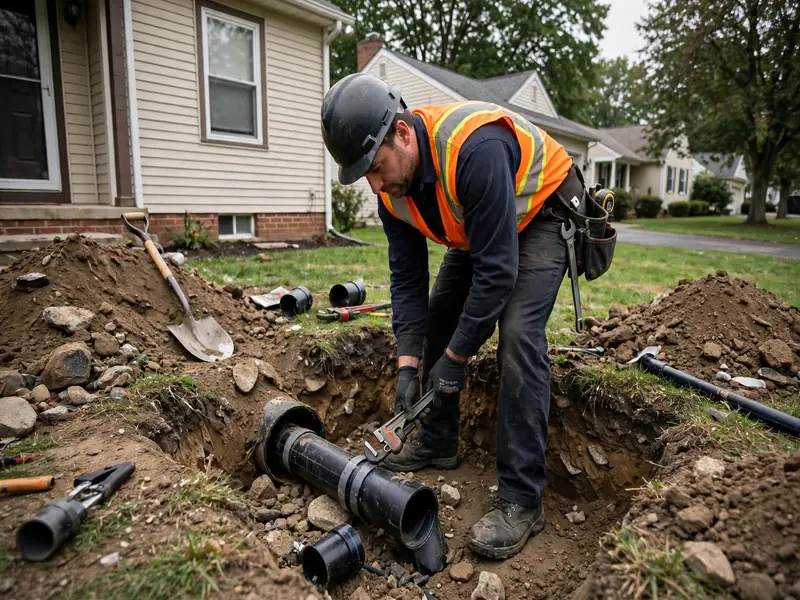
Avenel is a mix of eras: mid-20th-century colonials, Cape Cods, and ranch homes with a median build year around 1978, newer transit-oriented development around Avenel station, and former industrial ground along the rail corridor. That mix means the sewer laterals under Avenel streets range from 1940s clay tile to modern PVC — and the homes in between are exactly where replacement decisions get interesting.
The clay-tile-to-PVC transition era is the hardest to judge without a camera. A 1960s lateral might be sound clay with a few rooty joints, or it might be early PVC in perfect shape — or, in some 1950s tracts, bituminous fiber (Orangeburg) pipe that deforms and collapses after sixty years underground. Our sewer line replacement work in Avenel always starts with a full-length camera inspection so the recommendation matches the actual pipe, not the assumed era. When the footage shows systemic failure, we replace the whole lateral in one project: dig or trenchless, house to curb, with the yard restored afterward.
The Transition-Era Problem: Clay, Orangeburg, or Early PVC?
Avenel's subdivisions were built across the exact decades when sewer pipe materials changed. Clay tile dominated through the 1960s, bituminous fiber pipe (sold as Orangeburg) appeared in some 1950s tracts as a cheaper alternative, and PVC took over in the 1970s and 80s. A homeowner looking at a 1962 Cape Cod cannot know which material is under the lawn without a camera — and the answer changes everything about the project.
Clay tile fails at the joints: roots intrude, joints offset, and sections crack under soil movement. Orangeburg fails structurally: the fiber pipe softens, deforms into an oval, and eventually collapses inward, sometimes along its entire length. Early PVC, by contrast, usually fails only at isolated joints or from poor original bedding, and often does not need full replacement at all. That is why the inspection comes before any quote — replacing a line that could have been repaired wastes your money, and repairing a line that is systemically failed wastes it faster.
If the camera finds Orangeburg, replacement is the only real answer. Deformed fiber pipe cannot be lined or burst reliably in many cases, and its failures are never isolated. Clay tile with damage along most of the run is the classic pipe-bursting candidate. Early PVC with a single bad joint is a spot-repair job, not a replacement — and we will tell you that straight, because a contractor who recommends replacement for a repairable line is not one you should hire.
What Full Replacement Looks Like on an Avenel Lot
A replacement project has four phases: diagnosis, permitting, the pipe work, and restoration. Diagnosis is the camera survey plus locating — we mark the lateral's exact path and depth across your yard so the crew knows where every foot of the new line will go. Permitting covers the municipal excavation and plumbing permits for the house-to-curb work; we handle the paperwork and the inspections that the township requires.
The pipe work itself is either trenchless pipe bursting or an open-cut dig, chosen from the camera findings. Bursting pulls a new continuous HDPE line through the old pipe's path from two small pits, which keeps most of the yard, driveway, and walkways intact. A dig opens the full trench — necessary when the old line is fully collapsed, when bellies need regrading, or when the path crosses utilities that bursting cannot safely pass. Many Avenel jobs use a hybrid: bursting for the straight run, short open cuts at the foundation and curb connections.
Restoration closes the project. Trenches are backfilled and compacted in lifts to prevent settling, topsoil goes back, and the disturbed ground is seeded or sodded. Driveway and walkway sections that had to be cut are repoured to match. The goal is simple: within a few weeks of grass growing in, the only evidence of the project should be the new cleanout cap in the yard and drains that finally work.
Industrial Corridor Ground: Why Keasbey Border Jobs Need Extra Care
The former industrial zones near Avenel's rail corridor — the old General Dynamics site and the Ford plant grounds that operated from 1928 to 2004 — mean some properties sit near legacy utility runs and remediated ground. Sewer laterals in these areas can share the ground with abandoned lines, deep footings, and fill soils that complicate both bursting and digging.
On parcels near the industrial corridor, we add utility verification to the standard survey: private locates beyond the standard utility marking, and a careful review of the lateral's depth and surroundings before any excavation. Where records suggest remediated or fill soils, the excavation plan accounts for trench shoring and soil handling from the start rather than discovering problems mid-dig.
This is also where method selection gets conservative. Pipe bursting is a powerful tool, but near complex legacy utilities we favor open-cut sections with eyes on the ground, or we stage the burst only along verified-clear portions of the run. The extra planning costs a day; a struck unknown line costs far more.
Protecting Driveways, Walkways, and Patios During the Project
Avenel's mid-century lots are finished landscapes — concrete driveways, walkways, patios, and established plantings that homeowners don't want sacrificed to a sewer project. Trenchless pipe bursting exists largely for this reason: the new line follows the old pipe's path underground from two pits, so the hardscape above it stays exactly where it is.
Where the burst path must pass beneath a driveway or walkway, the tool tunnels underneath without cutting the surface. The only excavations are the pits at the foundation and the curb, positioned to avoid hardscape wherever the lateral's path allows. On lots where the camera shows a section that truly needs open cut — a collapse, a regrade — that section is opened, repaired, and restored with concrete repoured to match the existing work.
The planning matters more than the method. Before mobilizing, we map the lateral against every hardscape feature on the property and choose pit locations that minimize disruption. Restoration is specced to match — not just fill dirt, but compacted backfill, topsoil, and concrete or sod that blends with what was there. A sewer replacement shouldn't leave the property looking like a construction site a year later.
Partial Replacement: When Tying Into Sound Pipe Is the Honest Answer
Not every Avenel lateral needs full replacement. Where a previous owner already replaced part of the line — a common find in the transition-era stock — the camera may show sound PVC on one half and failing clay on the other. In that case, the honest project is a partial replacement: new pipe for the failed section, tied into the sound existing pipe with proper transition couplings.
The key word is proper. Clay-to-PVC transitions need shielded couplings rated for the diameter change, installed with correct grade on both sides so the joint doesn't become the next belly. The connection is pressure-tested and inspected like any other joint in the system — a transition done casually is a future failure point, and we don't install those.
But partial replacement has a strict limit: it only makes sense when the remaining pipe is genuinely sound. If the camera shows the 'good' section with roots at every joint and cracked tiles, tying new pipe into it just schedules the next project. We'll recommend partial replacement when the footage supports it — and we'll talk you out of it when the footage doesn't. The camera doesn't care about the invoice size; neither do we.
Local Insight
Avenel's housing eras shape every replacement quote we write here. The core subdivisions of mid-century colonials, Cape Cods, and ranches — median build around 1978, many dating to the middle of the 20th century — put most residential laterals squarely in the clay-tile-to-PVC transition, which is exactly why camera inspection decides between spot repair and full pipe bursting on nearly every job. Guessing the pipe material from the home's age is a losing game in this era range; the camera has to settle it.
The 1950s tracts carry an extra wildcard: some may contain Orangeburg-era fiber pipe, which fails by deforming and collapsing rather than by joint damage, and which commits a property to full replacement rather than lining or repair. We flag that possibility explicitly during inspection because the remedy is completely different.
And the geography matters. Freeze-thaw winters with January lows below freezing shift joints in old clay laterals, while heavy summer downpours drive infiltration and basement backups in aging systems. Former industrial ground near the rail corridor adds legacy utility runs and possible remediated soils to the excavation plan. A replacement in Avenel is never just a pipe swap — it is a pipe swap matched to the specific era, soil, and history of the lot.
Reach Out Today
One call connects you with a local sewer professional serving Perth Amboy, NJ — day or night.
Reach Out Today: (833) 713-2101Frequently Asked Questions
My Avenel home was built in the 1960s. How do I know what my sewer pipe is made of?
You can't tell from the surface — 1960s homes in Avenel may have clay tile, early PVC, or in some tracts Orangeburg fiber pipe. A camera inspection shows the material directly: clay appears as short jointed sections, Orangeburg as a deformed dark tube, PVC as long smooth runs. The inspection settles the material question before any replacement is quoted.
What is Orangeburg pipe, and does it change the replacement plan?
Orangeburg is a bituminous fiber pipe used in some 1950s-era installations. It softens underground, deforms into an oval, and eventually collapses — damage that is structural, not just at the joints. When inspection finds Orangeburg, full replacement is the only reliable fix; lining and spot repairs cannot restore a deformed fiber pipe.
Will pipe bursting damage my driveway or landscaping?
Bursting needs only two small pits — at the house and at the curb — so driveways, walkways, and most landscaping stay untouched. If the burst path must cross under a driveway section, the tool passes beneath it without cutting. Only the pit areas need restoration, which we handle as part of the project.
How do you handle the old industrial ground near the rail corridor?
With extra verification before excavation: private utility locates beyond standard markings, review of the lateral's depth and surroundings, and an excavation plan that accounts for fill soils and possible legacy lines. Near complex utility ground we favor open-cut sections with direct visibility over blind bursting.
Do I need a permit to replace my sewer lateral in Avenel?
Yes — sewer lateral replacement in Woodbridge Township requires municipal excavation and plumbing permits, with inspections of the new line before backfill. We prepare and file the permit paperwork and schedule the inspections, so the project stays compliant from the first pit to the final grade.
After replacement, will my basement stop backing up in heavy rain?
A new watertight HDPE or PVC lateral eliminates the infiltration and root intrusion that cause most backups — no joints for roots, no cracks for groundwater. If your home also has foundation drains tied into the sewer, we evaluate that connection separately during the project, since stormwater inflow is a different problem from a failing lateral.