Sewer Line Cleaning in Harbortown, Perth Amboy, NJ
Sewer line cleaning in Harbortown, Perth Amboy NJ deals with modern 1999-era PVC laterals — pipe that rarely needs replacement but still collects blockages, grease, and sediment. Professional service here focuses on clearing obstructions, camera-locating lines through slab foundations, and maintaining the shared and individual laterals of a waterfront townhome community exposed to high water tables.
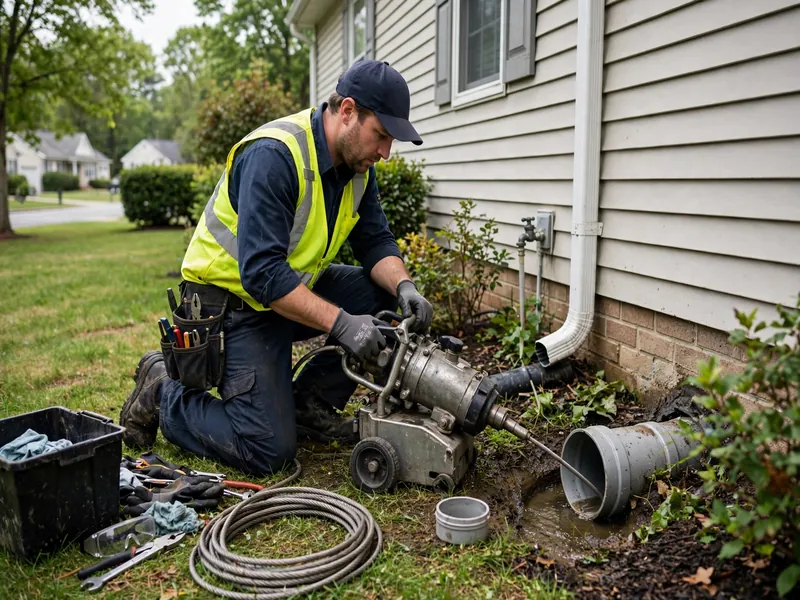
Harbortown is Perth Amboy's modern waterfront community: townhomes and condo buildings constructed around 1999 along Harbortown Boulevard, with slab-on-grade or garage-level foundations, plus the Harbortown Terrace rental complex. The sewer laterals here are late-1990s PVC — gasketed, watertight, and structurally sound in the way that only modern plastic pipe is. Sewer work in Harbortown is a different discipline from the root-and-scale battles of the city's century-old neighborhoods.
Sewer line cleaning is the removal of blockages to restore flow. In Harbortown, the blockages are behavioral and situational rather than age-related: grease and wipes accumulating in otherwise sound pipe, sediment settling where grading left a low spot, roots entering at the connection to the older municipal main, and the occasional foreign object or construction debris. The pipe is fine; what is inside it is the problem.
The community's waterfront setting adds the environmental dimension. Built on redeveloped waterfront land at low elevation near the Arthur Kill and Raritan Bay, Harbortown sits over fill soils with a high water table. Storm surge during nor'easters and heavy rain ponding on impervious townhome streets can push water into the system through any available opening — cleanouts, area drains, foundation connections. Cleaning here sometimes means dealing with what the water brought in.
Modern PVC: What Clogs When the Pipe Is Sound
A 1999 PVC lateral does not have the failure modes of old pipe. There are no mortar joints for roots to invade along the run, no corroding iron to scale shut, no century of joint displacement. The gasketed joints stay watertight, the smooth bore resists buildup, and the pipe's structural life is measured in many more decades. When a Harbortown lateral blocks, the cause is almost always what went into it or what settled around it.
The most common culprit is the modern household's drain habits. Wipes — even those marketed as flushable — do not disintegrate, and in a townhome lateral they accumulate at bends and connections until flow is restricted. Cooking grease, poured down the kitchen sink, coats the PVC bore and hardens; unlike old iron, the smooth plastic releases it easily under jetting, but it still has to be removed. Feminine products, paper towels, and the occasional children's toy complete the usual inventory of retrieved blockages.
The camera inspection on a PVC lateral is usually reassuring: clean joints, smooth walls, sound structure, with the blockage visible as a discrete mass rather than a systemic condition. That clarity is the advantage of modern pipe — the diagnosis is quick, the cleaning is straightforward, and the result is a line restored to essentially new condition. The conversation then turns to prevention, because on sound pipe, prevention is almost entirely about habits.
Locating Lines Through Slab Foundations
Harbortown's slab-on-grade and garage-level foundations change how sewer work is done. In a home with a basement, the building drain is visible overhead and the lateral's exit point is obvious. Under a slab, the drainage is buried in or beneath concrete — invisible, with access only through fixtures, vents, and exterior cleanouts.
Camera work with a locator sonde is the standard approach. The camera head emits a signal that the technician tracks from above with a receiver, mapping the lateral's path under the slab and through the yard, marking its depth and direction. This locating matters for cleaning — knowing exactly where the line runs, where it turns, and where it exits the building — and it matters enormously if a problem ever requires access through the slab.
For routine cleaning, interior access usually suffices: a toilet pull or a vent entry gives the equipment a path into the line. But homeowners should know where their exterior cleanout is — typically near the foundation on the lateral's path — because it is the preferred access for jetting and camera work. In a townhome community where units share walls, knowing which cleanout serves which unit avoids confusion during service. If you do not know where yours is, a locating visit that maps and marks it is time well spent.
Grease and Wipes: The Townhome Blockage Duo
In Harbortown's kitchens, grease is the slow builder and wipes are the sudden blocker, and together they account for most service calls. Grease poured down the sink — or rinsed from pans in dishwater — cools in the lateral and coats the bore. On PVC the coating does not bond the way it does on corroded iron, but layer upon layer still narrows the pipe, and the narrowed pipe then catches everything else.
Wipes are the accelerant. A single wipe can pass through a clean lateral without incident, but wipes accumulate: they snag at the toilet's trap, at pipe bends, at the connection to the main, and each snagged wipe catches the next. A lateral that has been quietly collecting wipes for a year can block suddenly and completely, with no gradual warning. The retrieved mass — a sodden tangle of wipes, paper, and grease — is unmistakable.
Hydro jetting clears both in a single visit. The scouring spray strips the grease coating and breaks up the wipe accumulation, flushing everything downstream. On sound PVC, the result is a line as clean as the day it was installed. The prevention is behavioral and absolute: grease in the trash, wipes in the trash, no exceptions. Townhome HOAs that communicate this to residents see measurably fewer blockages across the community.
Waterfront Water: Surge, Ponding, and Infiltration
Harbortown's waterfront position brings water challenges that inland neighborhoods do not face. During nor'easters, storm surge can raise water levels around the community's low-lying streets; heavy rain ponds on the impervious surfaces of townhome developments faster than the storm drains can clear it. That water looks for any opening into the sewer system — and it carries sediment, mulch, leaves, and street debris with it.
The entry points are usually above ground: area drains and driveway drains tied into the system, cleanout caps that are missing or unsealed, foundation drains connected to the lateral. A post-storm cleaning often finds the lateral loaded with storm debris that entered through these openings rather than through pipe defects — the PVC itself is watertight, but the system's openings are not.
The maintenance response is straightforward: keep cleanout caps sealed and accessible, keep area drains clear of leaves and mulch, and after a major storm, watch for slow drainage that signals debris in the line. A jetting visit flushes storm debris completely, and because the pipe is sound, there is no underlying damage to worry about — just the debris to remove and the entry points to secure before the next storm.
Shared Laterals and HOA Considerations
Townhome communities often have sewer arrangements that differ from single-family norms: laterals that serve multiple units before joining the main, shared cleanouts, or mains running under common areas. In Harbortown, understanding which pipe serves your unit — and who is responsible for which section — prevents confusion when a problem arises.
A backup in a townhome does not always originate in the affected unit's lateral. A blockage in a shared section downstream affects every unit above it, which means your backup might be caused by a neighbor's wipes three doors down. The camera survey sorts this out: it shows where the blockage is relative to each unit's connection, establishing whether the problem is individual or shared.
HOAs and property managers should maintain a sewer plan for the community: mapped laterals and mains, cleanout locations, service history, and a preventive cleaning schedule for shared sections. A shared lateral that is jetted on a planned interval — before blockages form — protects every connected unit. The cost of preventive maintenance on shared infrastructure is minor compared to the disruption of a multi-unit backup, and a community with a sewer plan resolves problems in hours instead of days.
Preventive Care for a Modern Sewer System
A 1999 PVC sewer system is a low-maintenance asset, not a no-maintenance one. The pipe will outlast the mortgage, but only if it is treated as infrastructure rather than ignored. The preventive program for Harbortown is simpler than for century-old neighborhoods, but it still matters.
The core of the program is habits. Grease in the trash, wipes in the trash, only toilet paper down the toilets — these three rules prevent the overwhelming majority of blockages in sound pipe. In rental units, where tenants may not know the system, landlords and property managers should communicate the rules at move-in; a one-page drain guide prevents more service calls than any equipment.
The second element is periodic verification. A camera inspection every few years — or after any backup, however minor — confirms the line is still sound and catches developing issues early: a belly forming from soil settlement, root intrusion beginning at the main connection, a cleanout cap failing. On modern pipe, these checks are quick and usually reassuring. And after major storms, a watchful eye on drainage speed catches storm debris before it compacts. Modern pipe plus modern maintenance equals decades of trouble-free service.
Local Insight
Harbortown's sewer cleaning profile is defined by modernity: 1999-era PVC laterals with gasketed watertight joints, structurally sound and decades from any age-related failure. The cleaning work here is not about deteriorating pipe — it is about blockages in sound pipe: grease, wipes, sediment, storm debris, and the occasional root intrusion at the connection to the older municipal main. This makes Harbortown cleanings among the most straightforward and most successful in the service area: the camera almost always shows sound pipe, the jetter restores it completely, and the results last because the pipe itself is not working against the cleaning.
The second defining factor is the slab foundation. With slab-on-grade and garage-level construction, the drainage is hidden under concrete, which makes camera locating — mapping the line's path and depth with a sonde — a core part of the service rather than an add-on. Homeowners should know their cleanout location and lateral path; a locating visit that marks both is valuable preparation that pays off in faster, less disruptive service for decades.
The third factor is the waterfront setting. Redeveloped waterfront land at low elevation, fill soils, a high water table, and exposure to nor'easter surge mean stormwater finds its way into the system through openings rather than pipe defects. Post-storm debris cleanings are the characteristic Harbortown service event, and securing entry points — sealed cleanout caps, clear area drains — is the characteristic prevention. For a community of this vintage, the sewer story is optimistic: modern pipe, maintainable with habits and periodic checks, serving reliably for generations.
Book Service
One call connects you with a local sewer professional serving Perth Amboy, NJ — day or night.
Book Service: (833) 713-2101Frequently Asked Questions
My Harbortown townhome was built in 1999. Why would its sewer line need cleaning?
Because blockages come from use, not just age. Grease, wipes, and sediment accumulate in even perfect pipe, and storm debris can enter through drains and cleanouts. The good news is that cleaning a sound PVC lateral restores it completely — the pipe is not deteriorating, so a professional jetting gives you essentially a new line's performance.
How do technicians find the sewer line under my slab foundation?
With a camera equipped with a locator sonde. The camera travels through the pipe while the technician tracks its signal from above with a receiver, marking the line's path and depth on the surface. This maps the lateral under the slab and through the yard without any digging, and it identifies the optimal access points for cleaning.
The backup affected my unit but the blockage was in a shared section. Who is responsible?
That depends on your HOA documents and local ownership rules — shared sections are typically common-area responsibility. The camera survey establishes the facts: exactly where the blockage was relative to each unit's connection. With that evidence, the HOA or property manager can determine responsibility under the community's governing documents.
Can roots really invade a PVC sewer line?
Not through the pipe's gasketed joints along the run — those stay watertight. But roots can enter at the connection to the older municipal main, at any damaged section, or through an unsealed cleanout. If the camera shows roots, they are at one of these vulnerability points, and the cleaning targets that specific location rather than the whole run.
What should I do after a big storm if my drains seem slow?
Check your area drains and cleanout caps first — storm debris often enters through these openings. If drainage stays slow, schedule a jetting visit: storm sediment and debris flush out completely from sound PVC, and the camera confirms nothing else is wrong. Do not ignore post-storm sluggishness; debris compacts over time and gets harder to clear.
Are flushable wipes really a problem in modern pipes?
Yes. Wipes do not break down in water the way toilet paper does, and they accumulate at bends, connections, and any slight irregularity — even in perfect PVC. A year's worth of flushed wipes can form a sudden, complete blockage. In a townhome community, one unit's wipes can block a shared section and back up neighboring units. They belong in the trash, without exception.