Sewer Line Cleaning in Downtown Perth Amboy, NJ
Sewer line cleaning in downtown Perth Amboy, NJ serves century-old clay and cast-iron laterals under dense Smith Street blocks, sometimes shared between rowhouses. It means careful root cutting and commercial-grade grease jetting in tight-access conditions, always starting with a camera inspection.
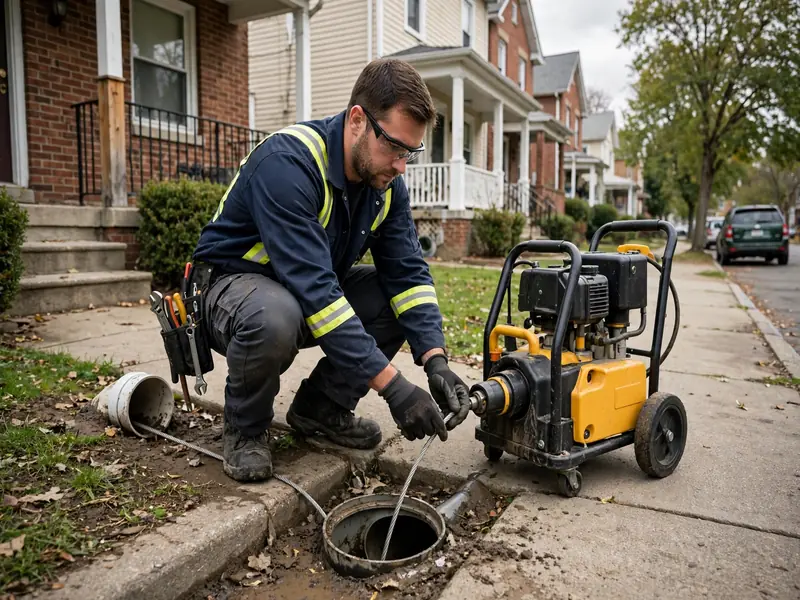
Downtown Perth Amboy is among the oldest urban cores in New Jersey — settled in 1683, with late-1800s and early-1900s colonials, rowhouses, and mixed-use buildings packed along Smith Street and the surrounding blocks. The sewer laterals under these properties are often as old as the buildings: clay tile and cast iron laid a century or more ago, in an era before standardized materials, before cleanouts were routinely installed, and sometimes before each building even had its own dedicated line to the street.
Sewer line cleaning downtown is specialized work. The blockages are the familiar ones — roots, grease, scale, sediment — but the setting complicates everything: tight lots with no yard access, laterals running under buildings and sidewalks, commercial kitchens discharging grease into century-old pipe, and the occasional shared party line serving two rowhouses from a single connection. A cleaning visit here requires planning that a suburban job never needs.
The commercial character of the district adds a second dimension. Smith Street's restaurants, food shops, and mixed-use buildings put grease loads into their laterals that residential lines never see. For these properties, cleaning is not an occasional service but a recurring operational necessity — and the difference between a planned jetting schedule and an emergency backup is the difference between a normal business day and a closed kitchen.
Century-Old Pipe: What Cleaning Can and Cannot Do
A lateral laid in 1910 has given a century of service, and cleaning can extend that service — but only within the pipe's structural limits. The clay tile of this era is joined every few feet, and after a hundred freeze-thaw cycles many of those joints are open, offset, or missing entirely. Cast-iron sections are deeply corroded, their interiors narrowed by scale. Cleaning removes what has accumulated inside the pipe; it cannot restore what the pipe has lost.
The camera inspection is therefore not optional downtown — it is the entire basis for the work plan. It reveals which sections are intact enough to clean aggressively and which must be treated gently or not at all. It maps the lateral's path, which on these old blocks may run under a neighboring property or tie into a shared line. And it documents the connection to the city main, which on century-old infrastructure can itself be a source of problems.
Where the pipe is sound, cleaning is remarkably effective. A century of roots cut out, decades of grease jetted away, sediment flushed to the street — the line can flow as well as it has in years. Where the pipe is failing, the camera shows it honestly: separated joints, collapsed sections, pipe walls too thin to trust. In those cases the cleaning visit becomes a diagnostic visit, and the honest recommendation is repair or replacement rather than another round of clearing.
Grease: The Downtown Commercial Challenge
Smith Street's food businesses — restaurants, takeout shops, bakeries, markets — discharge grease into laterals that were designed long before commercial grease loads existed. Hot grease goes down the drain as a liquid and hardens on the pipe walls within feet. Over months, the buildup narrows the lateral; over years, it can choke a century-old line that was already narrowed by scale.
Commercial grease behaves differently from residential grease. The volumes are larger, the discharge is hotter and more frequent, and it often carries food solids that embed in the grease layer and harden into a concrete-like mass. A residential jetting clears a coating; a commercial kitchen lateral may need an aggressive, extended jetting to cut through inches of accumulated material.
For downtown food businesses, scheduled preventive jetting is a cost of doing business — and a small one compared to the alternative. A grease backup that closes a kitchen during dinner service costs more in a single evening than a year of planned cleanings. The schedule depends on the volume: a busy fryer operation may need quarterly service, while a small café may go six months. The camera footage from each visit tracks the buildup rate and lets the schedule be tuned to the actual kitchen, not a generic recommendation.
Access Planning on Tight Urban Lots
Downtown's dense blocks were not designed with sewer maintenance in mind. Houses sit close together on narrow lots, laterals run under buildings, sidewalks, and paved courtyards, and cleanouts — the access points through which cleaning equipment enters the pipe — are often missing, buried, or inaccessible. The first task on many downtown cleaning visits is simply figuring out how to get into the line.
Where no cleanout exists, the technician has options. Roof vents can sometimes serve as access for camera and jetting equipment. A toilet can be pulled to provide entry to the line — effective but disruptive, and it requires resetting the toilet afterward. In some cases, the right move is to install a proper cleanout before cleaning, giving every future visit straightforward access. For a property with century-old pipe and recurring issues, a cleanout installation pays for itself in reduced service complexity.
Tight access also affects equipment choice. Full-size jetting rigs may not fit down narrow alleys or into cramped basements; compact equipment and sectional cable machines earn their keep downtown. Trenchless repair methods, which need only small access pits, are often the only practical replacement option on lots where open-trench digging would mean tearing up a building or a sidewalk. Cleaning keeps the line going; access planning keeps cleaning possible.
Shared Party Lines Between Rowhouses
Some of downtown's oldest rowhouses share sewer infrastructure — a single lateral serving two or more homes, or lines that cross property boundaries laid down before modern surveying. These shared arrangements complicate cleaning in ways that go beyond the technical work.
Technically, a shared line carries the combined load of multiple households, so it accumulates blockages faster than a single-family lateral. Roots invade the same joints; grease from multiple kitchens layers the same pipe. The cleaning itself is standard — cut, jet, camera — but the line must be cleaned as a whole, from the most upstream entry to the street connection, or debris cleared from one section simply relodges downstream.
Practically, shared lines raise questions of responsibility and access. Whose cleanout provides entry? Who schedules and pays for maintenance? What happens when one household's habits — wipes, grease — cause backups in the neighbor's basement? These are property questions, not plumbing questions, but they affect the work: a maintenance plan for a shared line needs the agreement of everyone it serves. A camera survey documenting the shared arrangement is the factual starting point for those conversations.
Roots and Water at the Bay's Edge
Downtown Perth Amboy sits adjacent to Raritan Bay at low elevation, and that geography reaches into the sewer system. Groundwater presses against old clay joints, infiltrating the lateral and carrying silt. During nor'easters and heavy rain, the system can surcharge — the public main fills, and water backs toward the buildings. A lateral already narrowed by a century of roots and grease has no spare capacity when the storm arrives.
Root intrusion downtown follows the urban pattern: street trees in tree pits, courtyard plantings, and the surprisingly vigorous vegetation of vacant lots all send roots toward leaking joints. The roots here are often discovered during emergency calls — a backup on a rainy Saturday night — because the combination of root narrowing and storm infiltration overwhelms the line suddenly.
Cleaning for this environment has to be thorough. Cutting the roots without jetting the silt leaves half the blockage. Jetting without addressing the grease leaves the commercial contribution. And any cleaning that is not followed by a camera survey leaves the property owner blind to how close the line is to its next failure. Downtown laterals reward comprehensive visits and punish quick ones.
From Emergency Clearing to Maintenance Planning
Too many downtown properties live in a cycle: emergency backup, emergency clearing, quiet months, repeat. Each emergency visit clears the immediate blockage under time pressure, often without a full camera survey, and the underlying condition — the joints admitting roots, the grease accumulating, the scale narrowing the iron — continues undisturbed until the next crisis.
Breaking the cycle starts with a non-emergency visit: a planned cleaning with a complete camera survey, done when the drains are working. Without the pressure of standing water, the technician can work methodically — cut every root mass, jet the full lateral, document everything. The footage becomes the property's sewer baseline, and the technician's recommendations become a maintenance plan with a real schedule.
For commercial properties, the plan includes the kitchen's contribution: grease trap maintenance coordinated with lateral jetting, staff training on what goes down the drain, and a service interval matched to the business's volume. For residential and mixed-use buildings, it includes the habits that protect old pipe and a cleaning rhythm that stays ahead of root regrowth. The goal is simple: the next visit should be on the calendar, not on the emergency line.
Local Insight
Downtown Perth Amboy's sewer cleaning reality starts with pipe age that is unmatched in the service area: laterals from the late 1800s and early 1900s, now a century or more old, built from clay tile and cast iron in an era before modern standards. Some properties may still tie into legacy combined or shared party-line laterals, which means the cleaning visit must begin with mapping — figuring out what the line is, where it runs, and who shares it — before any tool goes in. No other neighborhood requires this much diagnosis before cleaning.
The second defining factor is the commercial corridor. Smith Street's Urban Enterprise Zone concentrates food-service grease loads into century-old laterals, creating the area's most cleaning-intensive properties. A restaurant lateral downtown can need in a quarter what a residential lateral needs in years, and the businesses that thrive are the ones that treat jetting as scheduled maintenance rather than emergency response. The grease challenge here is structural to the district, not incidental.
The third factor is water and ground. Adjacent to Raritan Bay at roughly thirteen feet of elevation, with urban fill soils and flood-zone exposure, downtown laterals take on groundwater through every open joint and face surcharging during nor'easters. Cleaning must therefore handle silt and infiltration debris as routine blockage material, and every visit should leave the owner with camera documentation of how much water is entering the line — because on a century-old bay-edge lateral, infiltration is not a side issue but a central one.
Talk to a Specialist
One call connects you with a local sewer professional serving Perth Amboy, NJ — day or night.
Talk to a Specialist: (833) 713-2101Frequently Asked Questions
My downtown building has no accessible cleanout. Can the sewer still be cleaned?
Yes, though it takes more planning. Technicians can often work through a roof vent, pull a toilet for access, or camera from the street connection. For a building with recurring issues, installing a proper exterior cleanout is usually the smartest first investment — it makes every future cleaning faster, more thorough, and less disruptive.
How often should a restaurant lateral downtown be jetted?
It depends on kitchen volume, but busy food-service laterals often need preventive jetting quarterly, with smaller operations on a semiannual schedule. The camera footage from each visit shows the grease accumulation rate, which lets the interval be tuned to the actual kitchen. Waiting for a backup is always more expensive than the scheduled visit.
What is a party line, and how do I know if my building has one?
A party line is a sewer lateral shared between two or more properties — common in rowhouses built before modern codes. A camera survey reveals it: the technician can see connections joining from neighboring buildings. If your drains back up when the neighbor has plumbing work done, or vice versa, a shared line is a strong possibility worth confirming on camera.
Can a hundred-year-old lateral be cleaned safely?
If the camera shows the pipe is structurally intact — joints aligned, walls holding — then yes, with techniques matched to its fragility. If the camera shows separated joints, collapsed sections, or disintegrating walls, aggressive cleaning risks damage, and the honest recommendation is replacement, often by trenchless methods suited to tight downtown lots.
Why do downtown backups happen during storms even when drains were fine?
Stormwater infiltrates the old clay joints and surcharges the public main, sending water back toward buildings. A lateral narrowed by roots and grease has no spare capacity for that extra water. The pattern — fine in dry weather, backing up in storms — is the signature of infiltration meeting restricted flow, and it is common on bay-adjacent blocks.
Does the city maintain my lateral, or am I responsible for it?
In virtually all cases, the property owner is responsible for the lateral from the building to its connection with the public main — including the section under the sidewalk and street. The municipality maintains the main itself. That is why cleaning, camera surveys, and eventual replacement of the lateral fall to the property owner.