Sewer Camera Inspection in Edison, NJ
A sewer camera inspection in Edison, NJ first identifies your pipe's era — pre-war clay, mid-century Orangeburg, or modern PVC — then assesses its condition. Across the township's mixed housing, the footage matches each lateral to its right plan: maintenance, sectional repair, or replacement.
Edison — New Jersey's fifth-largest municipality, renamed from Raritan Township in 1954 — covers enough ground and enough history that two laterals on the same street can be fifty years apart in material. Property records show homes built from 1906 through 1984 as typical, with colonial-era pockets around Piscatawaytown, dense postwar subdivisions like Pumptown Corners, and modern townhome developments filling in the gaps. The 08837 area covers the southern township near Raritan Center.
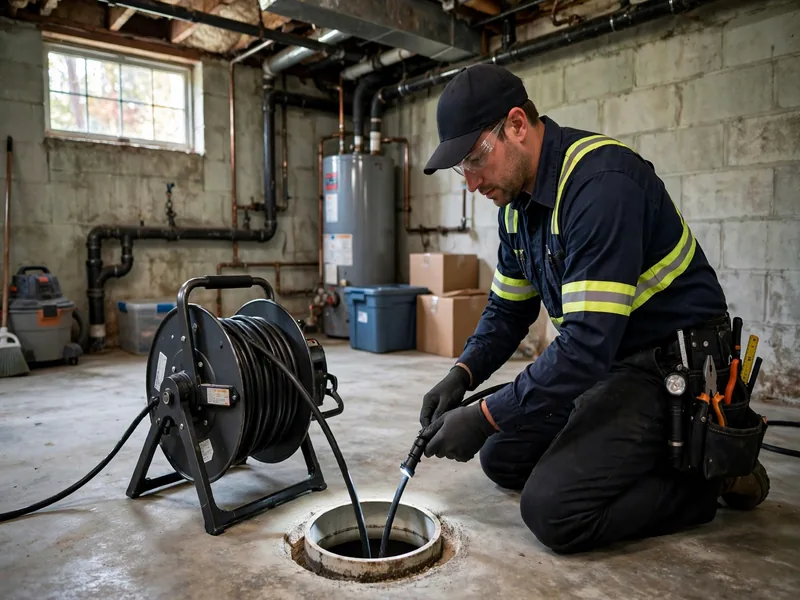
The technique never changes, only the pipe does: a waterproof camera head pushed on a flexible rod goes in through a cleanout or interior access, broadcasting live footage while the sonde in its tip lets the operator log the position and depth of everything it passes. What varies is what the camera finds — and in Edison, the range is the widest in the service area.
That range is precisely why inspection-first is the rule here. Quoting sewer work in Edison without camera footage means guessing the pipe's material, age, and condition — three variables that swing a project from a simple cleaning to a full replacement. The camera replaces all three guesses with footage.
Reading Pipe by Era: What the Camera Shows
In Edison's pre-1940 pockets, the camera finds clay tile and cast iron in the classic pattern: root intrusion at joints, freeze-thaw offsets, mortar washed away over the decades. These are the township's oldest laterals, and the camera's assessment is usually a lifespan question — maintainable or finished.
In the dense 1940-1969 subdivisions — the township's biggest cohort — the camera most often finds clay tile in mid-life crisis: joints invaded by roots from now-mature subdivision trees, sections offset by decades of heave, occasional bellies where backfill settled. Some tracts from the 1950s and 1960s may carry Orangeburg, and the camera's identification of that blistered, deformed fiber pipe is a pivotal moment: Orangeburg cannot be durably repaired, so the footage converts a maintenance question into a replacement plan.
In 1970s-and-later sections, the camera typically finds PVC — and the findings shift accordingly. PVC does not invite roots through its walls, but its joints can separate where the ground has moved, and poorly bedded runs develop bellies that hold standing water. The camera shows these clearly: a separated joint appears as a visible gap with soil behind it, a belly as a reflective pool with sediment. Modern townhome laterals are usually sound, and the camera's role there is blockage diagnosis — grease, wipes, or construction debris rather than pipe failure.
The Raritan River Factor: Floodplain Laterals
Edison's low land along the Raritan River floodplain — the Johnson Park area flooded in Floyd, Irene, and Sandy — gives some township laterals a second failure mode beyond age: flood-driven infiltration and surcharging. Laterals in the floodplain sit in ground that saturates during river flooding, and cracked clay joints admit water under pressure.
The camera documents this vulnerability in dry weather: joints and cracks that will admit floodwater, bellies that will hold it, offsets that will trap debris the flood carries in. For floodplain homeowners, the inspection doubles as flood-readiness documentation — the footage shows exactly where the line is vulnerable before the river rises.
After a flood, the camera serves a different purpose: damage assessment. Flood-borne debris, displaced sections, and newly opened joints all appear on camera, and dated post-flood footage supports insurance documentation. Homeowners in the floodplain should consider a post-event inspection part of the recovery checklist, alongside the more visible repairs.
Mixed Streets, Mixed Materials: Why Neighbors' Experience Misleads
On an Edison street with homes from several eras, the neighbor's sewer story tells you nothing about yours. The 1950s cape with original clay tile, the 1978 split with early PVC, and the 2005 townhome with modern PVC share a street but not a pipe — and not a failure mode, maintenance schedule, or replacement cost.
This is where the camera's identification function pays for itself repeatedly. A homeowner who assumes their line matches the neighbor's replaced PVC line — and therefore assumes a simple cleaning will fix recurring backups — may actually own Orangeburg that needs replacement. Conversely, a homeowner bracing for a full replacement may learn from the camera that their clay line needs only targeted joint work.
Real-estate transactions in Edison should treat the camera inspection as era-appropriate diligence. The township's housing turnover includes many mid-century homes changing hands, and a lateral's material and condition are invisible in every disclosure except a camera survey. Buyers who inspect know what they are buying underground; sellers who inspect can document what they are selling.
How Inspections Run Across Edison's Housing Types
Access varies by era. Colonial-era and pre-war homes usually lack cleanouts; the technician works through basement floor drains or pulled toilets — and basements are common across most Edison eras, which keeps interior access workable. Mid-century ranches on slabs or crawlspaces may need the toilet-pull method. Modern townhomes often have cleanouts as standard.
The inspection itself follows the lateral from the house to the public sewer, with the technician narrating material changes — the cast-iron-to-clay transition in older homes, the clay-to-PVC transition in hybrid lines, the Orangeburg identification when it appears. The sonde locator tracks position and depth throughout, marking the surface above each finding.
Edison's larger lots in some sections mean longer lateral runs, and the locator's path-mapping earns its keep: knowing the line's route across a deep yard prevents exploratory digging and keeps any future work surgical. The recording, with footage markers, becomes the property's underground record — useful across ownership changes in a township where homes turn over regularly.
From Diagnosis to Decision in a Multi-Era Township
The camera's verdict in Edison is always material-specific. Sound PVC with a blockage: clean it and move on. Clay with isolated root intrusion: targeted cleaning and monitoring. Clay with systemic joint failure: replacement planning. Orangeburg, whatever its current symptom: replacement — the camera's identification ends the maintenance conversation.
Floodplain findings add a watertight specification to any replacement: seamless pipe that keeps river-season groundwater out. The camera's documentation of infiltration points makes the case for that specification with visible evidence.
For the township's many mid-century homes approaching lateral end-of-life simultaneously, the camera also serves a timing function. A line that is deteriorating but not yet failed can be monitored with periodic inspections — the recordings compared over time — so replacement happens on the homeowner's schedule rather than as an emergency excavation. In a township where entire subdivisions are aging together, that planned approach beats the alternative: every line failing at once, every homeowner surprised.
Local Insight
Edison's camera inspections are defined by variety — the township's layered housing, from colonial-era pockets through dense 1940-1969 subdivisions to modern townhomes, buried a different pipe in each era, and the camera's first task is always identification. Pre-1940 clay tile shows root intrusion and freeze-thaw offsets; 1940s-60s tracts show the same plus possible Orangeburg, whose blistered interior the camera identifies definitively; 1970s-and-later PVC shows separated joints and bellies instead. Along the Raritan River floodplain, where Johnson Park-area flooding in Floyd, Irene, and Sandy is documented history, the camera doubles as flood-vulnerability documentation — showing the joints and cracks that admit water when the river rises. Freeze-thaw works every rigid joint in the township each winter, and nor'easter downpours test drainage across all eras. For Edison, the inspection is the antidote to assumption: on streets where neighbors' pipes differ by half a century, only the camera says what you actually own underground.
Request Service Today
One call connects you with a local sewer professional serving Perth Amboy, NJ — day or night.
Request Service Today: (833) 713-2101Frequently Asked Questions
My street has homes from the 1950s to the 2000s. Does that matter for my sewer?
It matters enormously. Your lateral's material depends on when your home — or its last sewer replacement — was built, not on your neighbors' pipes. A 1950s home may have clay or Orangeburg while the 2005 townhome next door has PVC, with completely different failure modes. The camera identifies your specific pipe, so your maintenance and repair decisions match your actual line rather than a neighbor's experience.
What does Orangeburg pipe look like on a camera?
Distinctive and unmistakable: the interior appears blistered, deformed, or delaminated — walls that look melted, flattened, or collapsed inward, unlike the crisp round sections of clay or the smooth bore of PVC. Technicians recognize it immediately. Finding Orangeburg is decisive because the pipe has no durable repair option; the inspection converts the question from 'how do we fix it' to 'when do we replace it.'
I live near the Raritan River. Should I inspect even without symptoms?
A baseline inspection is wise in the floodplain. The camera documents your lateral's vulnerability — the joints and cracks that admit water — before the next flood tests them, and that footage supports both repair planning and insurance documentation. After any flood that reaches your property, a follow-up inspection assesses new damage: displaced sections, debris, opened joints.
Can the camera inspect a line that has both clay and PVC sections?
Yes — hybrid lines are common in Edison, where partial replacements over the decades have spliced PVC onto original clay. The camera shows each material transition clearly, assesses each section on its own terms, and locates the transitions by footage. That segmented assessment is exactly what a hybrid line needs, since the clay portion and the PVC portion have different lifespans and failure modes.
How long does an Edison inspection take on a long lateral?
Most residential inspections finish in under two hours regardless of length; longer laterals simply mean a longer camera traverse, not a different process. The locator mapping that comes with a long run is valuable in itself — it charts the line's path across the yard, which prevents exploratory digging if work is ever needed.
My home was built in the 1970s with PVC. Do I still need inspections?
Less urgently than clay or Orangeburg owners, but PVC is not immortal. Joints can separate as ground moves, bellies form in poorly bedded runs, and blockages from grease or wipes still occur. An inspection every five years — or whenever symptoms appear — catches separated joints and bellies before they become emergencies. The camera's verdict on sound PVC is quick and reassuring.