Trenchless Pipe Lining in Metuchen, NJ
Pipe lining rehabilitates Metuchen's layered housing stock — Victorian-era clay, 1920s lines, and 1945-70 clay laterals — without disturbing landmark-adjacent streets or historic-district landscaping. A resin liner cures inside the old pipe into a jointless new wall, sealing a century of root intrusion and joint failure. Camera inspection establishes each property's material and era before the lining plan is drawn.
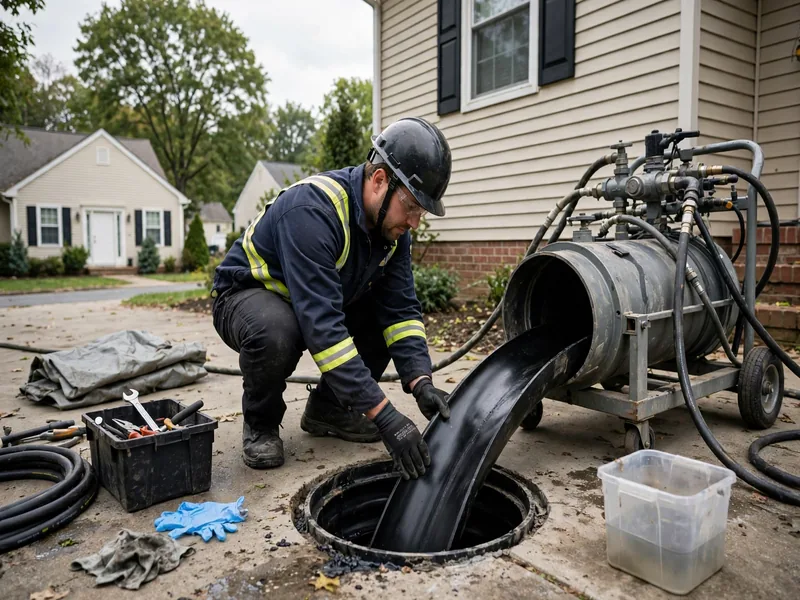
Metuchen's "Brainy Boro" streetscape is a timeline of American residential construction: Victorian-era homes around Tommy's Pond, 1920s apartment developments, 1945-1970 Capes and ranches in Beacon Hill, modern downtown townhomes. The sewer laterals beneath them span the same timeline — clay tile and cast iron at 100-plus years in the oldest homes, mid-century clay in the postwar tracts, PVC in the newest builds.
Trenchless pipe lining — cured-in-place pipe (CIPP) — serves this layered stock with a per-lateral candidacy model. A resin-saturated liner is installed inside the existing pipe and cured into a hard, jointless new wall. It rehabilitates whatever the inspection finds lineable: Victorian clay with century-old joints, 1920s lines with root intrusion, mid-century clay at peak failure age. One method, fitted to each era's pipe.
The historic districts add a preservation dimension: streets where excavation would disturb landmark-adjacent landscapes and mature trees. This page explains how lining serves each of Metuchen's eras, how the inspection sorts them, and where the limits fall.
Victorian Clay: The Oldest Lines in the Borough
Metuchen's Victorian-era homes — the Tommy's Pond district, the Middlesex Avenue-Woodwild Park Historic District — carry the borough's oldest residential laterals: clay tile and cast iron at 100-plus years. These lines predate modern jointing entirely; their connections have had twelve decades of freeze-thaw, soil movement, and root pressure to separate.
The camera pattern on Victorian clay is the end stage of joint failure: wide separations, heavy root colonization at every joint, cracked sections, occasional offsets where the ground has moved. Yet the vitrified segments themselves are frequently sound — clay does not rot or corrode. The pipe's shape survives its connections, which is the structural profile lining rehabilitates.
Cast iron from the same era shows interior corrosion — scale, tuberculation, wall thinning. Where the iron remains continuous, descaling plus lining restores it: the liner bonds to cleaned metal and becomes the new corrosion-proof interior. Perforated or collapsed iron needs replacement, which the inspection distinguishes.
What makes Victorian laterals worth lining rather than replacing is the setting as much as the pipe. These are landmark-adjacent streets with mature trees and historic landscapes where open-cut excavation is destructive and often restricted. Lining rehabilitates the pipe while the historic streetscape above remains untouched — preservation and function in a single trenchless project.
The 1920s and Postwar Layers: Lining's Core Demographic
Metuchen's 1920s developments — Jefferson Park, Redfield Village-era apartments — and the 1945-1970 Capes, ranches, and split-levels carry clay-tile laterals at 55 to 100 years old. This is lining's core demographic across the entire service area: joint failure well advanced, root intrusion established, pipe structure intact.
The 1920s lines show the deeper version: near-century joints, heavy colonization, more cracked sections. The postwar lines show the peak version: 55-80 years, joints separated enough for thorough root entry, segments still round. Both line well where continuous — the liner spans the defects identically regardless of which decade produced them.
Mature trees in the historic districts intensify the root pattern. Metuchen's tree canopy is one of its defining features, and decades-old root systems have thoroughly mapped the clay joints beneath these streets. The clearing cycle — cut, regrow, cut again — is well established on many blocks. Lining's jointless barrier is the only repair that ends it, sealing every entry point the roots have spent decades finding.
The inspection on these lines is the standard thorough survey: full-length camera run, defect mapping, material confirmation, connection verification. What it typically confirms is candidacy — continuous clay with joint defects — and the lining plan follows directly. These are the lines the method was built for.
Lining Near Landmarks: The Preservation Argument
Open-cut sewer replacement on a historic-district street is destructive by nature: a trench through mature landscaping, possibly through landmark-adjacent plantings, with restoration that can never quite return a decades-old landscape. Some districts also carry review requirements for exterior work that complicate excavation further. Trenchless lining avoids the entire question.
The installation happens inside the existing pipe through an access point. The mature oak over the lateral is never root-pruned by a trench. The historic garden bed is never excavated. The streetscape that gives the district its character remains exactly as it was. Preservation commissions, where they have jurisdiction, generally view trenchless rehabilitation as the least invasive option — because it is.
This is not just aesthetics. Mature trees pruned by trenching often decline, and declining trees become hazards and removal costs. The root systems that colonize clay joints are the same systems a trench would sever. Lining seals the joints without touching the roots — the tree keeps its root system intact while losing its access to the pipe interior. Both the landscape and the sewer end the project better off.
For Metuchen's historic-district homeowners, the lining evaluation therefore carries weight beyond the pipe: it is the rehabilitation method compatible with the street's historic character. The camera still decides candidacy — a collapsed Victorian lateral needs replacement regardless of setting — but where the pipe qualifies, lining is the preservation-consistent choice.
Cast Iron Descaling in Metuchen's Older Homes
Metuchen's Victorian and 1920s homes commonly pair clay-tile exterior laterals with cast-iron interior drainage — and sometimes cast-iron exterior sections. Iron of this age shows deep interior corrosion: scale buildup, tuberculation, narrowed bore, eventual perforation. A liner cannot bond to heavily scaled iron, so descaling precedes any lining of iron sections.
Descaling is mechanical: chain-flail heads or abrasive jetting worked through the pipe under camera guidance, stripping scale until sound metal shows. The technician watches the wall emerge — pitted but solid iron is the green light; paper-thin or perforated iron is the stop sign. This judgment, made from live footage, determines whether the iron lines or gets replaced.
Once descaled, century-old iron lines well. The liner covers the pitted interior with smooth epoxy, arresting corrosion from the inside. The iron's remaining job is structural support during installation — sound iron handles it. The finished lined iron has the flow characteristics of new pipe with the location of old pipe.
Clay sections skip descaling — vitrified clay does not corrode — and get root cutting plus jetting instead. A Metuchen lateral with both materials gets both preparations, sequenced in the same project: descale the iron, cut the clay's roots, verify everything on camera, then install one liner spanning the full run.
The Job Sequence, Era by Era
Every Metuchen lining job opens with the camera survey, and the survey's first deliverable is era identification: Victorian clay, 1920s clay, postwar clay, or modern PVC — each with its own defect pattern and preparation. Length, diameter, defect map, and municipal connection are documented regardless of era; the material determines what happens next.
Cleaning matches the material: root cutting and jetting for clay, descaling plus jetting for iron, debris clearing for PVC. The post-cleaning camera pass is the candidacy confirmation — with a century of roots or scale removed, the pipe's structural truth is visible, and the liner measurement is finalized from clean footage. No installation proceeds on uncleaned pipe.
The liner installation is era-independent: resin-saturated tube, measured to the run, inverted or pulled into position through the access point, seated under air or water pressure, cured over several hours with the lateral out of service. Victorian short runs cure quickly; longer postwar runs take proportionally longer. The physics does not change with the pipe's age.
Verification closes every job identically: final camera run showing the smooth, jointless, fully cured interior; ends trimmed and sealed; access restored; before-and-after footage to the homeowner. In a borough of many eras, that footage is also the property's pipe record — material, condition, and rehabilitation documented for whatever the next decades bring.
When Metuchen Pipes Do Not Qualify
Collapse is the universal disqualifier: where clay has caved or iron has fully deteriorated, no liner follows. Victorian lines collapse occasionally — usually under streets where traffic loading compounded a century of soil pressure. The camera marks these precisely; they become bursting or excavation targets.
Bellies disqualify by geometry: a liner preserves the pipe's shape, so settled low spots remain low. Metuchen's rolling terrain is generally stable, but localized settlement near old backfill or stream corridors happens. The waterline view on camera shows bellies plainly; they need regrading, not lining.
Major offsets defeat lining where clay joints have sheared into large steps — a real risk after a century of frost heave. Minor offsets bridge fine; the footage measures each step against the pipe diameter for the call.
Modern PVC in good condition needs no lining at all — proposing it would be selling, not diagnosing. And historic-district restrictions, while favoring trenchless methods, do not override structural reality: a collapsed Victorian lateral needs replacement, and the replacement is planned with the district's requirements in mind. The camera decides candidacy; the setting decides how the chosen method is executed most compatibly.
Local Insight
Metuchen's lining candidacy flows from three card facts. First, the layered housing: Victorian-era homes, 1920s developments, 1945-1970 Capes and ranches, modern downtown infill — laterals spanning 100-plus-year clay and iron through mid-century clay to modern PVC. Lining's per-lateral candidacy model fits this layering exactly, but it makes era identification the inspection's first job; the method follows the pipe's era, never a borough-wide assumption.
Second, the historic districts: the Middlesex Avenue-Woodwild Park Historic District and Victorian streetscapes where excavation would damage landmark-adjacent landscapes and mature trees. Lining's inside-the-pipe installation is the preservation-compatible rehabilitation — the streetscape above remains untouched while the century-old pipe below is renewed. Where the pipe qualifies, lining serves both function and preservation.
Third, the mature-tree root pressure: historic-district canopies with decades-old root systems thoroughly colonizing clay joints, plus freeze-thaw heave working those joints open. Lining's jointless barrier permanently ends the root cycle the canopy drives — sealing every entry point in one installation rather than resetting the clearing clock each season. For Metuchen, lining matches the pipe's era, the street's character, and the trees' pressure at once.
Reach Out Today
One call connects you with a local sewer professional serving Perth Amboy, NJ — day or night.
Reach Out Today: (833) 713-2101Frequently Asked Questions
Our home is in a historic district. Does lining require special approvals?
Trenchless lining typically faces fewer approval hurdles than excavation because it does not disturb the streetscape, landscaping, or exterior appearance — the work is invisible from the surface. Still, check your district's specific rules and your municipality's permit requirements before scheduling, since requirements vary. The access-point work is minor and usually the only visible activity. Your contractor should be familiar with working in historic districts and can advise on the local process.
Can 100-year-old Victorian clay really be lined, or is it too old?
It can, if it remains structurally continuous. Vitrified clay does not expire chemically — a century fails the joints, not the segments, and the liner rehabilitates exactly that failure mode. The post-cleaning camera footage is the verdict: continuous walls with joint defects line beautifully at any age. What disqualifies a Victorian lateral is structural failure — collapse, severe bellies, major offsets — not the number of years since installation.
Will lining harm the mature trees on our historic street?
No — lining never touches the trees. The work happens inside the buried pipe through an access point; no trench severs roots, no equipment compacts the root zone. The tree keeps its full root system while permanently losing its access to the pipe interior, since the jointless liner seals every entry point. Compared with open-cut replacement, which would root-prune every tree along the trench, lining is the tree-preserving option.
Our home has both clay and cast iron in the lateral. Can one liner cover both?
Yes, if each section qualifies. A single liner can span material transitions — clay to iron — as long as every section is continuous and properly prepared. The preparation differs by material: the iron gets descaled, the clay gets root-cut and jetted, and the camera verifies each section before installation. The liner then covers the full run including the transition joints, which are themselves sealed against future failure.
How does the inspection tell Victorian clay from later repairs?
The camera shows material transitions clearly: Victorian clay's aged segments and joint style differ visibly from mid-century clay or modern PVC splices, and the technician notes every transition along the run. Past spot repairs often used whatever material was current, so mixed-material laterals are common in old boroughs. Each section is assessed on its own condition, and the lining plan accounts for every material present — one liner, correctly prepared sections.
Does lining change how our old home's plumbing behaves day to day?
It improves it. The smooth epoxy interior flows more freely than old clay fouled with roots and scale, so slow drains and gurgling caused by lateral restriction typically resolve. What lining does not change is the interior plumbing layout — fixture behavior, venting, and water pressure are unaffected. Homeowners usually notice the difference as drains that simply work without the periodic slowdowns the old lateral caused.