Trenchless Pipe Lining in Maurer, NJ
Pipe lining rehabilitates Maurer's century-old clay-tile laterals — the 1920s brick-company-town worker homes carry some of Perth Amboy's oldest residential sewers — without excavation in refinery-adjacent industrial ground. A resin liner cures inside the old pipe into a jointless new wall, sealing root intrusion and joint failure. Where brownfield digging restrictions complicate open-cut work, trenchless lining avoids the ground entirely.
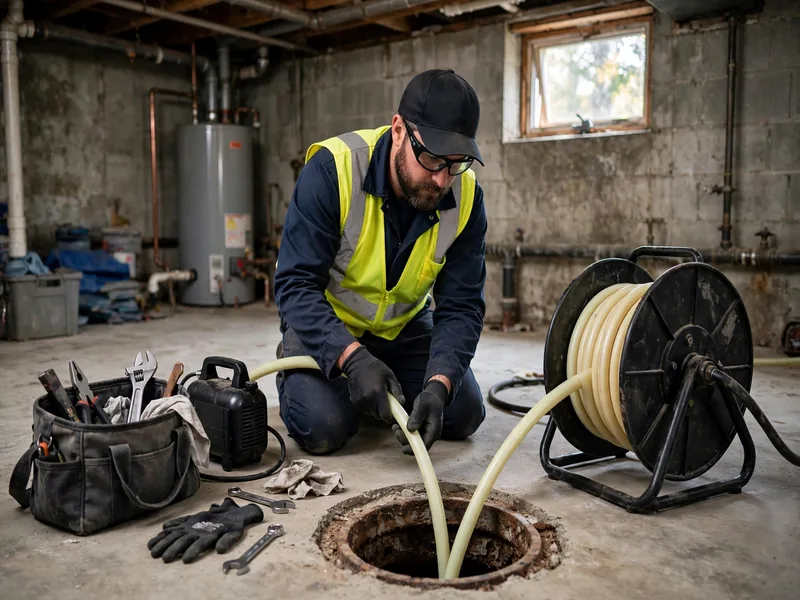
Maurer began in 1876 as a company town for the Henry J. Maurer Brick Company, and its residential streets still hold the modest worker homes of the 1920s — brick-cottage-era houses whose clay-tile sewer laterals are now a full century old. Around them sits heavy industry: refineries, former tank farms, brownfield ground that has been worked and reworked for over a century.
Trenchless pipe lining — cured-in-place pipe (CIPP) — fits Maurer for two converging reasons. The laterals are century-old clay at the joint-failure stage lining rehabilitates most effectively. And the ground is industrial: excavation near refineries and brownfields faces digging restrictions and soil complications that trenchless methods never trigger, because the work happens inside the existing pipe.
This page explains how lining serves Maurer's oldest residential sewers, how the inspection accounts for the industrial setting, and where the method's limits fall.
Company-Town Clay: A Century of Worker-Home Laterals
Maurer's residential laterals went in with the brick company's worker housing — 1920s cottages on streets like Bruck Avenue, clay tile outside, simple and durable. A hundred years later, the camera shows what a century does to clay joints: separations worked open by freeze-thaw, root masses at nearly every joint, cracked sections where soil loading or industrial ground vibration stressed the pipe.
The clay segments themselves are typically sound. Vitrified clay does not degrade chemically; it fails mechanically at its connections, and a century is enough to fail most of them. That is the precise profile lining was designed for: the liner becomes the new continuous wall, bridging every failed joint, while the old segments serve as the form. Age has destroyed the joints, not the pipe.
What distinguishes Maurer's century-old clay from downtown's is the setting, not the pipe. The failure pattern is the same — joint failure, root intrusion, cracking — but the ground above is industrial, the water table is high, and the neighborhood's infrastructure has absorbed a century of industrial activity. The pipe diagnosis is standard; the project context is not.
The inspection on these lines is thorough by necessity: full-length camera survey, defect mapping, material confirmation, connection verification. Century-old lines can hide collapses behind root masses, and the post-cleaning camera pass — after roots are cut and the true structure shows — is the candidacy verdict, not the first look.
Why Trenchless Matters in Refinery-Adjacent Ground
Excavation in Maurer is not a simple dig. The neighborhood sits among refineries, former tank farms, and brownfield parcels — ground with a century of industrial use. Opening a trench here can trigger soil-handling requirements, utility clearance procedures, and environmental precautions that a residential dig elsewhere never faces. A straightforward pipe replacement becomes a complicated project before the first bucket of soil is moved.
Pipe lining never opens the ground. The liner is installed through an access point — a cleanout or a small pit — and the rehabilitation happens entirely inside the existing pipe. No trench through industrial fill, no excavated soil to characterize, no dewatering in the low-elevation water table, no utility strikes. The industrial setting, which complicates every other method, is simply irrelevant to lining's installation.
This is a practical advantage, not just a regulatory one. Dewatering a trench at 13 feet of elevation near industrial flatlands is slow work; contaminated-soil protocols add time and cost unpredictably. Lining's one-to-two-day timeline holds regardless of what is in the ground, because the work never interacts with the ground.
For Maurer homeowners, this reframes the method choice. Elsewhere, lining competes with excavation on disruption and cost. Here, lining competes with excavation on feasibility — the trenchless method avoids a category of complications that the dig cannot. Where the pipe qualifies, lining is not the alternative; it is the rational default.
The Installation Sequence in an Industrial Setting
Access comes first: the crew locates or establishes a cleanout, a small and localized operation. On Maurer's modest worker-home lots, access is typically straightforward — the lateral runs a short path from house to main, and the access point serves the full run. This small pit is the project's only ground disturbance.
The camera inspection follows: full-length survey documenting material, diameter, defects, and the municipal connection. The technician watches for the century-clay pattern — joint separations, root masses, cracks — and screens for disqualifiers: collapses, bellies, major offsets. Industrial ground vibration over decades can shift joints more than residential settings, so offset screening gets particular attention.
Cleaning is the heavy phase: mechanical root cutting through a century of colonization, then high-pressure jetting to scour the walls. The post-cleaning camera pass confirms the channel is continuous and finalizes the liner measurement. Only clean, verified footage authorizes the installation.
The liner goes in through the access point — inverted or pulled into position — seats under air or water pressure, and cures over several hours with the lateral out of service. The final camera inspection shows the jointless, watertight interior; ends are trimmed and sealed; the access point is restored. The industrial ground above is untouched throughout — the project's entire footprint is the access pit and the equipment staged beside it.
Roots, Stormwater, and the Watertight Seal
Maurer's laterals face the standard century-clay symptom set, sharpened by the setting. Roots have had 100 years to colonize every joint; the neighborhood's trees and the long growing seasons have built root systems that recolonize aggressively after each clearing. The clearing cycle here is particularly futile — each cut leaves wider joints for more vigorous regrowth.
Stormwater is the second pressure. Low elevation, flat industrial terrain, and nor'easter rains that pond on the flatlands — defective joints admit groundwater as infiltration, surcharging laterals during exactly the storms that stress the whole system. A century of joint separation means a century of entry points for storm-driven water.
Lining addresses both with the same jointless wall. Roots lose every entry point along the lined run — the cured epoxy is impermeable, and there are no joints left to exploit. Infiltration stops at the same barrier — groundwater that pressed through dozens of separated joints now meets a continuous watertight interior. One installation, two mechanisms resolved.
The permanence matters more in Maurer than in milder settings because the alternative — repeated clearing plus living with infiltration — compounds. Each storm season works the joints wider; each clearing leaves them more open. Lining interrupts both cycles at once, which is why the inspection-to-lining path is the rational response to the first confirmed diagnosis rather than the last resort after years of clearing.
What the Camera Can Disqualify
Collapse is the absolute boundary: where century-old clay has caved — under streets, at deep sections, where industrial loading stressed the pipe — no liner follows. The camera marks these as impassable dark sections. Collapsed runs need bursting or excavation, with all of Maurer's ground complications applying to the dig.
Bellies disqualify by geometry: a liner takes the pipe's shape, so settled low spots remain low, ponding water and collecting solids after lining as before. Industrial fill and a century of ground disturbance make localized settlement plausible; the camera's waterline view shows it plainly. Bellied sections need regrading.
Major offsets are a heightened risk here. A century of freeze-thaw plus industrial ground vibration can shear clay joints severely, and some separations are too large for a liner to bridge. Minor offsets are routine; large steps are not. The footage measures each offset against the pipe diameter, and the technician judges.
Legacy industrial laterals add a configuration question: some parcels carry vitrified clay or concrete lines in larger diameters or undocumented routings from the industrial era. These can still line if continuous, but the inspection must map material, diameter, and path before the plan is drawn. And possible soil contamination near refineries and brownfields never affects the lining installation — but it is one more reason the trenchless method is preferred where the pipe qualifies.
Method Choice Where Digging Is Restricted
Maurer's method hierarchy differs from a typical suburb's because excavation carries the industrial-ground penalty. Lining is the first evaluation for every continuous pipe — century-old clay with joint failure and root intrusion, sound legacy lines on industrial parcels. It avoids the ground entirely, completes in one to two days, and delivers the jointless, watertight rehabilitation these pipes need.
Pipe bursting is the trenchless answer to structural failure: collapsed sections, severely deformed pipe, lines that cannot host a liner. It needs entry and exit pits — small, localized excavations — and pulls new HDPE through the old path. In Maurer's restricted-digging context, bursting's minimal ground disturbance is a major advantage over open-cut, though the pits still interact with the ground in a way lining never does.
Open-cut excavation is the last resort: bellies needing regrade, reroutes, configurations that defeat trenchless methods. Here it faces the full complication set — soil handling, utility clearance, dewatering at low elevation, industrial-flatland logistics. When unavoidable, it is planned with those realities priced in from the start.
The decision still belongs to the footage. But Maurer homeowners should understand that the method ranking here is not just about the pipe — it is about the ground. A lining candidate in Maurer is a stronger lining candidate than the same pipe elsewhere, because the alternatives carry complications that do not exist in ordinary soil.
Local Insight
Maurer's lining case is defined by three card facts pulling in the same direction. First, the 1920s company-town housing: modest worker homes from the brick-company era with clay-tile laterals now a full century old — joint failure advanced, segments typically sound, the textbook lining profile. The pipe population is old enough to need rehabilitation and structured exactly the way lining rehabilitates.
Second, the industrial setting: refineries, former tank farms, and brownfield ground where excavation faces digging restrictions and soil complications. Lining's inside-the-pipe installation never interacts with that ground — no trench through industrial fill, no soil to characterize, no utility clearance for excavation. The method's value here includes everything it avoids, not just what it installs.
Third, the water exposure: low elevation near 13 feet, flat industrial terrain where nor'easter rains pond and surcharge aging clay. A century of open joints admits both roots and storm-driven infiltration; the liner's jointless, watertight wall seals both mechanisms in one installation. For Maurer, lining is the method the pipe's age, the ground's restrictions, and the climate's pressures jointly recommend.
Call Now
One call connects you with a local sewer professional serving Perth Amboy, NJ — day or night.
Call Now: (833) 713-2101Frequently Asked Questions
Our home is near the refinery area. Is sewer work even allowed here?
Trenchless lining is well suited to industrial-adjacent neighborhoods precisely because it avoids the ground complications that excavation triggers. The work happens inside your existing lateral through an access point — no trench through industrial fill, no excavated soil to manage. Standard residential sewer rehabilitation does not face the restrictions that open excavation near refineries or brownfields can trigger. Your lateral is your property's pipe, and lining it trenchlessly is routine work.
Will industrial ground vibration damage the new liner?
The cured liner is a structural pipe engineered to withstand normal soil loading and ground vibration, and it is formed tightly against the host pipe which continues to surround it. It does not depend on undisturbed soil the way a newly trenched pipe does — the installation never disturbs the ground at all. Normal industrial-area vibration is well within the liner's structural tolerance; the inspection footage would show if the host pipe had already been damaged by such forces.
Our lateral is 100 years old. Isn't it too far gone for lining?
Age alone does not disqualify a lateral — structural condition does. Vitrified clay does not expire; it fails at joints, and a century-old pipe that remains continuous with joint defects is a strong lining candidate. The post-cleaning camera footage is the verdict: continuous walls with joint failure line beautifully, while collapsed sections do not. Many of Maurer's century-old laterals are lineable precisely because clay segments endure while only their connections fail.
What happens if the camera finds a collapse under the street?
A collapsed section under a public street cannot be lined — the liner needs a continuous channel. That section becomes a targeted repair, typically pipe bursting or a coordinated excavation with the proper street-work permits. The rest of a continuous run may still be lineable. The inspection marks the collapse location precisely so the repair plan addresses exactly the failed section rather than condemning the whole lateral.
Does lining stop stormwater from getting into our sewer?
It stops infiltration through your lateral's own defects — groundwater entering through cracked and separated joints during heavy rain — because the cured liner is watertight and jointless. In Maurer's low, flat terrain where nor'easter rains pond, that infiltration is a real contributor to backups. Lining does not stop surface flooding or a surcharged municipal main, but it eliminates the lateral's own leaks, which is the portion of the problem your pipe controls.
How long will the liner last in our industrial-area soil?
The liner's service life does not depend on the soil around it — it is a standalone structural pipe, chemically resistant and jointless, specified for decades of service. Industrial soils affect excavation, not the cured epoxy inside your lateral. What determines longevity is proper installation and curing, verified by the post-installation camera inspection. The ground's industrial history is irrelevant to the liner once it is cured in place.