Trenchless Pipe Lining in Keasbey, NJ
Pipe lining in Keasbey starts with identifying your pipe: 1970s-90s apartment laterals on PVC rarely need it, while older capes on clay tile are candidates. For qualifying lines — plus industrial parcels where excavation faces utility and soil complications — a resin liner cures inside the pipe into a jointless, watertight wall with no trench. Camera inspection sorts each property.
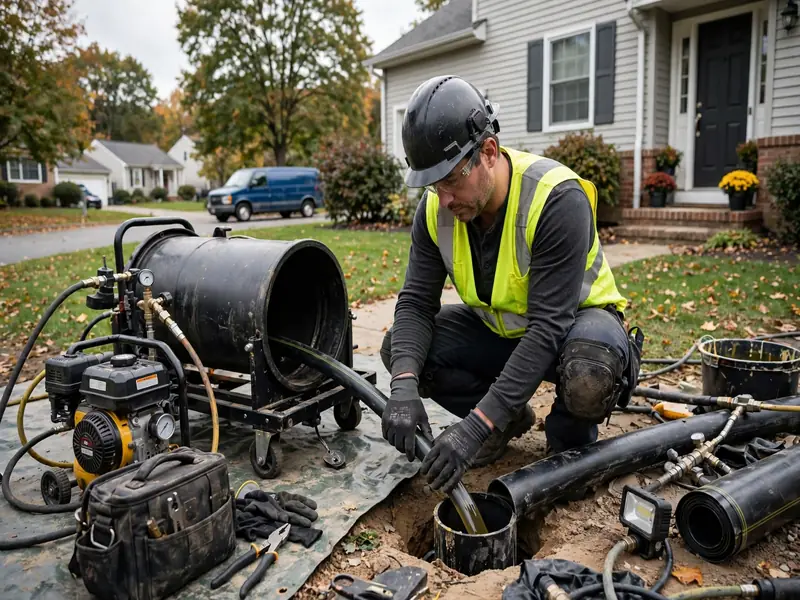
Keasbey has a split personality, and its sewers reflect it. The residential side — apartment complexes and small apartment buildings from the 1970s-90s, plus scattered 1960s capes — runs mostly on PVC laterals that are still in their prime, with clay tile on the older scattered homes. The industrial side, shaped by two centuries of brick manufacturing and heavy M-1/M-2 zoning, has deep legacy lines in complicated ground near the Raritan River.
Trenchless pipe lining — cured-in-place pipe (CIPP) — applies differently to each side. For the older capes on clay tile, it is the standard rehabilitation: a resin liner cures inside the old pipe into a jointless new wall, sealing root intrusion and joint failure with no excavation. For the PVC-era apartments, it is the precision tool for confirmed defects — settled joints, separated connections — not a default.
The industrial parcels add a third consideration: where excavation means utility clearance, possible contaminated soils, and river-flood exposure, lining's no-dig installation avoids the hardest parts of the job. This page covers all three contexts and how the inspection sorts them.
First Question: Which Keasbey Pipe Is Yours?
Keasbey's residential stock divides by era. The apartment complexes and small apartment buildings that dominate — roughly three-quarters of homes built 1970-1999 — run on PVC laterals. At 25 to 50 years old, PVC is generally sound; its failure modes are settlement, separated joints, and blockages, not material aging. Lining applies here only to confirmed defects, sectionally.
The scattered older capes — 1960s brick capes like those on Highland Avenue — run on clay tile now 60-plus years old. These are the classic lining candidates: joint failure advancing, roots colonizing, pipe structure intact. For these properties, the evaluation mirrors any mid-century clay neighborhood: inspect, confirm continuity, line the run.
Industrial parcels are the third category. Deep legacy lines, possibly vitrified clay or concrete, in ground with two centuries of industrial use — brick mining, manufacturing, refinery-adjacent activity. Excavation here faces utility clearance requirements and possible soil contamination questions. Where these lines remain continuous, lining rehabilitates them without disturbing the ground at all.
The inspection is therefore step zero in Keasbey in a way it is not in single-era neighborhoods. Material, era, and context must all be established before any method is discussed. A lining recommendation without that sorting is a guess, and Keasbey's variety punishes guesses.
Apartments on PVC: The Defect-Hunt Inspection
For Keasbey's 1970s-90s apartment laterals, the camera inspection is a hunt for specific defects rather than an age assessment. PVC at this age should be sound, and most inspections confirm it. What the technician looks for: joints separated by settlement, root intrusion at connections, bellies from fill consolidation, and blockages from usage patterns in multi-unit buildings.
Multi-unit usage adds a fouling dimension single-family lines do not have: heavier, more continuous flows with more grease and solids. A lateral serving an apartment building can develop buildup that mimics structural problems — slow drainage, recurring backups — when the pipe itself is sound. Thorough jetting sometimes resolves what looked like a pipe failure, which is why cleaning precedes any lining decision.
Where the camera finds a genuine defect — a separated joint admitting roots, a cracked section — sectional lining is the proportionate repair. A short liner seals the defect; the sound PVC on either side is left alone. Full-length lining of a sound apartment lateral would be unnecessary scope, and the footage is what keeps the scope honest.
Building sewers for apartment complexes can also be larger diameter than residential laterals, which the inspection confirms. Lining works in larger diameters, but the liner sizing, resin quantities, and cure parameters all scale with diameter — another reason the camera survey precedes every plan.
Clay Capes: The Standard Lining Playbook
Keasbey's scattered 1960s capes get the classic clay treatment. Sixty-plus-year-old clay tile shows the familiar pattern: joints separated by freeze-thaw, roots at the joints, occasional cracked sections, pipe shape intact. The inspection confirms continuity and maps the defects; the liner then rehabilitates the full run from the house to the main.
Cleaning on these lines is the thorough version: mechanical root cutting through the colonization, then jetting to scour the walls. The post-cleaning camera pass is the candidacy confirmation — with roots cleared, the pipe's structural truth shows, and the liner length gets finalized from clean footage.
Installation follows the standard CIPP sequence through an access point: liner in, pressure seated, resin cured over several hours, lateral out of service during the cure. The finished interior is jointless and watertight — roots permanently excluded, infiltration sealed, flow restored with a smooth epoxy bore.
For these capes, the value proposition matches any mid-century clay neighborhood: one trenchless project ends the root-clearing cycle and renews the lateral for decades. The only Keasbey-specific note is the floodplain context — the Raritan River borders the CDP to the south, and low-lying blocks carry flood exposure. Lining's watertight seal is genuine infiltration defense, which matters more here than in inland-only settings.
Industrial Parcels: Lining Where Digging Is Complicated
Keasbey's industrial ground — brick works since the 1800s, heavy manufacturing zoning, the Raritan River floodplain — makes excavation the complicated option. Deep legacy utilities cross these parcels, soil contamination is a documented possibility near industrial operations, and the river brings flood exposure to low-lying blocks. Opening the ground here triggers a cascade of clearances and precautions.
Trenchless lining sidesteps the cascade. The work happens inside the existing pipe: no trench through industrial fill, no soil to characterize or dispose of, no dewatering in the high water table near the river, no utility strikes from excavation. For a continuous legacy line — vitrified clay or concrete in sound shape — lining rehabilitates the pipe while the ground above remains entirely undisturbed.
The inspection on industrial parcels carries extra scope: verifying the line's material and condition, mapping its path relative to known utilities, and confirming the municipal connection. Legacy lines sometimes follow undocumented routes or connect through manholes rather than standard curb connections. The camera survey establishes all of this before the lining plan is drawn.
Flood exposure adds a performance argument: the Raritan's flood risk during hurricanes and nor'easters drives infiltration through every defective joint. A jointless, watertight liner seals the line against that pressure — genuine resilience value for industrial parcels where sewer failure during flood events carries operational consequences.
The River Factor: Watertight as Flood Resilience
Keasbey's southern boundary is the Raritan River, and low-lying blocks sit near 13 feet of elevation with documented flood exposure. For sewer laterals, river flooding attacks through infiltration: floodwater and elevated groundwater press into every crack and open joint, filling laterals and surcharging the system from below. It is a different mechanism than surface flooding but equally disruptive to drainage.
A cured-in-place liner is a watertight, jointless barrier — the most effective infiltration defense a lateral can have. Where the old clay admitted groundwater through dozens of joints, the lined pipe admits none. During high-water events, the lateral carries its design flow instead of filling with infiltration, which preserves drainage function when the system needs it most.
This does not make lining flood protection in the general sense. Surface water, overwhelmed municipal mains, and groundwater around foundations remain beyond any lateral repair. But the lateral's own infiltration — the portion of the problem the property owner controls — is eliminated, and in a river-adjacent community that portion is significant.
The inspection documents infiltration as part of the baseline: active water entry through joints shows on camera as weeping or flowing at defects. That footage establishes that the watertight liner is addressing an observed problem, not a theoretical one — and the post-lining behavior during the next wet event is the verification.
Limits That Apply Across All Three Contexts
Collapse disqualifies in every context — residential clay, apartment PVC, industrial legacy lines. Where the channel is gone, no liner follows. The camera marks collapsed sections precisely, and they become bursting or excavation targets with all the context-appropriate complications.
Bellies disqualify by geometry everywhere: a liner preserves the pipe's shape, so settled low spots remain low spots. Keasbey's fill soils and floodplain ground make settlement bellies worth watching for, especially in PVC-era installations. The waterline view on camera shows them without ambiguity; they need regrading, not lining.
Major offsets — sheared joints with large steps — can defeat lining where the liner cannot bridge smoothly. The footage measures the step against the pipe diameter; minor offsets are routine, large ones are not.
Configuration complexity is Keasbey's special limit: apartment buildings with shared or manifolded laterals, industrial parcels with undocumented legacy routing. Lining the wrong pipe or half of a shared system creates problems the method cannot solve. The inspection must map exactly what serves the property — and in multi-unit or industrial contexts, that mapping is a project phase in itself, not a quick look.
Local Insight
Keasbey's lining candidacy is governed by three card facts that demand sorting before method. First, the split residential stock: 1970s-90s apartments on PVC (lining only for confirmed defects, sectionally) versus scattered 1960s capes on 60-plus-year-old clay (standard full-run lining candidates). The same method serves both, but the scope logic is opposite — precision repair versus full rehabilitation — and only the camera assigns each property to its category.
Second, the industrial legacy: brick manufacturing since the 1800s, heavy industrial zoning, deep legacy utilities, and possible soil contamination near industrial operations. Where excavation triggers utility clearance and soil-management complications, lining's inside-the-pipe installation avoids the ground entirely — making trenchless the rational default for qualifying legacy lines, not merely the convenient one.
Third, the river: the Raritan borders the CDP's south edge, low-lying blocks sit near 13 feet with documented flood exposure, and tidal/stormwater surcharging punishes every defective joint. Lining's watertight, jointless result is infiltration defense matched to the community's dominant water risk. For Keasbey, the lining evaluation is: verify the pipe, verify the context, then let the footage choose the scope.
Request Service Today
One call connects you with a local sewer professional serving Perth Amboy, NJ — day or night.
Request Service Today: (833) 713-2101Frequently Asked Questions
Our apartment building has recurring sewer backups. Is lining the answer?
Maybe, but the diagnosis comes first. Multi-unit laterals develop heavy buildup — grease, solids, paper — that mimics structural failure; thorough jetting sometimes resolves what looked like a pipe problem. If the camera then shows genuine defects like separated joints or cracked sections, sectional lining seals them trenchlessly. But lining a pipe that only needed cleaning would be unnecessary work. The inspection-plus-cleaning sequence distinguishes buildup from structural defects before anyone proposes lining.
Can lining be used on the old industrial lines near the river?
If the line is continuous — vitrified clay or concrete holding its shape — yes, and it is often the strongest option there. Industrial parcels make excavation complicated: deep legacy utilities, possible soil contamination, high water table near the Raritan. Lining rehabilitates the pipe from inside without disturbing any of that ground. The inspection first maps the line's material, condition, and route, since legacy industrial lines sometimes follow undocumented paths.
Will lining protect our lateral during Raritan River flooding?
It protects against infiltration — floodwater and elevated groundwater entering through your lateral's own cracks and joints — because the cured liner is watertight and jointless. That removes a significant source of flood-adjacent backup. It does not protect against surface flooding, foundation seepage, or a surcharged municipal main pushing water back; those are system-level conditions. Lining seals your pipe's leaks, which is the portion of flood risk you control.
Our 1960s cape has clay tile. How is its lining different from a newer home's?
The older clay lateral typically gets full-run lining: 60-plus years of joint failure and root intrusion along the whole pipe, rehabilitated in one continuous liner from house to main. A newer PVC home, by contrast, gets sectional lining only if the camera finds an isolated defect — the sound pipe is left alone. Same technology, opposite scope logic, and the inspection footage is what assigns each property to the right scope.
Does lining work on larger-diameter building sewers?
Yes, within the method's range. Apartment and small commercial building sewers run larger than residential four-inch laterals, and liners are manufactured for those diameters — the resin quantities, installation pressures, and cure parameters all scale accordingly. The inspection confirms the actual diameter rather than assuming it, and the lining plan is engineered to those measurements. Very large or structurally failed building sewers may need different methods, which the footage determines.
How do we know whether our lateral is shared with neighboring units?
The camera inspection traces the system: which fixtures drain to which pipe, where lines join, and whether the lateral serving your unit is dedicated or manifolded with others. In apartment contexts, shared or manifolded configurations are common, and lining a shared line affects all connected units — which makes coordination part of the project. Mapping the configuration is a defined phase of the diagnosis, not an afterthought, and it precedes any lining plan.