Trenchless Pipe Lining in Iselin, NJ
Pipe lining is the playbook for Iselin's 1950s-60s Cape Cod and split-level laterals: clay tile at peak failure age, with joint root intrusion and bellies as the norm. A resin liner cures inside the pipe into a jointless wall — sealing roots out with no trench. Camera inspection sorts the lineable majority from bellied or Orangeburg exceptions before work begins.
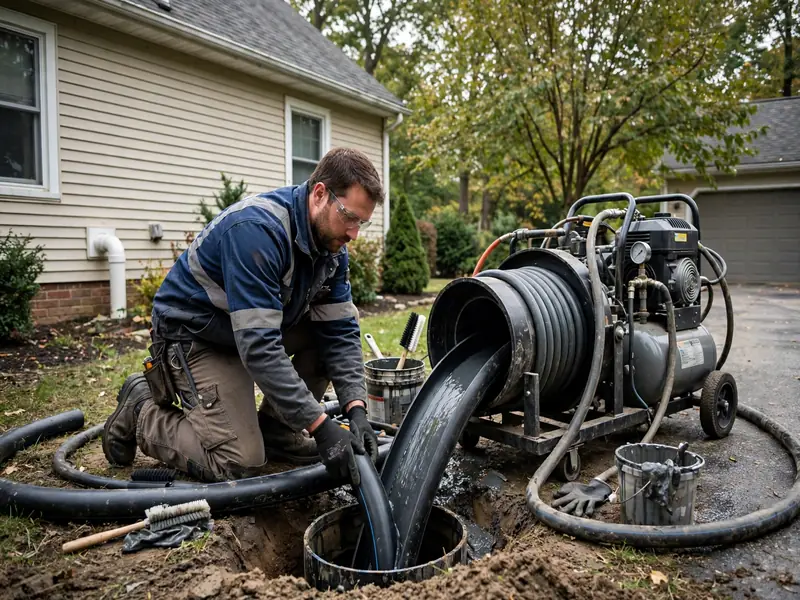
Iselin's postwar subdivisions are in the demographic sweet spot for trenchless pipe lining. Roughly 78 percent of the community's homes went up between 1940 and 1969 — Cape Cods, split-levels, and early ranches whose clay-tile laterals are now 55 to 85 years old. That is peak clay-failure age: joints well separated, roots thoroughly colonized, pipe segments still holding their shape.
Cured-in-place pipe lining (CIPP) rehabilitates these laterals from the inside. A resin-saturated liner is installed through an access point and hardened into a continuous, jointless new pipe wall. The root-entry joints get sealed under an impermeable barrier, cracked sections get bridged, and the line flows again — with the yard, driveway, and mature landscaping untouched.
Iselin's laterals are not uniform, though. The camera finds bellies, possible Orangeburg in 1950s tracts, and commercial-grade grease issues along the Route 27 corridor. This page explains the standard playbook, the exceptions the inspection must catch, and how the method decision gets made.
Peak Clay Age: Why Iselin Laterals Line So Well
Clay tile fails on a predictable timeline, and Iselin's 1950s-60s laterals are in the heart of it. The first decades are quiet — joints tight, roots probing but not yet inside. By mid-life, joints have separated enough for root entry, and each growing season widens the pattern. At 55 to 85 years, the typical Iselin lateral shows the full developed picture: root masses at most joints, cracked sections, minor offsets — with the pipe's round shape intact.
That combination — advanced joint failure, preserved structure — is lining's ideal input. The liner does not need the old pipe to be healthy; it needs the old pipe to be continuous. Clay segments at this age almost always are. The liner spans the defects and becomes the new pressure-bearing, root-proof wall, and the old clay becomes the form it was cast against.
The alternative at this age is the clearing treadmill. Mechanical root cutting restores flow for a season or two, but the joints stay open and the root systems — now decades established — return aggressively. Homeowners who have cleared twice are usually ready for the permanent fix; the inspection confirms the pipe qualifies, and lining ends the cycle in a single project.
There is a window to this candidacy, and Iselin is in it. Wait another decade or two without rehabilitation, and some of these lines will cross from joint failure into structural failure — collapses that lining cannot address. The camera inspection now captures pipes at their most lineable; delay risks losing the trenchless option to deterioration.
Bellies and Orangeburg: The Exceptions to Catch
The camera's most important job on an Iselin lateral is finding what lining cannot fix. Bellies — settled low spots holding standing water — are common in 1950s-60s tracts where soil consolidation over decades has sagged the pipe grade. A liner conforms to the pipe's shape, so a lined belly is still a belly: wastewater ponds, solids settle, and the maintenance problem persists. The waterline view on camera identifies bellies unambiguously.
Orangeburg is the material exception. Some 1950s Iselin tracts used the bituminized fiber pipe, which deforms over time — ovaling and flattening rather than holding round. A deformed host cannot accept a liner; the liner would follow the deformation and restrict flow. Where the camera shows Orangeburg, the recommendation is replacement by bursting or excavation, and any lining quote on that footage should be refused.
Minor offsets and cracked sections, by contrast, are routine lineable defects. Freeze-thaw has shifted some clay joints over 60-plus years, but small steps bridge cleanly under a liner. Cracks get covered by the new wall. The technician's judgment — informed by the footage measured against pipe diameter — separates the lineable majority from the exceptions.
This sorting is why the inspection is non-negotiable and why homeowners should watch it. The difference between a belly and a crack, between Orangeburg and clay, is visible on screen. An honest contractor points out each one and explains what it means for the method choice.
The Oak Tree Road Corridor: A Commercial Note
Iselin's Oak Tree Road and Route 27 corridors carry commercial laterals with a different fouling profile: grease and buildup rather than just roots and joint failure. Restaurant and food-service laterals accumulate grease deposits that narrow the bore and harden over time. Lining can rehabilitate these lines, but the preparation is heavier — grease must be thoroughly jetted and cleaned before a liner will bond.
For residential Iselin — the Capes and split-levels that make up most of the housing — the commercial corridor is context, not the main story. But homes near the corridor sometimes share the area's heavier soil disturbance history: utility work, road work, and commercial construction that can shift residential laterals. The inspection notes any anomalous offsets or damage patterns near these zones.
The broader point is that Iselin's laterals live in an active, built-up environment. The South Branch of the Rahway River drains the area to the northeast, and pockets near the river run a higher water table. Infiltration through defective joints is a wet-weather factor here as elsewhere — one more defect the liner's watertight seal addresses.
For the typical residential lateral, though, the story stays focused: clay at peak failure age, roots at joints, lining as the standard playbook. The corridor and the river are modifiers to that story, noted on the inspection and accounted for in the plan.
Installation: From Camera to Cure
The job opens with the full camera survey: material identification, defect mapping, length and diameter measurement, connection verification at the main. On an Iselin lateral, the technician is specifically screening for the exceptions — bellies in the waterline view, Orangeburg's telltale deformation, major offsets — while documenting the lineable defects the liner will cover.
Cleaning is the heavy phase. Root masses get cut mechanically joint by joint; the line is then jetted to scour walls and flush debris. On a 60-year-old clay lateral with full colonization, this takes hours — the liner's bond depends on a clean host, and there are no shortcuts. A post-cleaning camera pass verifies the channel and finalizes liner measurements.
The liner — felt or fiberglass saturated with resin — is cut to the measured length and installed through the access point by inversion or pull-in. Air or water pressure seats it against the host pipe's interior, pressing into joint bells and around minor offsets. Cure follows: hot water, steam, or ambient chemistry hardening the resin over several hours, with the lateral out of service throughout.
Verification closes the project: a final camera run showing the smooth, jointless, fully cured interior; ends trimmed and sealed at the access points; cleanout restored. The homeowner receives the before-and-after footage — the developed root-and-joint failure beside the pristine new bore — which documents both the problem and its resolution.
Symptoms That Point to a Lineable Lateral
The classic Iselin symptom set starts with drainage: multiple fixtures slowing together, toilets needing double flushes, gurgling between fixtures. These indicate a restriction in the shared lateral rather than a single branch — and on 1950s-60s clay, the restriction is usually root masses at joints. When plunging and single-fixture snaking do not resolve it, the lateral is the suspect.
Recurring main-line backups are the stronger signal. A backup cleared six months ago that returns is not bad luck; it is an unrepaired defect. Each clearing resets the symptom while the open joints guarantee recurrence. Two clearing cycles is the practical threshold where lining's permanent fix becomes the rational choice over another temporary one.
Wet-weather behavior adds information. If drainage worsens during heavy rain, infiltration through defective joints is contributing — groundwater filling the lateral alongside wastewater. Iselin's nor'easter rains and summer storms drive this pattern. Lining's watertight seal addresses the infiltration component directly, which clearing never does.
Outdoor signs — soggy strips, lush patches, odors along the lateral's path — mark leaks where the pipe vents moisture outward. And the age-based case stands on its own: a 1960s Cape with its original lateral and no inspection history is carrying unknown risk. Finding a lineable pipe early preserves options that emergencies remove.
Lining, Bursting, or Digging: The Iselin Decision
For Iselin's typical 1950s-60s clay lateral — continuous pipe, joint failure, root intrusion — lining is the standard playbook. Least disruption, one-to-two-day project, permanent root exclusion, watertight seal against infiltration. The inspection confirms candidacy, and the job proceeds through the access point with the property undisturbed.
Pipe bursting covers the structural failures: collapsed sections, severely deformed pipe, Orangeburg that cannot host a liner. Bursting fractures the old pipe outward and pulls new HDPE through — genuine replacement, trenchless in execution, needing entry and exit pits. It is the answer when the pipe's shape is gone but the run is straight enough to pull.
Open-cut excavation remains for bellies needing regrade and configurations needing rerouting. It fixes anything at the cost of a trench through the yard and full restoration. On Iselin's landscaped suburban lots, that restoration — sod, plantings, walkways — is a significant part of the project's true cost.
The decision discipline is the same across all three: the camera footage chooses. A contractor who shows the video, points out the bellies or the sound joints, and explains the reasoning is diagnosing. One who quotes a method before inspecting is selling. Iselin homeowners, with peak-age clay under their lawns, benefit most from insisting on the footage-first approach.
Local Insight
Iselin's lining candidacy is set by three card facts. First, the housing era: roughly 78 percent built 1940-1969 — Cape Cods, split-levels, and ranches with clay-tile laterals now 55-85 years old, at peak joint-failure age with pipe structure typically intact. This is the demographic lining serves most efficiently: developed defects, preserved shape, permanent fix in a single trenchless project.
Second, the exceptions the era carries: possible Orangeburg in 1950s tracts and bellies from decades of soil settlement — both of which the camera must rule out before lining. Iselin's standard playbook therefore pairs lining with rigorous inspection screening; the method is the default, but only the footage confirms it.
Third, the setting: drainage toward the South Branch of the Rahway River with freeze-thaw winters and nor'easter rains driving both joint separation and infiltration. Lining's jointless, watertight result counters the area's two weathering mechanisms at once — sealing the joints frost keeps opening and the infiltration storms keep exploiting. For Iselin's clay laterals, the method matches the pipe, the age, and the climate together.
Reach Out Today
One call connects you with a local sewer professional serving Perth Amboy, NJ — day or night.
Reach Out Today: (833) 713-2101Frequently Asked Questions
Our Iselin Cape was built in 1958. Is it too late for lining?
Probably not — 55-85-year-old clay is lining's prime demographic, not its limit. What matters is structural condition, not age: if the pipe remains continuous with joint defects and root intrusion, it lines well regardless of the birth year. The risk of waiting is that joint failure eventually progresses to structural failure — collapses that lining cannot fix. An inspection now captures the pipe while the trenchless option is available; delay is what closes the window.
The camera showed a belly in our lateral. Does that rule out lining completely?
A belly rules out lining for that section, because the liner preserves the pipe's shape and the sag would remain, still ponding water. But one belly need not condemn the whole run — options include lining the sound sections and addressing the belly separately by excavation or bursting, or full replacement if bellies are multiple. The footage shows exactly where the belly is and how the rest of the pipe looks, which is what the repair plan is built from.
How do we know if our 1950s tract has Orangeburg?
Only the camera can say. Orangeburg — bituminized fiber pipe — appears on camera as a dark, often deformed tube, visibly oval or flattened, very different from clay's rigid segmented joints. If your tract used it, the footage makes it unmistakable, and the recommendation shifts from lining to replacement. This is one of the highest-value findings an inspection can produce, because it prevents spending lining money on a pipe that cannot host a liner.
Will lining stop our wet-weather backups?
If the backups are driven by infiltration — groundwater entering through your lateral's defective joints during heavy rain — lining's watertight seal directly addresses the cause, and wet-weather behavior typically improves markedly. But if the municipal main itself surcharges during storms, lining your lateral will not stop that backpressure. The inspection should document whether your lateral shows active infiltration and assess the main's behavior, so the fix matches the actual source.
Our lateral runs under a big landscaped bed. Will lining destroy it?
No. Lining is installed through an access point — usually an existing cleanout — and the work happens inside the existing pipe underground. The landscaped bed above is never touched: no trench, no excavation, no root disturbance to your plantings. This is one of lining's defining advantages over open-cut replacement, which would remove the entire bed along the trench path. Mature landscaping is precisely what trenchless methods are designed to protect.
How many times should we clear roots before choosing lining?
Two clearing cycles is the practical threshold. The first clearing buys time and confirms the diagnosis; the second confirms the pattern — the roots are returning because the entry joints remain open. Beyond that, each clearing is money spent resetting a problem that lining would permanently end. If your Iselin lateral has been cleared twice and the roots are back, the inspection-and-lining conversation will save money and frustration over continuing the cycle.