Trenchless Pipe Lining in Fords, NJ
Pipe lining rehabilitates Fords' clay-tile laterals — from 1920s colonials to 1940s-60s tract homes — without digging up the yard. A resin liner cures inside the old pipe into a jointless new wall sealing root intrusion and cracked joints. Where Fords' homes often go from camera inspection straight to replacement quotes, lining offers a middle path: rehabilitation with minimal disruption.
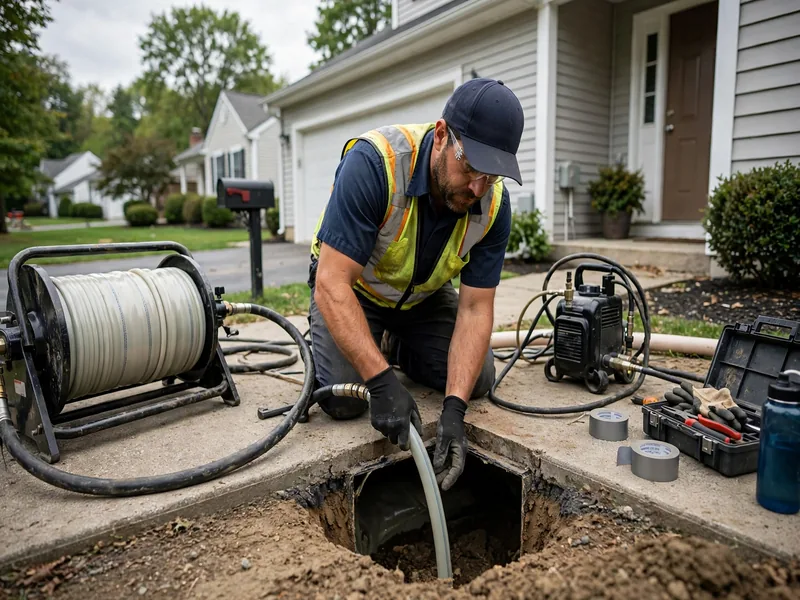
Fords' housing spans a full century of lateral materials. The 1920s-30s colonials and Capes — homes like the 1925 build on Woodland Avenue — carry clay-tile laterals now approaching 100 years old. The 1940s-60s tract homes carry clay of a younger vintage, with possible Orangeburg in some 1950s tracts. Modern townhomes run on PVC. Each era fails differently, and each gets its own verdict from the camera.
Trenchless pipe lining — cured-in-place pipe (CIPP) — earns its place in Fords as the middle path between endless clearing visits and full excavation. A resin-saturated liner is installed inside the existing lateral and cured into a hard, jointless new pipe. Roots lose their entry points, cracks get bridged, flow is restored — and the yard, driveway, and walkways stay exactly as they were.
Fords' older homes have a reputation for jumping from inspection straight to replacement quotes. Sometimes that is justified; often a lineable pipe is being condemned. This page explains how to tell the difference and where lining genuinely fits.
When the Camera Says Replace: Checking the Verdict
Fords' 1920s colonials and Capes carry laterals that inspectors sometimes condemn on sight — and occasionally they are right. A century of freeze-thaw, soil movement, and root pressure can leave clay pipe collapsed, severely offset, or so thoroughly root-destroyed that no continuous channel remains. Where the camera shows collapse or major structural failure, replacement by bursting or excavation is the honest recommendation, and lining should not be sold.
But condemnation deserves a second look when the footage actually shows a lineable pipe. The pattern that lines well — continuous clay with joint separations, root masses, cracked sections — is frequently described in alarming language that pushes homeowners toward the most expensive option. A root-filled lateral looks dramatic on camera. It is also, in most cases, exactly what lining was designed to rehabilitate.
The distinction is structural, not cosmetic. Roots, cracks, and open joints are surface and joint defects; the pipe's shape survives them. Collapse, severe bellies, and major offsets are structural failures; the pipe's shape does not survive them. A homeowner watching the footage with the technician can learn to see this difference — and should insist on seeing it before accepting any replacement verdict.
This is not an argument that every Fords lateral should be lined. It is an argument that the method decision belongs to the footage, not to the age of the house or the drama of the root mass. Get the inspection, watch it, and let the pipe's actual condition choose the method.
How the Liner Rehabilitates a Root-Damaged Line
The process starts where every lining job starts: a clean, measured, continuous channel. On Fords' older clay laterals, cleaning is substantial — mechanical root cutting joint by joint, then high-pressure jetting to scour the walls and flush debris. The post-cleaning camera pass is the moment of truth: with roots gone, the pipe's true structural condition shows clearly, and the lining decision gets its final confirmation.
The liner is a felt or fiberglass tube saturated with resin, cut to the lateral's exact measured length. It enters through the cleanout or a prepared access point and is inverted or pulled into position along the run. Air or water pressure then holds it firmly against the old pipe's interior — pressing into joint bells, around minor offsets, across cracked sections — while the resin cures.
Curing hardens the assembly into a structural, jointless pipe. Hot water, steam, or ambient cure each take several hours; the lateral stays out of service throughout. The cured liner stands on its own structurally — it does not need the old clay for strength — but it was formed by the old pipe, so it follows the lateral's path exactly.
The transformation addresses every defect the camera found: root-entry joints sealed under an impermeable barrier, cracks bridged by the new wall, rough scaled surfaces replaced with smooth epoxy. Flow improves because the bore is uniform and smooth; the root cycle ends because there are no joints left to exploit. The yard above never knows the work happened.
Clay, Possible Orangeburg, and PVC: Fords' Material Mix
The 1920s-30s homes are clay tile, nearly without exception — laterals now 90 to 100 years old. This is lining's ideal host material when the pipe remains continuous: vitrified clay segments endure for a century while their joints fail, and the liner replaces joint function with one continuous surface. Most of these laterals, if never collapsed, are candidates.
The 1940s-60s tracts are also predominantly clay, 60-80 years old, with the era's caveat: some 1950s tracts used Orangeburg. The bituminized fiber pipe deforms over decades — ovaling, flattening, eventually collapsing — and cannot host a liner. The camera distinguishes Orangeburg from clay unmistakably, and where it appears the path is replacement, not lining. Material identification is not optional in Fords' mid-century tracts.
Modern townhomes run PVC that rarely needs lining; their lateral issues are blockages, settlement, or construction defects. Proposing lining for sound PVC is selling, not diagnosing.
Foundation drains deserve a local note: Fords homes with foundation drains tied to the sewer can show wet-weather symptoms that mimic lateral failure. The inspection should note these tie-ins, since lining the lateral does not change foundation-drain behavior. Sorting lateral defects from drainage-system behavior is part of an honest diagnosis.
Freeze-Thaw, Nor'easters, and the Case for Sealing Joints
Fords' weather works clay joints the way it works everything buried: freeze-thaw cycles heave and settle the soil around the pipe, walking joints apart a fraction each winter. Summer deluges and nor'easter rains then exploit the opened joints two ways — roots surge with the moisture, and groundwater infiltrates through the gaps, surcharging the lateral exactly when the system is most stressed.
A cured liner answers both mechanisms at once. It is jointless, so frost heave has no joints left to work open. It is watertight, so storm-driven infiltration through the lateral's own defects stops. The pipe becomes a sealed system rather than a segmented one, and the weather loses its two main points of attack.
This matters for the homeowner's decision because the alternative — repeated clearing — addresses neither mechanism. Cutting roots does not close joints; frost keeps opening them wider each winter, and infiltration keeps pace. Each clearing buys a season; lining changes the pipe's relationship with the weather permanently.
The nor'easter pattern also argues for timing. A lateral that backs up during every major storm is signaling infiltration, and the inspection can document active water entry through joints on camera. Lining before the next storm season converts a known vulnerability into a sealed, jointless line.
What Disqualifies a Fords Lateral
Collapse is the absolute line. Where clay has caved — under driveways, at deep sections, where backfill was poor — no liner can pass. The camera shows collapse as an impassable dark section, and the location gets marked for bursting or excavation. Fords' oldest laterals collapse often enough that every inspection watches for it.
Bellies disqualify structurally: a settled low spot holds standing water, and a liner preserves the sag's shape. Wastewater ponds there after lining exactly as before, and solids keep settling. The camera's waterline view reveals bellies plainly; they need regrading by excavation or bursting.
Major offsets — sheared joints with large steps — can defeat lining where the liner cannot bridge the gap smoothly. Freeze-thaw has had a century to shift Fords' oldest joints, and some shifts are severe. Minor offsets are fine; the footage measures the step against the pipe diameter and the technician judges.
Orangeburg, where present in 1950s tracts, is a material disqualification: deformed fiber pipe cannot host a liner. And laterals that are simply too far gone — collapsed in one section, bellied in another — get the honest replacement recommendation rather than a heroic lining attempt. The footage decides; the contractor reports what it shows.
Choosing Between Lining, Bursting, and Digging
For Fords' older clay laterals, the decision tree is straightforward once the footage is in. Continuous pipe with joint defects, root intrusion, and cracking: line it. The method is the least disruptive, typically completes in one to two days, and permanently ends the root cycle. This is the most common verdict for Fords' 1920s-60s clay.
Collapsed sections, severe deformation, or Orangeburg: burst it or dig it. Pipe bursting fractures the old pipe outward while pulling new HDPE through — trenchless replacement that handles what lining cannot, with entry and exit pits as its footprint. It is the right call for structurally failed pipe on runs straight enough to pull.
Bellies needing regrade, reroutes, or configurations that defeat trenchless methods: excavate. Open-cut remains the universal fallback — it fixes anything, at the price of a trench through the yard and full restoration. On Fords' established lots, that restoration is a real cost in time and landscaping.
The through-line for Fords homeowners: do not accept a replacement verdict — or a lining quote — without watching the inspection footage. The camera is the only authority on which branch of the tree your lateral occupies, and a contractor who insists you watch it with them is giving you a diagnosis you can trust.
Local Insight
Fords' lining candidacy turns on three card facts. First, the housing span: 1920s-30s colonials and Capes alongside 1940s-60s tracts and modern townhomes — laterals ranging from 90-year-old clay to possible 1950s Orangeburg to modern PVC. Lining fits the clay majority where pipes remain continuous, but the material mix makes camera identification mandatory; the method follows the pipe, never the home's era alone.
Second, the inspection-to-replacement pattern: the card notes Fords' older homes often go from camera inspection straight to replacement quotes. Lining deserves its place in that conversation as the evaluated middle path — full rehabilitation without excavation — rather than a skipped option. Homeowners should require the footage to justify whichever method is recommended, in either direction.
Third, the weather exposure: freeze-thaw opening clay joints and nor'easter rains surcharging old laterals, with possible foundation-drain tie-ins contributing wet-weather symptoms. Lining's jointless, watertight result counters both the frost-driven joint failure and the storm-driven infiltration — addressing the mechanisms, not just the symptoms, of Fords' lateral problems.
Get Help Now
One call connects you with a local sewer professional serving Perth Amboy, NJ — day or night.
Get Help Now: (833) 713-2101Frequently Asked Questions
An inspector said my 1920s lateral needs full replacement. Should I get a second opinion?
If the recommendation came with camera footage you watched and understood, it may be justified — collapsed or severely failed pipe genuinely needs replacement. But if the verdict was based on the home's age or a dramatic-sounding description without footage you reviewed, a second inspection is worthwhile. Many root-damaged but continuous clay laterals are described as needing replacement when lining would rehabilitate them fully. The footage is the evidence; ask to see it.
How can I tell if a root-filled pipe is lineable or truly destroyed?
Watch the post-cleaning camera footage with the technician. A lineable pipe shows continuous walls with joint defects — roots at joints, cracks, separations — but the pipe's round shape intact. A destroyed pipe shows collapse (impassable sections), severe bellies (permanent low spots holding water), or major offsets (large steps between sections). Roots look dramatic but are a surface problem; structural shape is what determines candidacy. The cleaned pipe tells the truth.
Will lining work if part of my lateral was repaired with PVC years ago?
Usually yes. It is common to find a clay lateral with a PVC splice from a past spot repair, and a single liner can span the transition as long as both sections are continuous and properly cleaned. The inspection maps each material; the cleaning protocol addresses each — root cutting for the clay, debris clearing for the PVC — and the liner covers the full run including the transition joints, which are themselves potential failure points now sealed.
My basement backs up every nor'easter. Is that a lateral problem?
It may be infiltration through your lateral's defective joints — storm-driven groundwater entering the pipe and surcharging it — which lining's watertight seal directly fixes. But nor'easter backups can also come from a surcharged municipal main or foundation drains tied to the sewer, neither of which lining addresses. The inspection should document whether your lateral shows active infiltration and whether the main is contributing. Match the fix to the actual source.
Does lining require tearing up my driveway if the lateral runs under it?
No — that is precisely the situation lining is designed for. The liner is installed through an access point, typically an existing cleanout, and travels inside the existing pipe beneath the driveway without disturbing it. Open-cut replacement would saw-cut and remove the driveway section; bursting needs pits that may fall under it. When a lateral runs under expensive hardscape, lining's no-dig installation protects that investment completely.
How soon after lining can we use our plumbing normally?
Once the final camera inspection confirms the liner is fully cured and open, normal use resumes — typically the same day the cure completes. The out-of-service window covers the curing period, usually several hours within a one-to-two-day project. The crew will tell you exactly when the restriction lifts. There is no extended curing delay; the post-installation camera verification is the green light.