Trenchless Pipe Lining in Downtown Perth Amboy, NJ
Pipe lining rehabilitates Downtown Perth Amboy's century-old clay and cast-iron sewer laterals without open-cut excavation — critical on tight lots where digging is barely feasible. A resin liner cures inside the old pipe into a jointless new line, sealing root intrusion and cracked joints in laterals now 100-plus years old. Camera inspection verifies candidacy, including any shared or party-line configurations.
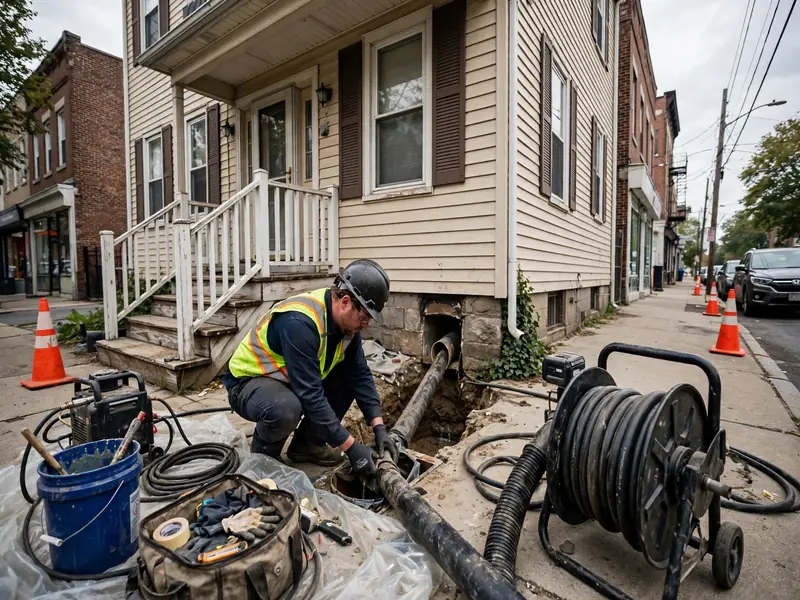
Downtown Perth Amboy has the oldest sewer laterals in the service area. The dense blocks around Smith Street and Five Corners hold late-1800s and early-1900s colonials, rowhouses, and mixed-use buildings — properties whose clay-tile laterals are now a century or more old. Some may still connect through legacy configurations, including shared party lines between rowhouses that complicate every repair decision.
Trenchless pipe lining — cured-in-place pipe (CIPP) — matters here for a reason beyond the technology itself: access. These are tight lots with minimal yards, buildings packed close, and commercial frontages where an open trench is barely feasible. Lining installs a new pipe inside the old one through an existing access point. No trench across a narrow lot, no excavation in front of a Smith Street storefront.
The age of these lines makes the camera inspection doubly important. Century-old pipe can still line beautifully if it remains continuous — or it can be past saving. And any shared-line configuration must be mapped before work begins. This page explains the method, the downtown-specific considerations, and the limits.
Century-Old Laterals: What 100 Years Does to Clay and Iron
A lateral installed in 1905 has lived through every freeze-thaw cycle, every soil shift, and every root growing season of the last twelve decades. Clay tile from that era is vitrified and chemically tough, but its joints — the mortar or simple bell connections of the period — have had a century to separate. Camera footage from downtown laterals typically shows the end stage of joint failure: wide separations, heavy root colonization, and sections where soil has begun migrating into the pipe.
Cast iron from the same era fails differently. Interior corrosion roughens the bore with scale and tuberculation; exterior corrosion thins the wall. In mixed-use buildings, larger-diameter cast-iron or clay building sewers carry heavier loads and show corresponding wear. The inspection must cover the full building sewer, not just the residential-style lateral, because downtown properties often have commercial-scale drainage.
What surprises many owners is how often century-old pipe still qualifies for lining. Vitrified clay does not have a chemical expiration date — it fails mechanically at joints and through cracking, and as long as the segments remain in alignment and the channel is continuous, a liner can rehabilitate it. Age alone is not a disqualifier; structural condition is.
The inspection also serves a forensic purpose downtown: identifying legacy configurations. Shared party lines between rowhouses, undocumented connections, and tie-ins modified over a century of renovations all appear on camera. Mapping exactly which pipe serves the property — and whether it is shared — is prerequisite to any lining plan.
Why Trenchless Is Often the Only Practical Option Downtown
Open-cut excavation needs room: room for the trench, room for the excavator, room for spoil piles, room for shoring. Downtown Perth Amboy's tight lots offer none of it. Houses sit close together with minimal yards; commercial buildings front directly on sidewalks. A trench along a lateral's path here crosses property lines, public walkways, and sometimes the street itself — each crossing a separate permission and restoration problem.
Pipe lining needs an access point. That is the entire surface footprint: a cleanout, perhaps a small pit. The lateral's full run — under the yard, under the walkway, to the main — is rehabilitated from inside without disturbing any of it. On a lot where excavation would require negotiating with neighbors and the city, lining's minimal footprint is not a convenience but the difference between a feasible project and an impractical one.
Mixed-use buildings add another dimension: downtime. A Smith Street building with ground-floor retail cannot easily absorb a week of torn-up frontage. Lining's one-to-two-day timeline, with the lateral out of service only during the cure window, keeps businesses operating. Scheduling can even target off-hours for the cure.
None of this overrides the candidacy requirement. A collapsed downtown lateral still needs bursting or excavation regardless of how inconvenient the dig is. But where the pipe qualifies — and century-old clay often does — lining converts an otherwise nightmarish excavation into a contained, predictable trenchless job.
Shared Lines and Party Laterals: Sort First, Line Second
Some of downtown's oldest blocks carry a complication that suburban neighborhoods never face: shared or party-line laterals. In the era these buildings went up, it was not uncommon for adjacent rowhouses to share a single connection to the municipal main, or for laterals to interconnect in ways no modern plan records. Lining one side of a shared configuration without understanding the whole is a recipe for disputes and incomplete repairs.
The camera inspection is the sorting tool. A technician can trace which fixtures drain to which pipe, identify interconnections, and determine whether the lateral in question is dedicated or shared. Dye testing through fixtures sometimes supplements the camera when the configuration is ambiguous. What matters is certainty: the lining plan must cover the pipe that actually serves the property.
Where a line is genuinely shared, the repair becomes a coordination problem among property owners — and lining's minimal disruption is an asset in that negotiation. It is far easier to get neighbors to agree to a one-day trenchless rehabilitation than to a trench crossing multiple properties.
There is also the legacy-combined question. Some very old downtown infrastructure tied storm and sanitary flows together, and remnants of those configurations can persist. The inspection should note any combined characteristics, since they affect both the lining plan and the property's long-term drainage behavior. An honest contractor reports what the camera shows, including the complications.
The Lining Process on a Downtown Property
Access comes first and can be the trickiest part downtown. Older buildings may lack a modern cleanout, or the cleanout may be buried under a century of surface changes. The crew locates or establishes an access point — sometimes indoors at the building's sewer exit, sometimes at the property line. This small, localized work is the only excavation the project needs.
Inspection and cleaning follow the standard sequence but deserve extra care on century-old pipe. Roots have had 100 years to colonize; scale in cast iron is deep. Mechanical cutting and jetting proceed methodically, with the technician watching the camera for sections where aggressive cleaning might disturb fragile pipe. The goal is a clear, continuous channel — not a spotless one at the cost of the host.
Liner installation is the same proven process: measured to the run, inverted or pulled into place, pressurized against the host pipe, cured with heat or ambient chemistry. On downtown's short lateral runs — tight lots mean short pipes — installation and cure move quickly. The lateral is out of service during curing, a window the crew schedules with the building's occupants or business.
Verification closes the job: a final camera pass showing the smooth, jointless interior, ends trimmed and sealed, access restored. For mixed-use buildings, the crew also confirms that all connected fixtures drain correctly through the lined section — the camera plus functional testing leaves no ambiguity about the result.
Limits the Camera Enforces
Century-old pipe collapses, and collapsed sections cannot be lined — the liner needs a channel to follow. Downtown's oldest clay, subjected to a century of soil loading and traffic vibration, sometimes shows collapsed segments, particularly under roadways or where backfill was poor. The camera marks these precisely; they become excavation or bursting targets.
Bellies disqualify as they do everywhere: a liner takes the shape of the pipe it is formed in, so a sag remains a sag. In downtown's fill soils and disturbed urban ground, localized settlement is common. The camera's waterline view identifies bellies without guesswork.
Major offsets are a particular risk in 100-year-old jointed pipe — a century of ground movement shears joints apart. Small offsets line without issue; large steps do not. The footage measures the offset against the pipe's diameter, and the technician makes the call on whether the liner can bridge it cleanly.
The final limit is configuration, not condition: if the inspection reveals that the "lateral" is actually a shared line, an undocumented interconnection, or a legacy combined run, the project scope changes. Lining may still be the method, but the plan must account for every connected property and every flow the pipe carries. Sorting the configuration is part of the diagnosis, not an afterthought.
Lining, Bursting, or Digging: The Downtown Decision
Downtown's constraints reorder the usual decision hierarchy. Elsewhere, open-cut excavation is the universal fallback — feasible anywhere, just disruptive. Downtown, open-cut is often barely feasible at all: no staging room, multiple property and right-of-way crossings, business disruption. That elevates the two trenchless methods to primary options rather than conveniences.
Lining is the first evaluation for any continuous pipe: century-old clay with joint failure and root intrusion, corroded-but-sound cast iron, short runs under improved surfaces. It is the least disruptive method and the fastest, and it directly addresses the dominant downtown defect pattern.
Pipe bursting is the trenchless answer to structural failure: collapsed sections, severely deformed pipe, or lines that cannot host a liner. It needs entry and exit pits — more footprint than lining, far less than a trench — and it installs a brand-new HDPE pipe. On tight lots, pit placement takes planning, but it remains feasible where open-cut is not.
Open-cut becomes the last resort for bellies needing regrade or configurations needing rerouting. When it is unavoidable, the project includes the full downtown complication set: permits, shoring, dewatering in low-elevation fill, restoration of walkways and street surfaces. The inspection footage usually makes clear which tier the property falls into — and a contractor who has worked these blocks will explain the reasoning with the video as evidence.
Local Insight
Downtown Perth Amboy's lining candidacy is shaped by three intersecting card facts. First, the age: a city settled in 1683 with downtown blocks of late-1800s/early-1900s buildings — the oldest lateral stock in the service area, clay and cast iron at 100-plus years. Paradoxically this strengthens the lining case where pipes remain continuous, because vitrified clay's joints fail while its segments endure, and lining replaces joint function entirely.
Second, the density: tight lots, minimal yards, buildings packed close around Smith Street and Five Corners. Open-cut excavation here is not merely disruptive but often practically infeasible — which makes trenchless lining the default evaluation rather than an alternative. The method's access-point footprint fits lots where a trench simply cannot go.
Third, the configuration risk: possible shared party lines between rowhouses and legacy combined tie-ins from the earliest infrastructure. These do not disqualify lining, but they require the inspection to map exactly what is being lined and who it serves before any work is planned. The downtown lining job is therefore equal parts technology and investigation — and where the pipe is dedicated and continuous, it is the strongest option available.
Get Help Now
One call connects you with a local sewer professional serving Perth Amboy, NJ — day or night.
Get Help Now: (833) 713-2101Frequently Asked Questions
Our rowhouse may share a sewer line with the neighbor. Can it still be lined?
Possibly, but the configuration must be mapped first. A camera inspection — sometimes supplemented with dye testing — determines whether your lateral is dedicated or shared, and exactly which pipe serves your property. If the line is shared, all connected owners need to coordinate, since lining affects the common pipe. Lining's minimal disruption actually helps these negotiations: a one-day trenchless job is an easier agreement than a trench across multiple properties.
Is 100-year-old pipe too old for lining?
Not necessarily. Vitrified clay does not expire chemically — it fails at joints and through cracking, and a liner rehabilitates exactly those failure modes. What matters is structural condition, not age: a continuous century-old clay lateral with joint defects is a strong lining candidate, while a 40-year-old collapsed line is not. The camera inspection answers the question definitively, which is why no reputable contractor quotes lining by age alone.
Can lining be done without closing our ground-floor business?
In most cases, yes. The work happens through an access point with a modest equipment footprint — no trench across your frontage. The lateral is out of service only during the resin cure, typically several hours, which can often be scheduled during off-hours. Fixtures cannot be used during the cure window, so the crew coordinates timing with occupants. Compared with open-cut excavation, the business disruption is minimal.
What if the inspection finds the pipe collapsed under the sidewalk?
A collapsed section under a public walkway or street cannot be lined — there is no channel for the liner to follow. That section becomes a targeted excavation or a pipe-bursting operation, which involves permits and coordination with the city for work in the right-of-way. The rest of a continuous run may still be lineable. The inspection marks the collapse location precisely so the repair plan addresses exactly the failed section.
Do old buildings usually have a cleanout for lining access?
Not always. Many century-old buildings lack a modern exterior cleanout, or it is buried under decades of surface changes. The crew's first task is locating or establishing access — sometimes at the building's sewer exit indoors, sometimes via a small new pit at the property line. Creating access is minor, localized work and the only digging the project requires. Once established, the cleanout serves the property for all future maintenance.
Will lining handle the heavy use of a mixed-use building?
The cured liner is a structural pipe rated for normal sanitary flows, including the heavier use patterns of mixed-use buildings with residential units above commercial space. What matters is correct sizing and full cure, both verified by the inspection and installation process. The inspection should also confirm the building sewer's diameter and condition along its full length, since downtown mixed-use buildings sometimes have larger or more complex building sewers than single-family homes.