Trenchless Pipe Lining in Carteret, NJ
Trenchless pipe lining repairs Carteret's aging clay and cast-iron sewer laterals without excavation — a clear advantage in this low-lying Arthur Kill waterfront borough of high water tables and remediated soils. A resin liner cures inside the pipe into a watertight, jointless new line that blocks root intrusion and resists tidal infiltration. Camera inspection confirms your lateral is a candidate.
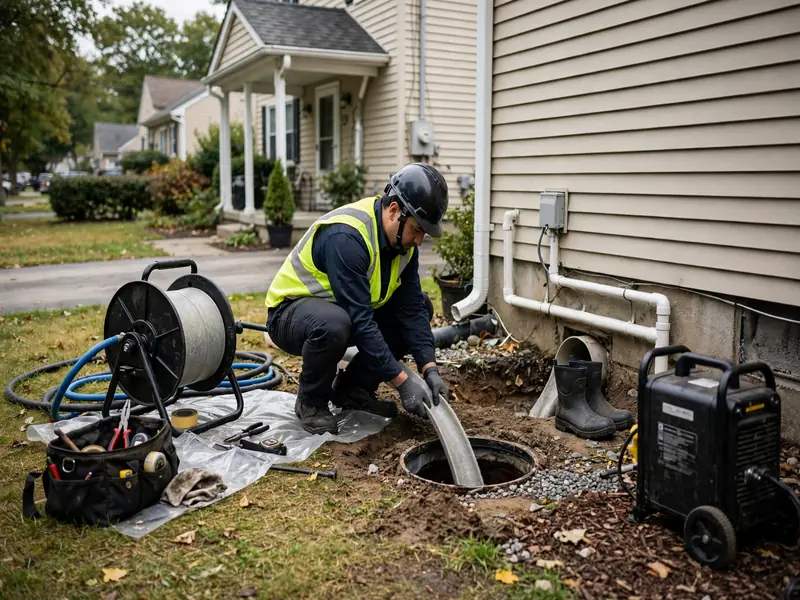
Carteret's sewers face a double challenge that few inland towns share. The borough's housing — 1950s Cape Cods, colonials, and older worker homes near the Washington and Roosevelt Avenue corridors — runs on clay-tile laterals now 60 to 70 years old. And the borough itself sits low against the Arthur Kill, with a high water table and flood exposure that punish every crack and open joint in those aging pipes.
Pipe lining, formally cured-in-place pipe (CIPP), answers both problems at once. A resin-saturated liner is installed inside the existing lateral and cured into a hard, continuous new pipe wall. It needs no trench — a real advantage where excavation means dewatering and working around remediated waterfront soils. And the finished liner is watertight, sealing out the infiltration that tidal pressure and storm surge force through cracked clay.
This page covers how lining works, why Carteret's conditions make it worth evaluating, the installation process, and the limits every homeowner should understand before committing.
Why Watertight Matters More on the Arthur Kill
In most towns, a cracked sewer lateral is a root-intrusion problem. In Carteret, it is that plus an infiltration problem. The borough borders the Arthur Kill to the east and the Rahway River to the north, with low-lying eastern blocks sitting around 13 feet of elevation. Groundwater sits high, and tidal pressure plus storm surge push water toward every opening in a buried pipe.
An aging clay lateral has openings by design — every joint between sections is a gap, and 60-plus years of freeze-thaw and soil movement widen them. During wet weather, groundwater infiltrates through those gaps, filling the lateral with water that was never meant to be there. The result is surcharging: the pipe runs full, drainage slows throughout the house, and backups become more likely exactly when storms are already stressing the system.
A cured-in-place liner changes the equation because it is jointless and watertight. One continuous epoxy surface replaces dozens of leaky joints. Infiltration drops, the lateral carries wastewater instead of groundwater, and the system's wet-weather behavior improves noticeably. For Carteret's waterfront-adjacent blocks, this infiltration seal is arguably as valuable as the structural renewal.
None of this removes the need for honest candidacy screening. Lining seals cracks and joints; it does not fix collapses or bellies. The camera inspection remains the gatekeeper — but where the pipe qualifies, the watertight result directly addresses Carteret's defining sewer challenge.
Clay Tile at 60-Plus Years: Carteret's Typical Lateral
Carteret's median year built sits around 1962, with heavy 1950s construction — Cape Cods and colonials whose laterals are clay tile. Sixty to seventy years of service puts these lines at the stage where joint failure is the norm rather than the exception. Roots have had decades to colonize the joints, and each freeze-thaw cycle works the separations a little wider.
Clay fails gracefully from a lining perspective. The pipe segments themselves are durable — vitrified clay resists chemical attack well — but the joints are the weak link. A camera inspection of a typical Carteret lateral shows the pattern: sound pipe walls interrupted by root masses at joints, occasional cracked sections, maybe a minor offset where soil has shifted. The pipe keeps its round shape. That is the textbook lining candidate.
Some 1950s tracts may carry Orangeburg — the bituminized fiber pipe used briefly in that era — and it deserves a direct mention because it changes the recommendation entirely. Orangeburg softens and deforms over decades, losing the round shape a liner needs. If the camera shows Orangeburg, lining is off the table and replacement by bursting or excavation is the path. The inspection identifies it before anyone commits to a method.
Cast-iron sections appear in older worker housing near the historic corridors. Iron fails by interior corrosion — scale, tuberculation, eventual perforation. Cleaned and lined, corroded-but-continuous iron performs well; iron with holes through the wall or collapsed sections does not qualify.
Digging Less in Difficult Ground
One of lining's underappreciated advantages in Carteret is what it avoids underground. Waterfront and near-waterfront blocks sit on urban and industrial fill, and some areas near the Arthur Kill fall within brownfield remediation zones. Excavation in such ground is not just a matter of renting a backhoe — it can mean dewatering a high water table, managing contaminated soils, and coordinating around deep legacy utilities.
Trenchless lining sidesteps nearly all of that. The work happens inside the existing pipe, accessed through a cleanout or a small pit. No trench through fill soils, no dewatering operation, no soil disposal questions. For laterals that qualify, the installation footprint is dramatically smaller than open-cut replacement.
This matters practically as well as environmentally. Dewatering a trench in a high water table is slow and expensive — pumps run continuously, the trench walls need shoring, and every rainstorm during the project complicates things. Lining's access-point approach keeps the project on a predictable one-to-two-day timeline regardless of groundwater conditions.
None of this means lining is always possible. The pipe must still qualify structurally. But where it does, Carteret homeowners avoid the most difficult and unpredictable part of sewer work in this borough: opening the ground itself.
The Installation Process, Step by Step
Candidacy starts with a camera inspection from an access point to the municipal connection. The technician records material, diameter, length, and every defect — root masses, cracks, offsets, bellies. In Carteret, particular attention goes to the lateral's far end near the main, where tidal infiltration often shows as active water entry through joints. The footage determines whether lining can cover the full run or the damage pattern calls for a different method.
Preparation is thorough. Roots are cut mechanically, then the line is jetted to scour scale and debris. On clay laterals with heavy root colonization, this step can take real time — the liner needs a clean, continuous channel. A second camera pass after cleaning confirms the pipe will accept the liner and finalizes its length measurement.
The liner itself is a felt or fiberglass tube saturated with resin, sized to the run. It goes in through the access point — inverted or pulled into position — and is then pressurized with air or water to hold it tight against the old pipe's interior. Curing follows: hot water, steam, or ambient cure hardens the resin over several hours. The lateral is out of service during curing, so the crew schedules around the household's needs.
Completion means verification. A final camera run shows the cured interior — smooth, continuous, fully adhered — and the ends are trimmed and sealed at the access points. The homeowner keeps the before-and-after footage, which documents both the original defects and the finished rehabilitation.
Recognizing a Lateral That Needs Attention
In Carteret, watch for wet-weather drainage problems specifically. If fixtures drain fine in dry weather but slow down or back up during heavy rain, infiltration is likely filling the lateral through cracked joints. The pipe is not just old — it is leaking groundwater inward. Lining's watertight seal directly addresses this pattern, which is common in the borough's low-lying blocks.
Year-round symptoms matter too. Recurring backups that return after clearing, gurgling fixtures, and sewage odors in the yard or basement all point to lateral defects. On 1950s-60s clay lines, the usual culprits are root masses at joints and cracked sections. A camera inspection distinguishes these lining-friendly defects from disqualifiers like collapses.
Outdoor signs deserve attention in a waterfront borough. Soggy ground along the lateral's path, unusually green patches, or visible soil settlement can indicate exfiltration — wastewater leaking out — or soil washing into a broken pipe. Either condition warrants prompt inspection, since soil loss around a lateral can undermine walkways and foundations.
Age-based inspection is simply prudent here. A Carteret home with its original 1950s lateral and no inspection history is carrying unpriced risk. Finding a lineable pipe early preserves the trenchless option; discovering a collapse during an emergency backup removes it.
What Lining Cannot Do
Collapsed pipe is the absolute boundary. Where the old pipe has caved in, no liner can pass through — the channel is gone. Camera inspections find these as dark, impassable sections. Collapsed runs in Carteret need pipe bursting or open-cut replacement, with all the groundwater management that excavation here entails.
Bellies — settled low spots holding standing water — are the quiet disqualifier. A liner follows the pipe's shape, so a lined belly is still a belly, still collecting solids. The camera shows bellies as sections where water pools even when flow is clear. They need regrading, which means excavation or bursting.
Large offsets between pipe sections can also defeat lining. A liner pulled across a major step may wrinkle or restrict flow. Minor offsets are generally fine, but the call comes from the footage, measured against the pipe diameter — not from a rule of thumb.
Finally, lining fixes the pipe, not the system around it. Municipal main problems, a failed connection at the curb, or interior plumbing issues will not improve because the lateral was lined. The inspection's job is to confirm the lateral is actually the problem before any trenchless work is proposed.
Local Insight
Carteret's pipe-lining picture is defined by the intersection of three card facts. First, the housing: a working-class borough incorporated in 1906 with a median build year around 1962 — 1950s Cape Cods and colonials on clay-tile laterals now 60-plus years old, the prime lining demographic. These lines fail at joints from roots and infiltration, exactly the defects a jointless liner eliminates.
Second, the waterfront geography: the borough borders the Arthur Kill and the Rahway River, with low-lying eastern blocks near 13 feet elevation and a high water table. This makes lining's watertight result disproportionately valuable — sealing infiltration that tidal pressure drives through cracked clay — while making open-cut excavation disproportionately difficult, with dewatering and fill-soil complications. Trenchless methods are not just convenient here; they avoid the hardest part of the job.
Third, the industrial legacy: brownfield and remediation zones near the Arthur Kill where excavation faces soil-management questions. Lining works inside the existing pipe and never disturbs that ground. The candidacy checklist for a Carteret lateral is therefore: clay or sound cast iron, continuous shape, no collapse or belly — and where those hold, lining is typically the strongest option on the table.
Ask a Pro
One call connects you with a local sewer professional serving Perth Amboy, NJ — day or night.
Ask a Pro: (833) 713-2101Frequently Asked Questions
Does pipe lining help with water getting into my sewer line during storms?
Yes — infiltration control is one of lining's distinct strengths. Storm-driven groundwater enters aging laterals through cracked joints and fractures; a cured-in-place liner creates a continuous watertight interior that seals those entry points. In Carteret's low-lying blocks, where tidal pressure and high water tables push water toward every pipe opening, this sealing effect noticeably improves wet-weather drainage behavior. The liner does not stop surface flooding, but it stops the lateral from filling with groundwater.
My lateral runs near a remediated waterfront area. Is digging a problem?
It can be. Excavation near brownfield or remediation zones can trigger soil-handling requirements and complicate a straightforward pipe replacement. Trenchless lining avoids the issue entirely because the work happens inside the existing pipe — no trench, no excavated soil to manage. This is one of the strongest practical arguments for evaluating lining first on waterfront-adjacent Carteret properties.
How do I know if my 1950s lateral is clay or Orangeburg?
Only a camera inspection can say for certain. Clay shows as rigid segments with visible bell joints; Orangeburg looks like a dark, often deformed fiber tube that may be oval or flattened. The distinction matters enormously: clay is an excellent lining candidate, while deformed Orangeburg generally is not. Any lining proposal for a 1950s Carteret home should be preceded by footage that positively identifies the pipe material.
Will lining fix backups that happen only when it rains?
Rain-only backups strongly suggest infiltration — groundwater entering through defective joints and filling the lateral until it surcharges. Lining seals those joints and is often the correct fix. But rain-only symptoms can also come from a municipal main overwhelmed by storm flow, which lining your lateral will not solve. The inspection should check whether your lateral shows infiltration and whether the main is backing up into it.
Can the liner handle the tidal pressure near the Arthur Kill?
The cured liner is a structural, watertight pipe designed to withstand normal groundwater and soil pressures, including the hydrostatic pressure in high-water-table ground. It seals the joints that tidal pressure currently exploits. What lining cannot do is protect against surface flooding or a surcharged municipal main — those are system-level conditions beyond any single lateral. The liner solves the pipe's own defects, which is where most infiltration originates.
How long is my lateral out of service during lining?
Plan for the lateral to be unavailable for several hours while the resin cures — typically the better part of a working day within a one-to-two-day project. The crew will tell you exactly when to avoid water use. Toilets, showers, laundry, and dishwashers all drain to the lateral, so households usually schedule the cure window during the day and resume normal use once the final camera check confirms the liner is hard and open.