Commercial Sewer Services in Chickentown, Perth Amboy NJ
Commercial sewer services in Chickentown serve the neighborhood's Route 440 and Convery Boulevard businesses — food spots, small retail, and offices on some of Perth Amboy's oldest clay-tile laterals. With pre-1940 pipe and tight lots, camera inspection, root management, and trenchless replacement keep storefronts open. Request a site evaluation today.
Chickentown, on Perth Amboy's west side, is named for the pre-WWII chicken farms that once covered it — and much of its building stock is nearly as old. Many residences were built in 1939 or earlier, with 1940s–1969 infill: small single-family homes, small apartment buildings, and the neighborhood commercial strips along Route 440 and Convery Boulevard.
For businesses here, the defining fact is pipe age. Pre-1940 commercial properties almost always still carry their original clay-tile laterals — 80-plus-year-old lines where root intrusion and joint collapse are not possibilities but expectations. Sewer work in Chickentown is usually replacement work that has been postponed, not maintenance that has been performed.
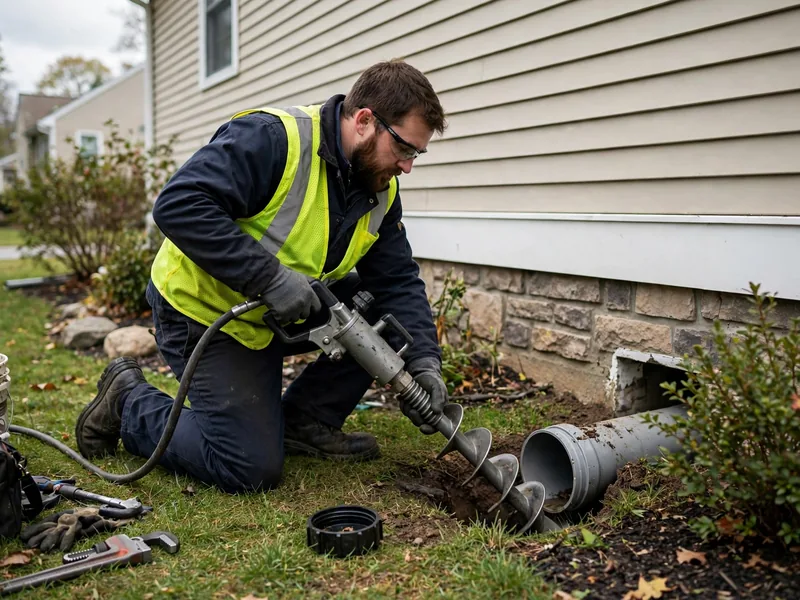
The lots are tight and the access is narrow, which makes the repair method as important as the diagnosis. Trenchless replacement — pipe bursting or lining — is the practical default on these blocks: no open trench through the sidewalk, no weeks of disruption, just a new seamless pipe pulled through the old line's path.
The Camera Inspection Is the Whole Game Here
In Chickentown, a commercial camera inspection is not a sales tool — it is the only reliable way to know what you own. A push camera run from the cleanout to the public main records the pipe's material, diameter, depth, and every defect along the way: cracks, offsets, root masses, collapsed sections, bellies. For a line that is 80-plus years old, this footage is the difference between a modest scheduled maintenance visit and an emergency excavation that was never necessary.
The inspection answers the only question that matters commercially: clean it or replace it? If the pipe is structurally intact — grease, scale, or roots at the joints — hydro jetting and scheduled maintenance keep it in service. If the footage shows broken clay, displaced joints, or sections that have collapsed entirely, every cleaning dollar from that point on is spent on a countdown.
The deliverable matters too. Recorded video with a written condition summary goes into the building's file, where owners, management companies, and lenders can find it. In a neighborhood where the lateral is the same age as the building, that file is due-diligence gold.
Roots, Clay Tile, and Washington Park's Trees
Root intrusion is Chickentown's signature sewer problem, and Washington Park's mature trees are part of the reason. Tree roots seek water, and an 80-year-old clay-tile lateral with cracked joints is effectively a watering system. Once roots enter, they grow, expand the cracks, and catch everything else flowing past — grease, paper, solids — until the line chokes.
Root cutting buys time, not a fix. A cutter head clears the mass and restores flow, but the roots return through the same joints, usually within one or two growing seasons. Cutting twice is a pattern; cutting three times is a habit worth breaking. The permanent fix is a pipe without joints: trenchless pipe bursting installs a seamless high-density polyethylene line through the old clay's path, and roots have nothing to exploit.
For businesses near the park or any mature tree canopy, the maintenance plan should include annual camera checks during growing season. A root mass that is caught early is a cutting visit; a root mass that is caught during a backup is an emergency.
Trenchless: Built for Tight Blocks
Small commercial buildings in Chickentown — the food spot on Route 440, the storefront on Convery Boulevard — usually cannot afford to close for construction. Trenchless methods were designed for exactly this constraint.
Pipe bursting replaces the full lateral through two small pits: one at the building, one at the curb or main. The old clay is fractured outward as the new seamless pipe is pulled through. No trench through the sidewalk, no torn-up parking apron, no weeks of cones and dust. Most commercial bursting jobs finish in a day or two, and the storefront stays open throughout.
Cured-in-place lining handles a different set of constraints: where pits cannot be placed or the line runs under a slab, a resin liner is inverted into the old pipe and cured into a new pipe inside it. Both methods leave the property looking the way it looked that morning — which, for a business whose appearance is its advertising, is not a minor benefit.
Mixed-Use Buildings and Shared Laterals
Neighborhood commercial strips in Chickentown mix uses in ways that complicate sewer responsibility: a restaurant at street level, offices or apartments above, one lateral for the whole building. Grease from the kitchen meets roots from the clay joints, and when the line backs up, every tenant has an opinion about whose fault it is.
The technical answer is a shared maintenance program sized to the heaviest user. Restaurants need jetting intervals matched to menu volume — grease is the one blockage source that never takes a season off. Offices and apartments need the camera checks that track the clay pipe's structural condition. Both need a written schedule that the building's ownership enforces, not a handshake that everyone forgets.
Where the footage shows the lateral is structurally done, replacement ends the argument permanently. A new seamless line with a maintenance schedule is cheaper than a decade of emergency cleanings plus the revenue lost to each backup.
Slab-on-Grade Buildings: Access Is the Challenge
A slab-on-grade building has no basement and no crawlspace — the lateral leaves through the floor and runs under concrete. For Chickentown's mid-century ranch infill used as offices, salons, or small retail, that means the usual cleanout locations do not exist and access must be found another way.
Camera work in these buildings often starts inside: locating the line's path with a tracer, finding or installing an accessible cleanout, and mapping where the pipe runs before any repair is planned. Cutting through a slab to reach a broken line is expensive and disruptive — which is exactly why trenchless lining, which needs no slab penetration, is often the right method for these properties.
For owners of slab-built commercial space, the lesson is to establish access before there is an emergency. A cleanout installed on a quiet Tuesday costs a fraction of the emergency slab work on a Saturday night, and it makes every future inspection and cleaning routine instead of heroic.
Storms, Freeze-Thaw, and Old Clay
Nor'easters and heavy summer downpours are the recurring test of Chickentown's old laterals. Cracked clay joints admit stormwater, surcharging lines that then back up at the lowest fixture — usually a basement drain or a ground-floor restroom. Freeze-thaw cycles through winter open new cracks in joints that survived the previous year.
A commercial maintenance plan here should treat weather as a scheduling input, not background noise. Camera inspections timed after storm season catch the infiltration paths the rain just proved. Jetting scheduled before the wet months clears the capacity the storms will need. And any building with a basement should know exactly where its lateral enters and where its lowest fixture sits — because that is where the water goes first.
After a significant storm, a brief camera check buys the information that prevents the emergency. Infiltration damage is cumulative and silent; the footage is how you see it before the backup shows it to you.
Local Insight
Chickentown shapes commercial sewer work through its age profile. The neighborhood's pre-1940 core means the laterals under its small commercial buildings are typically original clay tile, 80 or more years old, with root intrusion and joint collapse as the normal condition — cleaning these lines without a camera inspection is just renting time, because the footage is what separates a maintenance plan from a replacement that has been overdue for years. Second, the setting adds a specific pressure: Washington Park, Perth Amboy's largest park, sits in this neighborhood, and its mature trees push roots aggressively into any adjacent lateral with cracked joints — a commercial property within a block of the park should assume roots until a camera proves otherwise. Third, the construction mix complicates access: slab-on-grade construction in some mid-century ranch infill means no crawlspace and no basement cleanout, so locating and reaching the line often requires interior camera work and careful planning before any repair method is chosen. Put together, Chickentown's commercial sewer jobs are replacement-first, tree-aware, and access-limited — the camera inspection is not a formality here, it is the job's foundation.
Get Help Now
One call connects you with a local sewer professional serving Perth Amboy, NJ — day or night.
Get Help Now: (833) 713-2101Frequently Asked Questions
Our block is tight with no room for equipment. How do you replace a lateral here?
Almost always trenchless pipe bursting. Open excavation in tight neighborhood blocks disrupts sidewalks, parking, and neighboring businesses for weeks; bursting needs only small pits and finishes in days. Where the old pipe is a viable host, cured-in-place lining is the second option.
Roots keep coming back in our clay line. Should we just keep cutting them?
Yes, and they will keep coming until the joints are gone. Roots exploit clay-tile joints — cutting removes the symptom for a season or two, but the pipe keeps cracking. If roots return twice, the camera usually shows the line is done. Replace it and the problem ends.
Two businesses share one lateral. How do we handle repairs fairly?
A shared line makes repairs a joint decision. Get the camera inspection first — it maps the line's path and shows where the defect sits. Then the owners agree on scope and cost split before work begins. Put the resulting maintenance schedule in writing so it never becomes an argument again.
Why do you emphasize camera inspections so much in Chickentown?
They matter more here than almost anywhere, because the camera footage shows whether that 80-year-old clay is intact or collapsing — which is the difference between a maintenance plan and a replacement budget. Share the video with owners, insurers, and lenders; it's the building's sewer biography.
What should we do after a big storm?
A post-storm camera check, especially after nor'easters. Cracked joints admit water, and the damage is invisible until the line backs up at the worst moment. A 45-minute inspection after heavy weather buys the information that prevents the emergency. On 80-year-old clay, that information is worth more than the visit costs.
We have a restaurant and offices in one building. Does the restaurant need special sewer attention?
Usually yes — restaurants concentrate grease, and a camera inspection of the shared line plus a jetting schedule matched to kitchen volume protects both tenants. Grease blockages are the classic shared-line failure: one tenant's habits, everyone's backup. Put the program in writing so the next backup doesn't restart the argument.