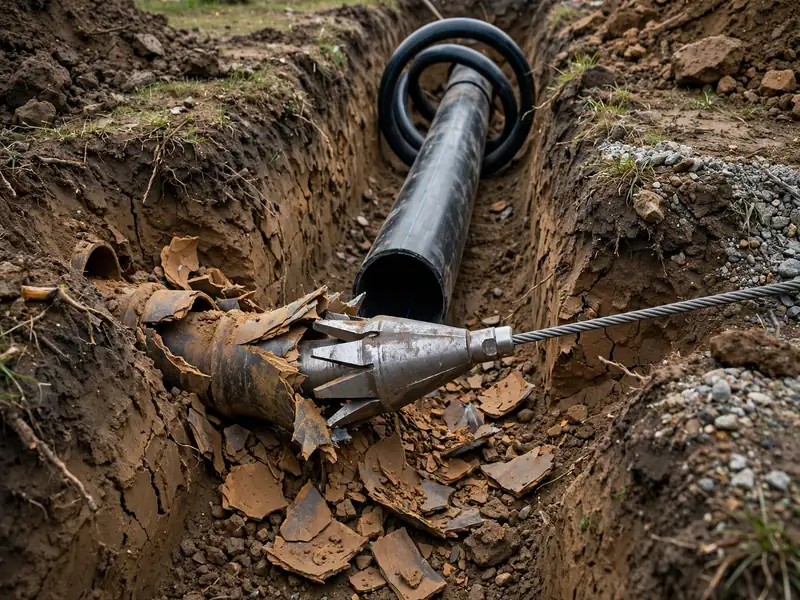
Bursting vs. Lining: Replacement, Not Rehabilitation
Pipe bursting is a replacement method, not a rehabilitation method. Lining creates a new pipe inside the old one and needs the old pipe to hold its shape. Bursting destroys the old pipe entirely and installs a completely new one — typically high-density polyethylene (HDPE) — in the same underground path. The old pipe's condition barely matters, because it does not survive the process.
This makes bursting the trenchless answer for the worst-case pipes: collapsed clay tile, cast iron corroded to lace, lines with severe offsets or missing sections. Where lining sees a disqualified host pipe, bursting sees raw material to be fractured and displaced.
The new pipe is seamless HDPE with heat-fused joints — effectively one continuous tube from the house to the street. No joints means no weak points for roots to exploit, and HDPE's flexibility lets it handle minor ground movement without cracking. It is a full replacement in every sense except the excavation.
Step 1: Inspection, Utility Locating, and Pit Excavation
The project starts with the same camera inspection as any sewer job, but the technician is asking different questions. For bursting, they need to know the line's path, its depth, the location of branch connections, and what lies nearby underground — other utilities, especially. They are also confirming that the line is burstable: no impassable sharp bends, no sections under structures that cannot tolerate ground displacement.
Utility locating is critical. The bursting head displaces soil outward as it travels, and any unmarked gas line, water line, or electrical conduit in the burst zone is at risk. Professional crews call for utility marking and often pothole — hand-dig small test holes — to verify exact utility positions before the pull.
Then the pits are dug. An entry pit at the house end and a receiving pit at the street end, each just large enough for the equipment. Compared with an open trench along the entire run, these two pits are a minor disturbance — and they are the only digging the project requires.
Step 2: The Bursting Pull
With the pits open, the crew threads a steel cable or rod through the old pipe from one pit to the other. The bursting head — a cone-shaped tool slightly larger than the old pipe's diameter — attaches to the cable at the entry pit, and the new HDPE pipe attaches behind the bursting head.
A hydraulic puller at the receiving pit then draws the entire assembly through the old line. As the bursting head advances, its conical shape fractures the old pipe outward, pushing fragments into the surrounding soil. The head also expands the cavity slightly beyond the old pipe's diameter, creating room for the new pipe, which slides into place directly behind the head.
The pull is steady and monitored. The crew watches pulling force, which spikes if the head encounters an obstruction, and tracks the head's position. A typical residential pull — 40 to 80 feet — takes a matter of hours, not days. When the head reaches the receiving pit, the old pipe is gone and the new HDPE line occupies its path end to end.
Step 3: Connections and Restoration
A new pipe in the ground is not a finished job until it is connected at both ends. At the house end, the HDPE line is connected to the building's drain system, usually at the foundation wall or an existing transition point. At the street end, it is connected to the municipal main or the existing tap, meeting local code requirements.
Branch connections along the run need attention. Unlike lining, where branches are reopened robotically from inside, bursting requires each branch connection to be excavated and reconnected to the new pipe. If your lateral has multiple branch tie-ins along its length, each one means a small additional excavation. The crew identifies these during the camera inspection so there are no surprises.
The pits are then backfilled, compacted, and restored. Because the pits are small and localized, restoration is a fraction of what open-trench excavation requires — a couple of patches rather than a torn-up yard. The new line is pressure-tested or camera-verified, and the system is returned to service.
What Bursting Requires: The Constraints
Bursting needs a relatively straight run. The bursting head follows the old pipe's path, and sharp bends — 90-degree turns or multiple tight offsets — can stop the head or damage the new pipe as it follows. Gentle sweeps and minor offsets are fine; hard angles are not. The camera inspection maps every bend before anyone commits to the method.
Nearby utilities are the other major constraint. The bursting head displaces soil outward by design, and anything buried close to the old line — gas services, water lines, communication conduits — must be identified and protected. In congested utility corridors, usually near the street, the crew may hand-dig or use alternative methods for that section.
Very shallow pipes and pipes under structures need evaluation. Bursting under a building foundation or a retaining wall can transmit ground movement to the structure. A competent crew assesses these risks during planning and tells you honestly when a section should be excavated traditionally instead of burst. The method is powerful, but it is not appropriate everywhere.
When Bursting Is the Right Choice
For a collapsed or severely damaged line, the realistic comparison is bursting versus open excavation — lining is already off the table. Against excavation, bursting's advantages are disruption and speed. Two pits versus a full trench. Days versus a week or more. A yard that needs patching versus a yard that needs rebuilding.
The new HDPE pipe is a genuine upgrade over what it replaces. Seamless, jointless, root-resistant, and flexible, it addresses the exact failure modes — joint separation, root intrusion, brittle fracture — that destroyed the old clay or cast-iron line. In practical terms, you get a modern pipe system without the modern excavation.
The honest limitations: branch reconnections add small excavations, utility congestion near the street can complicate the pull, and the method costs more in specialized equipment than a simple dig. But for the right pipe — damaged beyond lining, running under a yard or driveway you want to keep — bursting is often the strongest balance of thoroughness and restraint. Our pipe bursting projects in Woodbridge and the surrounding area show how the method performs on the same clay-tile laterals found throughout Perth Amboy.