When a Permit Is Required
The general rule in New Jersey municipalities: if the work alters, replaces, or newly installs the sewer lateral, it needs a plumbing permit. Full lateral replacement, spot repairs that cut into the pipe, new installations for additions or new construction, and cleanout installations that tie into the lateral all fall in this category.
Routine maintenance does not. Hydro jetting, root cutting, and camera inspections through existing access points are service work, not construction, and do not trigger permit requirements. This is one of several reasons maintenance is simpler than repair — but it does not make repair optional when the pipe is failing.
Work in the public right-of-way is a separate layer. If the repair extends under the sidewalk or street to reach the municipal tap — common in Perth Amboy, where laterals run under front yards and sidewalks — a road-opening permit is typically required on top of the plumbing permit. Your contractor should know this and plan for it; it affects both scheduling and the restoration work afterward.
How the Application and Review Work
The standard process starts with the contractor submitting a permit application to the building department: the scope of work, the pipe material and size, the route of the line, and often a simple sketch or plan. For replacements, the application typically specifies the new pipe material (usually PVC), its diameter, and the bedding and backfill method.
The town reviews the application for code compliance — proper pipe size, correct slope, approved materials, proper connection to the municipal main. For straightforward residential laterals, this review is routine. Complications arise with unusual situations: shared laterals, lines crossing property boundaries, or connections to very old municipal infrastructure.
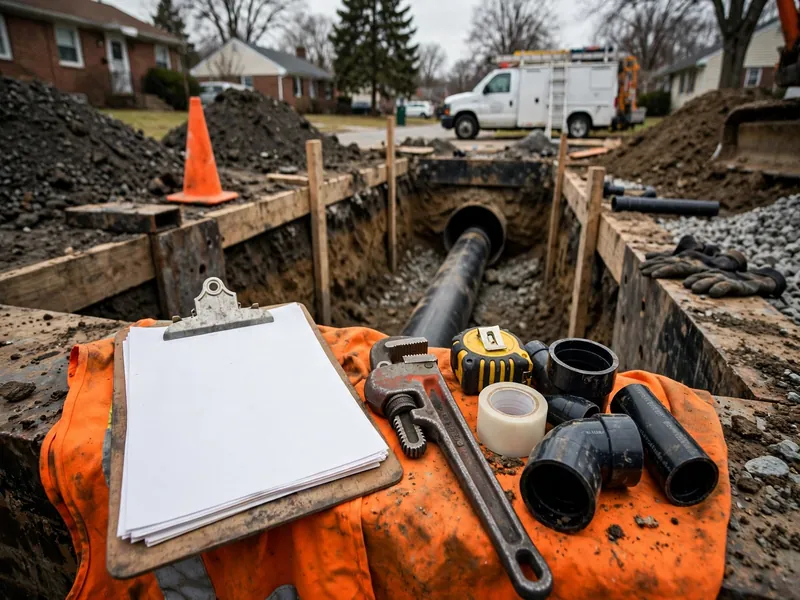
Once issued, the permit sets the inspection schedule. The key inspections for sewer work are the rough or open-trench inspection — the inspector views the new pipe in the open trench before backfill, checking slope, bedding, joints, and materials — and the final inspection after backfill and restoration. No backfilling before the trench inspection passes; this is the rule contractors and homeowners both need to respect.
What Inspectors Actually Check
Inspections are the part of the process that actually protects you. The open-trench inspection verifies the things you will never see again once the ground is closed: that the pipe has proper fall toward the street, that it is bedded in suitable material rather than sitting on rocks, that joints are properly made, and that the specified materials were actually used.
Slope deserves special attention because it is the most common installation defect. Too little slope and solids settle out, creating chronic blockages. Too much slope and liquids outrun solids, with the same result. The inspector's level and the code's slope requirements exist because getting this wrong condemns the line to a lifetime of problems.
Be present for inspections if you can, or at least get the results in writing. A passed inspection is documentation that the work met code — valuable at resale and essential if problems ever arise. Keep the permit card and inspection records with your house documents.
The Real Cost of Skipping Permits
The temptation to skip permits usually comes from one of two places: a contractor offering a lower price for unpermitted work, or a homeowner trying to save time. Both are bad trades.
Unpermitted sewer work discovered later — during a sale, a neighbor's complaint, or a future problem — can trigger stop-work orders, fines, and a requirement to expose the work for inspection retroactively. That means paying for excavation twice. Worse, unpermitted work can complicate a home sale: buyers' attorneys and title companies routinely ask about permits for major work, and an undocumented sewer replacement is a red flag that can delay or kill a closing.
There is also the practical matter: the permit process is what verifies your contractor's work independently. A sewer line replacement done without inspection is a leap of faith about slope, bedding, and materials — the exact things buried where you cannot check them. The permit is cheap insurance on an expensive project.
Trenchless Work and Special Cases
Trenchless methods interact with the permit process favorably. Pipe lining and pipe bursting still typically require permits — they are still sewer construction — but they often simplify the inspection picture because there is less open trench to inspect and less surface restoration to verify. Some municipalities have streamlined procedures specifically for trenchless work.
That said, do not assume trenchless means permit-free. Confirm with the building department or your contractor before work begins. The permit also matters for trenchless work for the same resale and documentation reasons — a lined or burst lateral is still a major system improvement that should be on the record.
If you are planning a sewer line installation for new construction or an addition, start the permit conversation early in the planning process. Sewer permits can interact with other approvals — site plans, zoning, health department sign-offs — and sequencing them correctly avoids delays. Your contractor should be guiding this, but an informed homeowner catches problems the contractor misses.