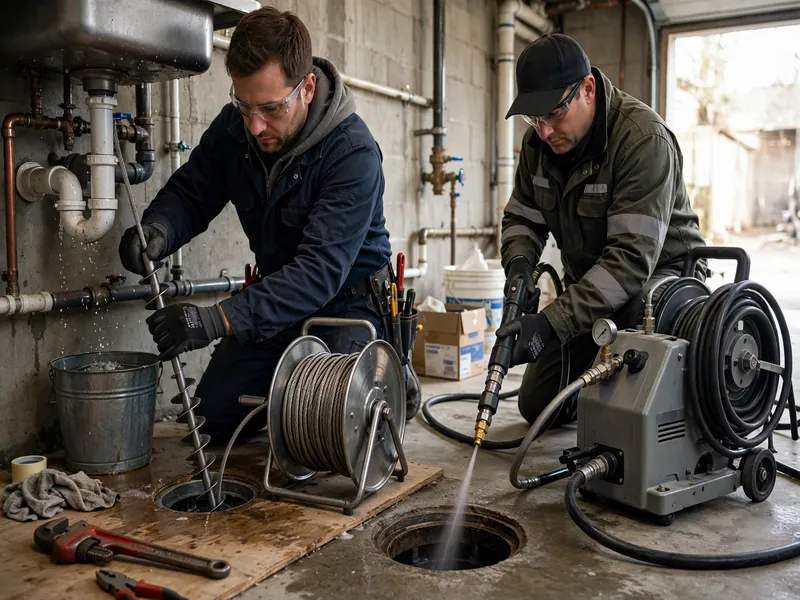
Snaking: Punching Through the Blockage
A drain snake — technically a drain cable machine — feeds a flexible steel cable into the pipe. The cable's head rotates, and depending on the attachment it bores through blockages, cuts roots, or scrapes the pipe walls. It is the classic tool because it is versatile, relatively quick, and effective at restoring flow.
What snaking does well is punch through. A solid obstruction — a dense root mass, a wad of wipes, a hard grease plug — meets a spinning cutter and gets broken apart. Flow is restored, often within the hour. For a straightforward blockage in an otherwise healthy line, snaking is the efficient, appropriate fix.
What snaking does not do well is clean. The cable follows the bottom of the pipe, clearing a path roughly the cable's width. Grease coating the upper walls, scale lining the full circumference, sludge settled along the run — most of it stays put. That is why grease-heavy lines snake clear and clog again: the snake made a hole through the blockage but left the buildup that will become the next one.
Hydro Jetting: Scouring the Whole Pipe
Hydro jetting takes the opposite approach. A hose with a precision nozzle blasts water at pressures high enough to scour the pipe's interior — typically thousands of PSI, calibrated to the pipe material and condition. The nozzle's rear-facing jets pull the hose forward through the line while the forward jets blast debris back toward the access point.
What jetting does well is clean comprehensively. Grease, sludge, soap scum, and mineral scale get stripped from the full circumference of the pipe, not just punched through at the bottom. The line is restored close to its original interior diameter, which is why jetting provides longer-lasting results for buildup problems.
Jetting also flushes everything out of the line rather than just breaking it up. After a root cutting, for example, jetting clears the shredded root debris and scours the joint areas — the combination is more effective than either method alone. For restaurants and homes with chronic grease, jetting is often the only cleaning that actually solves the problem.
Matching the Method to the Problem
The choice starts with diagnosis, and diagnosis starts with the camera. Without seeing inside the pipe, choosing between methods is guesswork — which is why a reputable technician cameras first on recurring problems rather than just running whatever tool is on the truck.
Choose snaking (or mechanical root cutting) first when the problem is a discrete obstruction: a root mass, a foreign object, a localized plug. Choose hydro jetting when the problem is distributed buildup: grease throughout the line, heavy scale in cast iron, sludge in a bellied section, or recurring slow drainage with no single blockage point.
Pipe condition is the other deciding factor. Hydro jetting a sound PVC or cast-iron line is routine. Jetting a cracked clay tile line or any Orangeburg requires caution — high-pressure water can exploit existing weaknesses. The camera inspection before jetting is not upselling; it is the step that prevents the cleaning from becoming a repair.
When the Answer Is Both — or Neither
For many Perth Amboy homes, the right approach is often both, in sequence. Consider the classic scenario: an older clay lateral with root intrusion and decades of grease. The root cutter clears the intrusion, then hydro jetting flushes the debris and scours the grease from the pipe walls. The line ends up cleaner than either method alone could achieve.
This combined approach is also the foundation of ongoing maintenance for problem lines. An annual or biennial visit — cut the roots, jet the line, camera-verify the result — keeps a challenging lateral functioning for years, often postponing the replacement decision significantly.
If your line has been snaked repeatedly with shrinking intervals between visits, ask about jetting. And if it has been jetted and still struggles, ask about the camera — because at that point the issue may not be cleanliness at all. A professional sewer line cleaning assessment looks at the whole picture: method, pipe condition, and whether cleaning is still the right answer or the line is telling you it needs repair.